

West Marine Alternatives for Rigging: 2026 Guide

Table of Contents
- Why Boat Owners Look Beyond West Marine for Rigging
- How to Choose Sailboat Lines: Material and Performance Comparison
- Top Rigging Alternatives to West Marine
- Marine Electronics Return Policy Explained: What to Expect
- DIY vs. Professional Rigging Installation: When to Call a Rigger
- Rigging Safety Standards and Certification
- Measuring for Custom Rigging: Step-by-Step Guide
- Conclusion
Last Updated: August 30, 2026
Why Boat Owners Look Beyond West Marine for Rigging
West Marine dominates marine retail, but boat owners increasingly seek alternatives because the megastore model doesn't always deliver what serious sailors need. One-stop convenience often means compromised selection, slower turnaround on custom work, and prices reflecting overhead rather than value.
Specialty rigging shops, direct manufacturers, and focused online retailers offer custom fabrication, expert consultation, and competitive pricing on the exact lines and hardware your boat requires. For owners upgrading lifelines with modern materials like Dyneema, building standing rigging from scratch, or replacing running rigging with low-stretch alternatives, the hunt for better options makes sense. Charleston Yachting has compiled this breakdown to help you make informed decisions about rigging sourcing and installation.
How to Choose Sailboat Lines: Material and Performance Comparison
The material you choose determines durability, stretch characteristics, cost, and how your boat handles.
Double Braid Nylon vs. Dyneema: Cost and Durability
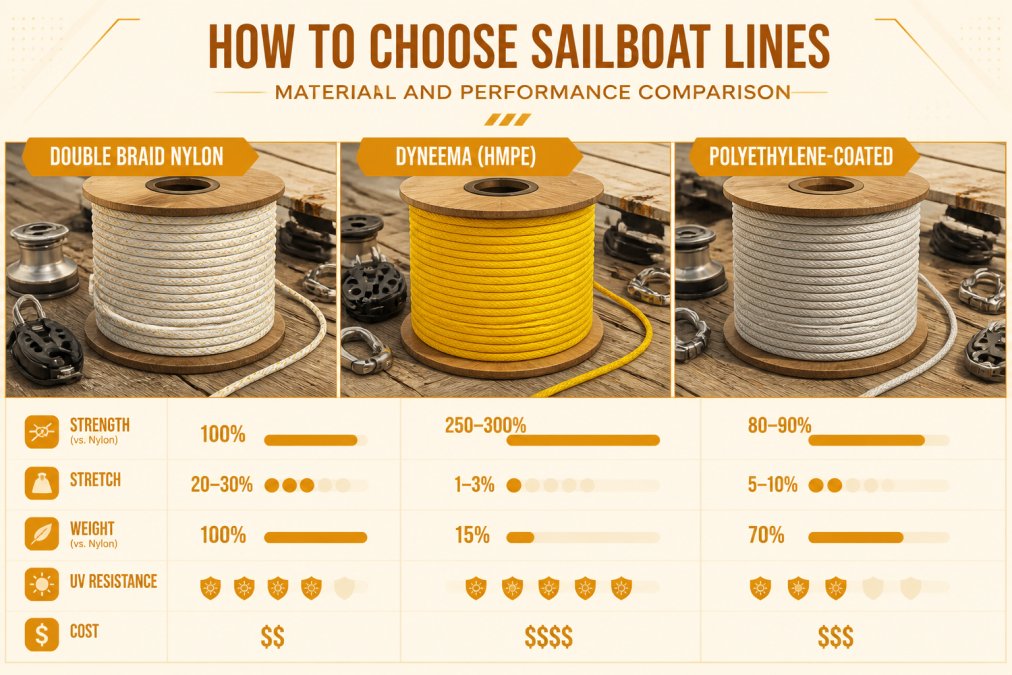
Double braid nylon remains standard because it's affordable and forgiving. It stretches under load but degrades under UV exposure, requiring replacement every 5-7 years in harsh conditions (peer-reviewed research). For casual cruising, it's adequate; for racing or high-performance sailing, it's limiting.
Dyneema (also called Spectra) is three times stronger than nylon at the same diameter, exhibits minimal stretch, and resists UV degradation far better (peer-reviewed research). It costs roughly 3-4 times more per foot but lasts 15+ years without replacement. The choice depends on your sailing pattern: cruisers benefit from nylon's forgiving nature and lower cost; racers and active cruisers justify Dyneema's premium for consistent performance and longevity.
Running Rigging vs. Standing Rigging: What You Actually Need
Standing rigging holds the mast up: shrouds, backstay, forestay. It's under constant tension and rarely moves. Running rigging controls the sails: halyards, sheets, travelers. It moves constantly and takes dynamic loads.
Standing rigging fails catastrophically; running rigging fails gradually with warning. For standing rigging, low-stretch materials are essential to maintain precise mast geometry. For running rigging, the choice is more flexible; many sailors use nylon because stretch doesn't hurt performance and cost is lower.
Upgrade standing rigging to Dyneema or wire-core first, it's safety critical. Running rigging can follow as budget allows or as lines wear out.
Top Rigging Alternatives to West Marine
Specialty Rigging Shops: Custom Fabrication and Master Rigger Services
Specialty shops offer hands-on expertise, custom splicing, and the ability to spec lines for your exact boat. A master rigger examines your mast, measures your existing setup, and recommends materials based on your actual sailing style. Custom fabrication means lifelines cut to your boat's dimensions, halyards spliced with the right fittings, and standing rigging pre-stretched and tuned. Turnaround typically runs 2-4 weeks.
A master rigger catches problems before they become failures and knows which material combinations create weak points. For boats with non-standard dimensions, this expertise is worth the price. Finding a specialty shop means asking local sailing communities or contacting builders and riggers in your region.
Online Marine Retailers: Speed and Selection
Online retailers stock more inventory than specialty shops but offer less expertise. The advantage is speed, many offer same-day or next-day shipping on common items. Selection is broad: multiple brands, colors, diameters, and materials all available at once.
The disadvantage is that you make material and sizing decisions yourself. Charleston Yachting exemplifies this approach: curated inventory from premium brands like C. Sherman Johnson, fast fulfillment, and expert-selected rigging hardware. The C. Sherman Johnson Splice Line fittings allow you to easily splice high-tech Dyneema line to standard lifeline fittings. Options like the C. Sherman Johnson Tubular Turnbuckle with Splice Eye ($67.00) and Open Body Turnbuckle with Splice Eye ($102.00) give you flexibility in connecting and adjusting your rigging.
![C. Sherman Johnson Tubular Turnbuckle w/Splice Eye [LS-2900]](https://cdn.shopify.com/s/files/1/0842/4914/9751/files/80938XL.jpg?v=1697834143)
![C. Sherman Johnson Open Body Turnbuckle w/Splice Eye [LS-5200]](https://cdn.shopify.com/s/files/1/0842/4914/9751/files/80946XL.jpg?v=1697834215)
Direct Manufacturer Sources: Cost Savings on Premium Brands
Buying directly from manufacturers like Harken, Lewmar, or Schaefer eliminates retailer markup. For large orders, savings are substantial, a full standing rigging package might cost 15-20% less than retail.
The tradeoff is minimum order quantities and longer lead times. For a single boat owner, this rarely makes sense. For a boatyard or charter company outfitting multiple vessels, it's the obvious choice.
Marine Electronics Return Policy Explained: What to Expect
Return policies vary widely. Most retailers offer 30-day returns on unopened electronics, with some extending to 60 days. Once opened, the window narrows or closes, especially for custom-ordered items.
Damaged goods are typically covered under manufacturer warranty. Custom-fabricated rigging often has no return option, once a line is spliced to your specifications, it's yours. This is why working with a specialist who gets specs right the first time matters more than having an easy return path.
Check the specific retailer's policy before ordering. Charleston Yachting's commitment to same-day shipping reflects a focus on getting orders right quickly, reducing the need for returns.
DIY vs. Professional Rigging Installation: When to Call a Rigger
Simple jobs, replacing worn dock lines, swapping a halyard, adjusting turnbuckles, are well within reach for any boat owner with basic tools. Splicing is learnable through online tutorials.
Complex work, replacing standing rigging, building a complete running rigging system, tuning a mast, requires professional expertise. A master rigger measures your mast under load, accounts for your boat's geometry, and specs materials that work together as a system. Standing rigging failure is a safety issue; a botched splice or miscalculation can lead to mast failure at sea.
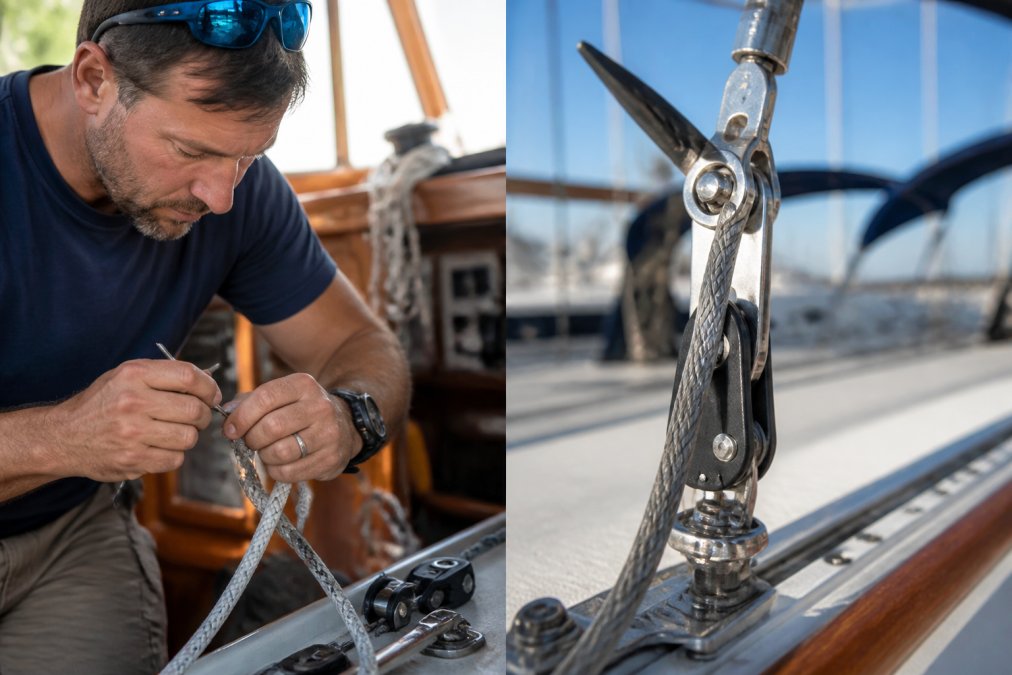
A practical approach: handle running rigging yourself if comfortable. Hire a rigger for standing rigging and major system work.
Rigging Safety Standards and Certification
Rigging failure at sea is rare but catastrophic. In the United States, sailing vessels follow guidelines from the American Boat and Yacht Council (ABYC), which sets standards for rigging design, materials, and installation. Racing vessels follow additional rules from the United States Sailing Association (US Sailing), which incorporates International Sailing Federation (ISAF) standards.
These standards specify minimum breaking strengths, safe working loads for hardware, and inspection intervals. Dyneema and Spectra are now approved for lifelines under ISAF rules, but only when properly certified and installed.
Hardware rated for marine use has been tested for corrosion resistance, load capacity, and fatigue. When sourcing rigging, look for products certified to marine standards. If unsure, ask the retailer or rigger.
Measuring for Custom Rigging: Step-by-Step Guide
Custom rigging starts with accurate measurement.
Step 1: Document Your Current Setup Photograph your existing rigging from multiple angles. Note diameter, material, and color of each line. Record any custom fittings or unusual configurations.
Step 2: Measure Each Line's Length For standing rigging, measure from fitting to fitting along the line's path. For running rigging, measure from the cleat or winch to where the line exits the boat. Use a flexible measuring tape and stretch it along the actual path. Record measurements to the nearest inch and add 2-3 feet for splicing and adjustment.
Step 3: Specify Diameter and Material Measure the diameter of your current halyard or sheet with calipers. Common sizes are 3/8-inch, 7/16-inch, and 1/2-inch for running rigging; 5/16-inch and 3/8-inch for lifelines (abycinc.org). Decide whether you're keeping nylon or upgrading to Dyneema.
Step 4: Identify Fittings and Connection Points Note how each line connects to the boat. Take close-up photos of each connection point. The C. Sherman Johnson Double Jaw Rigging Toggles, available in 1/4-inch pin ($35.50), 5/16-inch pin ($48.50), and 3/8-inch pin ($53.25), provide flexibility in connecting rigging to your boat's existing hardware.
![C. Sherman Johnson Double Jaw Rigging Toggle - 1/4" Pin [12-320]](https://cdn.shopify.com/s/files/1/0842/4914/9751/files/106575XL.jpg?v=1731557617)
Step 5: Communicate With Your Supplier Send your measurements, photos, and material preferences to the rigging supplier or rigger. Include your boat's name, model, and year. Describe your sailing style. A quality supplier will ask clarifying questions before quoting.
| Measurement Type | What to Record | Why It Matters |
|---|---|---|
| Line length | Fitting to fitting, along actual path | Ensures lines fit without excess or shortage |
| Diameter | Current line diameter in inches | Determines strength and compatibility with existing hardware |
| Material | Nylon, Dyneema, wire-core, other | Affects performance, cost, and durability |
| Connection type | Splice, shackle, carabiner, cleat | Determines what fittings are needed |
| Boat model and year | Exact specifications | Helps supplier match recommendations to your vessel |
Conclusion
The market for rigging alternatives has matured. Specialty shops, focused online retailers, and direct manufacturers now offer boat owners real choices beyond big-box marine stores. The decision hinges on what you value: custom expertise, fast fulfillment, or cost savings.
For most boat owners, a combination approach works best: source common items quickly from retailers like Charleston Yachting, consult a master rigger for standing rigging and major systems, and handle routine maintenance yourself. This balances cost, safety, and expertise.
Charleston Yachting's curated inventory of premium rigging hardware from brands like C. Sherman Johnson, combined with same-day shipping, makes it a practical source for both planned upgrades and emergency replacements. Whether you're replacing worn lifelines with modern Dyneema or building a complete running rigging system, having access to high-quality components and expert-selected hardware means your boat stays rigged for the sailing you actually do. Shop All rigging and hardware to find what your boat needs.
Frequently Asked Questions
What are the best alternatives to West Marine for sailboat rigging?
Specialty rigging shops offer custom fabrication and master rigger services. Online marine retailers like Charleston Yachting provide same-day shipping and competitive pricing on quality brands. Direct manufacturer sources for running rigging and standing rigging components often have lower costs than general retailers. Each option excels in different areas: specialty shops for custom work, online retailers for speed and selection, and manufacturers for bulk purchases and professional-grade equipment.
How do I choose sailboat lines for my specific rigging setup?
Evaluate your boat type, sailing style, and budget. Double braid nylon offers affordability and durability for cruising sailors, while dyneema and vectran provide low-stretch performance for racing. Consider whether you need running rigging (adjustable lines like halyards and sheets) or standing rigging (fixed lines like shrouds and backstays). Check the load capacity requirements for your mast and sails, then compare material tensile strength and abrasion resistance. Professional riggers can assess your existing setup and recommend appropriate upgrades.
What should I expect from a marine electronics return policy?
Most reputable marine retailers offer 30-day returns on electronics and rigging hardware, provided items are unused or defective. Check whether the retailer covers return shipping for defective items and whether restocking fees apply. Professional rigging services typically cannot be returned, but custom fabrication orders may have modification periods. Always confirm the return window and condition requirements before purchasing.
Is it cheaper to buy rigging components from specialized retailers than West Marine?
Specialized marine retailers often offer competitive pricing through direct manufacturer relationships and lower overhead. Online retailers eliminate physical store costs, passing savings to customers. Bulk purchases of running rigging, standing rigging, and marine hardware components can yield savings compared to general retailers. However, factor in shipping costs and turnaround time. Professional custom rigging services may cost more upfront but reduce future maintenance and mast failure risk.
This article was written using GrandRanker