

Is Open Box Marine Equipment Worth Buying?

Last Updated: October 28, 2026
Quick Summary
Open box marine equipment is worth buying when the discount is real, the unit is verified to work, and the warranty still applies. The open-box label alone does not make a deal, so compare the all-in price and test the functions you need before you commit.
- Compare the open-box price against current new prices, including shipping and any missing accessories.
- Confirm in writing whether the item is open box, refurbished, or used, and what was tested.
- Inspect seals, connectors and casing for moisture and corrosion before you accept the unit.
- Check that the unit's network protocol and transducer or antenna match your existing system.
- Confirm the warranty transfers to you and how the claim process works if the unit fails.
Table of Contents
- What Open Box Marine Equipment Actually Means
- Open Box vs. New, Refurbished and Used Marine Electronics
- Pricing Breakdown: When the Savings Are Real
- Marine Equipment Warranty Coverage on Open Box Items
- How to Test Used Marine Hardware Before You Commit
- Compatibility, Installation and Total Cost of Ownership
- Choosing Your Next Marine Electronics Purchase
- Frequently Asked Questions
Open box marine equipment is worth buying when the discount is real, the unit is verified to work, and the warranty still applies, but the open-box label alone does not make a deal. Buyers want the savings, and they want to know the gear will work once it is bolted into their boat. The research available for this topic is thin on marine-specific pricing, so the answer below is built on how open-box purchasing works in general and where it tends to go wrong for boat owners.
Open-box retail is a general category with broad savings claims. One buyer's guide says purchases from reputable sellers can save 10%-30% or more, though that figure is not specific to marine equipment. The U.S. marine electronics market was valued at $7.0 billion in 2025 and is projected to reach $12.5 billion by 2033, according to Grand View Research marine electronics market forecast. That growth tells you the category is large, not that any particular open-box unit is a bargain.
What Open Box Marine Equipment Actually Means
Open box marine equipment is a product that has been opened, usually returned, and resold, typically at a discount. The unit may have been unboxed for inspection, tested briefly, or used in a demo, and the seller may or may not have verified its condition. "Open box" is a retail term, not a grading standard, so the label can cover anything from a sealed item with a torn carton to a unit with visible wear.
For marine gear, the distinction matters more than it does for a toaster. A chartplotter or VHF radio is part of your vessel's safety and navigation system, so you need to know exactly what the seller tested and what they did not.
Open Box vs. New, Refurbished and Used Marine Electronics
These four categories are often confused, and the differences affect both price and risk:
| Category | Typical condition | Warranty | Main risk |
|---|---|---|---|
| New | Factory sealed | Full manufacturer warranty | Highest price |
| Open box | Opened, possibly tested | Often the original warranty | Unknown prior handling |
| Refurbished | Repaired and tested to a standard | Varies by seller | Quality depends on the refurbisher |
| Used | Previous owner's condition | Usually none | Hidden faults, no recourse |
Open box usually sits between new and used. The unit may still carry manufacturer coverage, which is the main thing that separates it from a private-party used sale. Refurbished units can be strong value if the seller publishes what was repaired and what was tested. Used equipment carries the most risk because you are relying on a previous owner's care and your own inspection.
Pricing Breakdown: When the Savings Are Real
Savings only count if you can verify the comparison. Check the current new price from the manufacturer or an authorized dealer, then compare it to the open-box listing, including shipping and any sales tax. A unit listed at 20% off can end up close to a new price once you add delivery, a restocking fee, or an extended warranty you need to buy separately.
Qualified language applies here: the discount you actually get depends on the model, how long it has been on the market, and the seller's own pricing. For current prices and availability, check the product pages on our website or request a quote.
Marine Equipment Warranty Coverage on Open Box Items
Warranty coverage is the single biggest factor separating a good open-box purchase from a risky one. Confirm three things before you buy:
- Whether the manufacturer warranty transfers to a second owner or applies only to the original purchaser
- Whether the seller offers its own warranty or return window
- How the claim process works if the unit fails after installation
Manufacturer support is usually the strongest protection. Many marine electronics makers require product registration within a set period after purchase. If you are buying used or open box, check whether the registration can still be completed under your name. Post-purchase support also matters for software updates, replacement parts and technical questions, so ask whether the seller can help if something goes wrong after the sale. Our guide to post-purchase marine electronics support explains what to expect after you buy.
How to Test Used Marine Hardware Before You Commit
Open-box marine gear needs a different inspection than a used boat or a private-party parts sale, because the unit was likely returned for a reason the seller may not disclose. Treat the inspection as a sequence, and stop at the first failure rather than talking yourself past it.
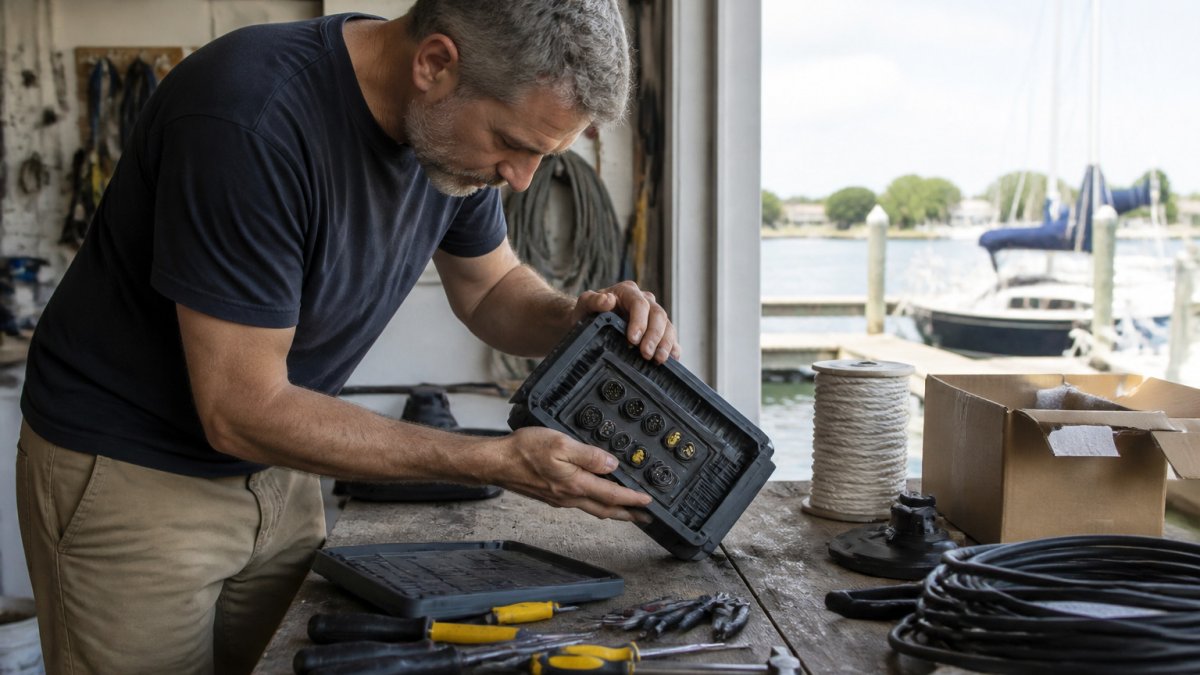
1. Verify the listing before you touch the unit. Ask the seller to confirm in writing whether the item is open box, refurbished, or used; whether it was customer-returned, a demo unit, or a display model; and what, specifically, was tested. "Powers on" is not a test result.
2. Inspect the carton and seals. A factory seal that is intact but a carton that is crushed is a different risk than a carton that has been resealed. Look for water staining, salt residue, and crushed corners that suggest the unit was dropped or stored in a damp locker.
3. Open the unit and inspect for moisture and corrosion. On marine electronics, the failure mode is rarely a dead screen; it is corrosion on connector pins, a compromised gasket, or water intrusion around the casing.
4. Inventory the accessories against the manual. Open-box units are frequently missing the parts that make them installable: power cables, NMEA 2000 drop cables and tees, transducer adapters, mounting brackets, sun covers, fuses, and documentation. Missing accessories are not free, price them before you decide the discount is real.
5. Power it up and exercise the functions you will actually use. A splash screen proves almost nothing.
6. Test network and data behavior, not just standalone operation. Marine electronics fail at the seams. Verifying these communication protocols prevents the common pitfalls associated with the hidden risks of as-is electronics.
7. Ask what happens after the sale. Confirm the return window in writing, who pays return shipping, whether a restocking fee applies, and whether the manufacturer or the seller handles a warranty claim.
A unit that powers on can still have failing internal components, corroded connectors, or a compromised water seal. Test the functions you will rely on in conditions close to real use, not just a splash-screen check.
Risk varies by category. Electronics (chartplotters, radios, instruments) carry the highest hidden-failure risk and the most compatibility headaches; safety gear (life rafts, EPIRBs, flares) may have service-life or certification dates that make an open-box unit a poor value regardless of price; engines and mechanical components need a compression or bench test that most sellers cannot provide; and hardware and rigging should be inspected for fatigue cracks and galvanic corrosion. Match the depth of your inspection to the consequence of failure.
A practical open-box inspection is a sequence: verify the listing, inspect seals and corrosion, inventory accessories, power up, exercise real functions, test network behavior, and confirm the return path. If any step fails, walk away, the discount is not worth a navigation or safety system that quits in its first season.
Compatibility, Installation and Total Cost of Ownership
A discounted unit still has to fit your system, and on a boat the fit is where open-box savings quietly disappear. Compatibility is not a single check, it runs across network protocol, transducer and antenna matching, software version, mounting, and wiring.
Network and data compatibility. Confirm the unit speaks the protocol your boat already uses. NMEA 2000, NMEA 0183, Ethernet, and proprietary manufacturer networks are not interchangeable without hardware. See these marine hardware compatibility and integration tips before you buy.
Transducer and antenna matching. Sonar and radar are the most common compatibility traps. A transducer must match the unit's frequency, connector type, and power output, and a radar antenna must match the radar's model family. If the open-box unit ships without its original transducer or antenna, price the correct one before you buy, it can erase the discount.
Mounting and wiring. Check the cutout dimensions, bracket type, and cable routing against your helm or nav station. A unit that is the wrong size for an existing cutout means fiberglass or panel work. Confirm the power requirements and fuse rating, and whether the unit needs a separate power cable or a network backbone drop.
Installation labor. Professional installation is priced by the hour and varies by region and yard, so get a quote rather than assuming. If you plan to install it yourself, the AIS transponder DIY guide walks through the realistic effort involved.
Total cost of ownership and break-even. The real comparison is not the sticker price but the all-in cost over the expected service life. Build a simple break-even: add the open-box price, shipping, any missing accessories, adapters, installation labor, and any extended warranty you buy. Compare that total to the new price plus installation.
Run the break-even before you commit: open-box price plus shipping, missing accessories, adapters, installation, and any warranty, compared with the new all-in cost. If the gap is small and the warranty is weaker, buy new, the savings are not real.
Charleston Yachting carries Garmin, B&G and Harken hardware. For current prices, check the product pages or request a quote.
Choosing Your Next Marine Electronics Purchase
Open box marine equipment is worth buying when three conditions hold: the discount is confirmed against current new prices, the unit passes inspection and testing on the functions you need, and the warranty or return path is clear. If any of those fails, the savings are probably not worth the risk on a navigation or safety system.
Charleston Yachting carries Garmin, B&G and Harken hardware and offers same-day shipping. Whether you choose new or open box, compare the total cost and the warranty terms before you decide.
Frequently Asked Questions
Does an open box count as refurbished?
Not necessarily. Open box usually means a product was returned or opened and resold, often with little or no testing, and it may still carry the original manufacturer warranty. Refurbished products are typically inspected, repaired and tested by the manufacturer or an authorized service center, and they often come with a separate warranty. Before you buy, ask the seller which category the item falls into, who performed any testing, and what warranty applies. The label alone does not tell you the condition or the level of support you will receive.
Is it better to buy a new or open box marine electronics unit?
It depends on the savings, the warranty and how much risk you can accept. Open box marine electronics can be discounted, but the discount has to be weighed against any reduction in warranty coverage and the chance of hidden damage. For mission-critical navigation gear on a vessel you rely on offshore, a new unit with full warranty is often the safer choice. For a backup unit, a DIY project or a budget upgrade, an open box item from a reputable seller with a clear return policy can make sense. Compare the final price against new pricing from authorized dealers before deciding.
Does open box marine equipment come with a full manufacturer warranty?
Coverage varies by manufacturer, seller and item. Some open box products keep the original manufacturer warranty, while others carry only a limited warranty from the seller or none at all. Check the warranty terms before purchase, including the coverage period, whether the warranty transfers, and whether the manufacturer will provide technical support for an item bought open box.
What should I look for when buying open box sailing hardware?
Start with the item's condition: look for cosmetic damage, missing accessories, scratches on displays, bent or corroded fittings and signs of prior installation. Confirm that all included components are present and that the item matches the model and compatibility you need for your vessel. Ask the seller what testing was done and what the return window is. For rigging hardware, check threads, load points and wear surfaces. Once you have the item, test it as soon as possible so that any defect can be reported within the return period.
