

Where to Buy Marine Rigging Hardware: Top Retailers & Gear

Table of Contents
- Where to Buy Marine Rigging Hardware: Retailer Options
- Standing Rigging Components and Turnbuckles
- How to Choose Sailboat Rigging Hardware for Your Vessel
- Running Rigging Hardware and Blocks
- Marine Hardware Inspection Checklist Before Purchase
- Stainless Steel vs Galvanized Rigging Hardware
- Furling Systems and Maintenance for Long-Term Performance
- Conclusion
Last Updated: August 23, 2026
Finding the right marine rigging hardware requires knowing where to source quality components and understanding what separates premium gear from budget alternatives. Charleston Yachting specializes in premium marine rigging and sailing hardware from industry-leading brands, offering same-day shipping and expert-curated inventory for both professionals and enthusiasts.
Where to Buy Marine Rigging Hardware: Retailer Options
Your options for purchasing marine rigging hardware fall into several categories, each with distinct advantages. Specialty marine retailers dominate this space because they understand the technical requirements and compatibility issues that generic online marketplaces miss.
Charleston Yachting stands out as a top choice for recreational and professional sailors. The retailer carries premium brands like C. Sherman Johnson and Barton Marine, with same-day shipping on in-stock items. The inventory spans standing rigging components, running rigging hardware, blocks, sheaves, and complete systems for boats ranging from small cruisers to large racing yachts.
![C. Sherman Johnson Tubular Turnbuckle w/Splice Eye [LS-2900]](https://cdn.shopify.com/s/files/1/0842/4914/9751/files/80938XL.jpg?v=1697834143)
What distinguishes Charleston Yachting is the curation. If you're upgrading to modern Dyneema lifelines, switching to rod rigging, or installing advanced furling systems, you need a retailer that understands these nuances. Charleston Yachting's team focuses specifically on rigging and sailing hardware, which means better product knowledge and fewer compatibility surprises.
Specialty marine retailers typically offer better technical support than general e-commerce platforms. When you have questions about load ratings, material compatibility, or sizing, you're speaking with people who understand the hardware. This becomes critical when dealing with safety-critical components like lifelines, mast support systems, and boom preventers.
| Retailer Type | Best For | Advantage | Limitation |
|---|---|---|---|
| Specialty Online (Charleston Yachting) | Curated selection, fast shipping | Expert knowledge, same-day options | No physical inspection |
| Local Chandlery | Immediate needs | Hands-on inspection, personal service | Limited selection, higher prices |
| General Marine | Broad selection | One-stop shopping | Less rigging expertise |
| Direct from Manufacturer | Specific brands | Lowest prices sometimes | Limited to single brand |
Standing Rigging Components and Turnbuckles
Standing rigging forms the structural support system for your mast, and every component carries load continuously. Turnbuckles are the tensioning mechanism that allows you to adjust and maintain proper mast bend and sail shape. Toggles provide articulation points that prevent stress concentration at attachment points.
The C. Sherman Johnson Tubular Turnbuckle with Splice Eye (LS-2900) at $67.00 represents a solid entry point for smaller vessels. The tubular design reduces weight while maintaining strength, and the splice eye allows direct connection to modern Dyneema lifelines, increasingly popular because Dyneema offers superior strength-to-weight ratio compared to traditional stainless steel cable (peer-reviewed research).
For applications requiring stronger construction, the C. Sherman Johnson Open Body Turnbuckle with Splice Eye (LS-5200) at $102.00 provides greater adjustability and easier inspection. The C. Sherman Johnson Double Jaw Rigging Toggle with 1/4" Pin ($35.50) features a safe working load of 1,000 lbs and facilitates articulation between turnbuckles and mechanical fittings.
![C. Sherman Johnson Open Body Turnbuckle w/Splice Eye [LS-5200]](https://cdn.shopify.com/s/files/1/0842/4914/9751/files/80946XL.jpg?v=1697834215)
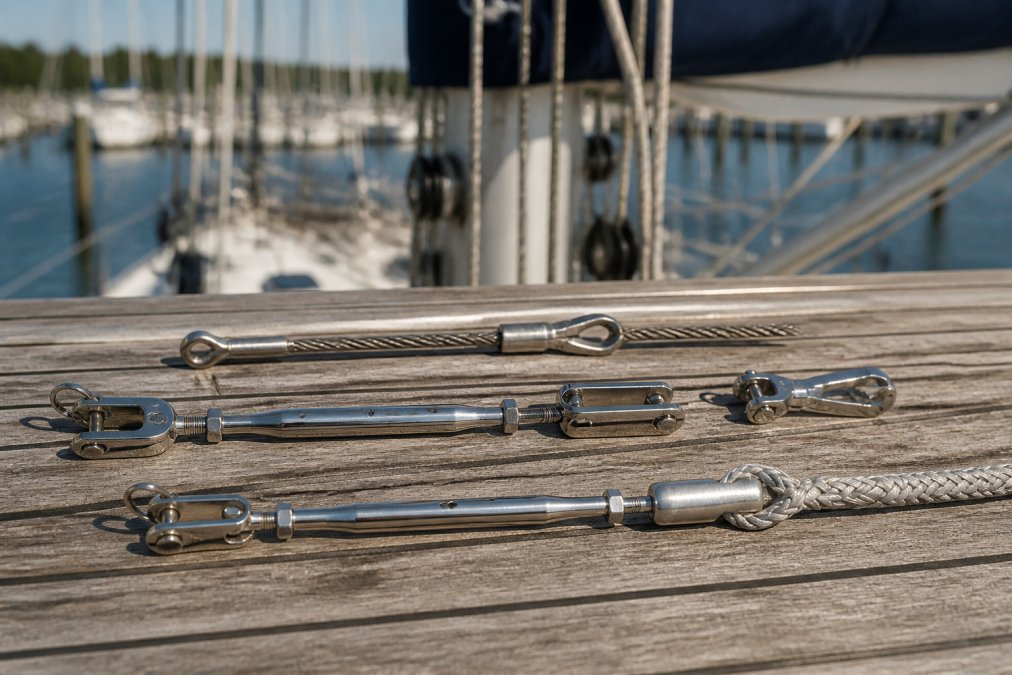
The choice between tubular and open body designs depends on your maintenance philosophy. Tubular designs are lighter, preferred for racing applications. Open body designs sacrifice some weight savings for easier inspection and adjustment, better for cruising vessels where reliability matters more than performance margins.
All C. Sherman Johnson components use marine-grade stainless steel, but the specific alloy and manufacturing process determine corrosion resistance and longevity. Swaged terminals represent potential failure points if not properly installed or if galvanic corrosion develops between dissimilar metals.
How to Choose Sailboat Rigging Hardware for Your Vessel
Selecting the right rigging hardware requires understanding three variables: vessel size and type, sailing conditions, and intended use. A weekend cruiser in protected waters has different requirements than an offshore racing yacht.
Start with load calculations. Every component has a breaking strength and a safe working load (typically 25-50% of breaking strength for safety margin). Your mast height, boom length, sail area, and anticipated wind conditions determine the loads your rigging must handle.
Vessel type matters significantly. Monohulls and catamarans experience different forces; catamarans create tremendous lateral loads requiring heavier-duty rigging systems. Multihulls are more prone to capsize, which is why quick-release levers like the C. Sherman Johnson Quick Release Lever ($109.50) become essential safety equipment. The lever's ultimate strength of 2,500 lbs and safe working load of 1,000 lbs make it suitable for critical applications where crew safety depends on rapid deployment (uscg.gov).
![C. Sherman Johnson Double Jaw Rigging Toggle - 1/4" Pin [12-320]](https://cdn.shopify.com/s/files/1/0842/4914/9751/files/106575XL.jpg?v=1731557617)
Material compatibility becomes critical when combining components from different manufacturers. Stainless steel and aluminum create galvanic couples that accelerate corrosion when exposed to saltwater. Charleston Yachting's inventory focuses on compatible systems specifically to avoid these issues.
Consider your maintenance capability. Modern Dyneema lifelines require different splicing techniques than traditional wire rope. The C. Sherman Johnson Splice Line kits (Small Boat Kit at $425.00 for boats up to 30', Large Boat Kit at $455.50 for boats up to 40') include everything needed for installation, but professional splicing is recommended for critical applications.
Running Rigging Hardware and Blocks
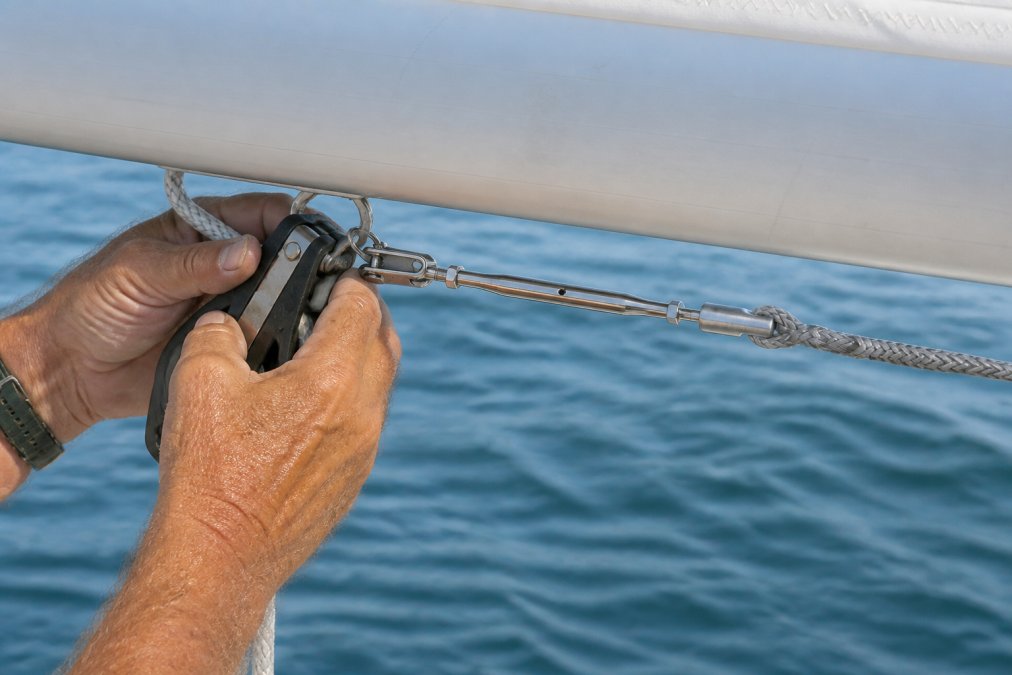
Running rigging, the lines you actively handle while sailing, requires different hardware than standing rigging. Blocks and sheaves handle dynamic loads and require smooth operation under varying tension. The Barton Continuous Line Furler ($230.83) combines hybrid-bearing technology with a safe working load of 600kg at just 175 grams.
The Barton Marine Size 5 Vang Tackle 4:1 ($519.42) provides a 4:1 mechanical advantage, meaning you need only one-quarter the force to tension the boom vang. This matters both for crew comfort and for maintaining consistent sail shape.
The sheave diameter, bearing type, and material all affect performance. Larger sheaves reduce line wear and allow smoother operation. Quality bearings keep the sheave spinning freely even under load. Anodized aluminum and stainless steel construction resist corrosion while keeping weight manageable.
Load rating matters differently for running rigging than standing rigging. Standing rigging handles static loads that change slowly with wind conditions. Running rigging experiences dynamic loads, sudden jerks when the sheet catches, and repeated cycles as the sail flaps. These dynamic loads often cause failures at lower absolute loads than equivalent static loads.
Marine Hardware Inspection Checklist Before Purchase
Before buying any marine rigging hardware, verify several critical factors to prevent costly mistakes and compatibility issues.
Compatibility Verification
- Confirm pin diameters match across all components (1/4", 5/16", 3/8" are common sizes)
- Verify that swaged terminals fit properly into turnbuckle eyes
- Check that block sheaves accommodate your line diameter without pinching or excessive slack
Material Verification
- Confirm stainless steel grade (316 is superior to 304 for saltwater)
- Verify that dissimilar metals aren't creating galvanic couples
- Check that bronze or copper components won't corrode stainless steel wire rope
Load Rating Verification
- Confirm safe working load is appropriate for your vessel size and sailing conditions
- Verify that the weakest component in any system matches the intended load path
- Check that dynamic load ratings are appropriate for your application
Condition Assessment
- Inspect for surface corrosion, pitting, or discoloration indicating galvanic attack
- Check that moving parts articulate smoothly without binding
- Verify that swaged terminals show no signs of stress, cracking, or deformation
This checklist prevents the common mistake of purchasing components that don't work together. A turnbuckle and toggle with different pin sizes won't connect properly. Stainless steel wire rope in an aluminum block creates corrosion problems.
Stainless Steel vs Galvanized Rigging Hardware
The choice between stainless steel and galvanized hardware fundamentally affects maintenance requirements and longevity. Stainless steel costs more upfront but requires less maintenance. Galvanized hardware costs less but demands regular care.
Stainless Steel Advantages: Stainless steel resists corrosion through passive oxide layer formation. In saltwater environments, 316-grade stainless steel maintains this protection even when scratched. The material requires no painting or coating maintenance. For marine applications, stainless steel is the industry standard because the cost premium is justified by dramatically reduced maintenance.
Galvanized Hardware Advantages: Hot-dip galvanizing creates a zinc coating that sacrifices itself to protect underlying steel. Galvanized hardware costs significantly less than stainless steel. For freshwater or low-corrosion environments, galvanized hardware provides excellent value.
Where Stainless Steel Matters Most: Saltwater immersion demands stainless steel. Lifelines, spreader boots, and any component regularly exposed to spray or seawater should be 316-grade stainless. The passive oxide layer provides protection that galvanized coatings eventually lose.
Charleston Yachting's inventory focuses on stainless steel components because serious sailors prioritize reliability over cost savings. The C. Sherman Johnson products use marine-grade stainless steel throughout, eliminating compatibility concerns and maintenance headaches.
Furling Systems and Maintenance for Long-Term Performance
Furling systems transform sail handling, particularly for cruising sailors and shorthanded crews. The Barton Continuous Line Furler ($230.83) uses hybrid-bearing technology, combining solid-state and Torlon ball bearings, to maintain smooth operation under load. The 3D-printed tri-rotor wheel and integrated fairlead grip the furling line without requiring tools for rope insertion.
Modern furling systems demand regular maintenance to maintain reliability. The bearing assemblies require occasional lubrication, typically light machine oil or silicone spray, to prevent corrosion and maintain smooth rotation. Inspect the furling line regularly for chafe, UV damage, or contamination. Salt crystals and dirt in the bearing races accelerate wear and can cause the furler to jam under load.
Seasonal maintenance should include a complete inspection of the furling mechanism. Check that the drum rotates freely without binding. Verify that the furling line feeds smoothly through all fairleads. Inspect the mast attachment point for cracks or corrosion.
The C. Sherman Johnson Splice Line kits ($425.00-$455.50 depending on boat size) provide a complete system for upgrading to modern Dyneema lifelines. The advantage of Dyneema over traditional stainless steel cable is significant: lighter weight, superior strength-to-weight ratio, and easier handling. The tradeoff is that Dyneema requires different maintenance protocols and specialized splicing knowledge.
Furling system compatibility with your mast design matters. Some masts have internal furling mechanisms; others use external systems. Verify that any furler you purchase matches your mast type and diameter. Charleston Yachting's product selection includes options for various mast configurations, reducing the risk of purchasing incompatible hardware.
Finding the right marine rigging hardware comes down to matching components to your vessel's requirements, understanding material compatibility, and purchasing from retailers who understand the technical details. Charleston Yachting offers premium brands and expert curation specifically designed to eliminate guesswork. With same-day shipping on in-stock items and a focus on rigging and sailing hardware, the retailer removes friction from the upgrade and maintenance process. Shop All to explore the full inventory of standing rigging components, running rigging hardware, blocks, furlers, and complete systems for vessels of all sizes.
Frequently Asked Questions
What is the difference between standing and running rigging?
Standing rigging (shrouds, stays, lifelines) supports the mast and remains fixed in place. Running rigging (halyards, sheets, vang tackle) moves through blocks and sheaves to control sails. Standing rigging uses wire rope with swaged terminals and turnbuckles for tensioning. Running rigging typically uses braided line with mechanical fittings like blocks and snap shackles. Both require marine-grade materials to resist galvanic corrosion and salt water exposure.
How do I choose the right marine rigging hardware for my boat?
Start with your boat's size, sailing style, and existing rigging setup. Measure load requirements and check breaking strength ratings against your vessel's specifications. Select marine-grade stainless steel (316) for saltwater environments to prevent corrosion. Consider whether you need toggles for flexibility or rigid fittings for stability. For lifelines, decide between traditional wire rope or lightweight Dyneema line. Match all components to the same material standard, mixing stainless and galvanized hardware accelerates corrosion through galvanic action.
Are there specific brands to look for when buying marine hardware?
C. Sherman Johnson, Barton Marine, and Harken are industry standards trusted by professional sailors and yacht captains. These brands offer rigorous testing, certified breaking strength ratings, and components designed for high-performance and cruising applications. Charleston Yachting carries premium selections from these manufacturers, including turnbuckles, toggles, furling systems, and vang tackle. Verify that hardware carries load ratings and marine-grade certifications before purchase to ensure safety and durability on the water.
How often should marine rigging be inspected and replaced?
Inspect rigging before every season and after heavy use or storm conditions. Look for corrosion, cracking in swaged terminals, bent toggles, and wear on blocks and sheaves. Wire rope typically lasts 7-10 years depending on use and maintenance; Dyneema line lasts 5-8 years. Replace any hardware showing rust, loose pins, or reduced movement immediately. Professional inspection every 2-3 years catches hidden damage and prevents mast failure. Regular maintenance and lubrication extend hardware life and ensure safe operation.
This article was written using GrandRanker