

Sailboat Blocks: How to Choose the Best for Rigging

Last Updated: October 29, 2026
Quick Summary
To choose the best sailboat blocks for rigging, match the block type to the job, then size the sheave to six to eight times your line diameter. Check the working load rating with margin for shock loads, and pick ball bearings for frequent trimming or plain bearings for static leads.
- Single blocks handle one line run, while double and triple blocks add mechanical advantage for high-load jobs.
- Snatch blocks open on the side so you can drop in a line already under load.
- Size to working load, never breaking load, and add margin for gusts and snatches.
- Ball bearing blocks suit fast, frequent trimming; plain bearing blocks tolerate grit and neglect.
- A single block swap takes roughly 45 minutes from start to finish.
Table of Contents
- Start With Sailboat Block Types
- How to Size Sailboat Blocks for Your Line
- Reading a Sailboat Block Load Rating
- Ball Bearing vs Plain Bearing Blocks
- Matching Materials and Hardware to Your Rig
- Step-by-Step: Selecting and Rigging Your Blocks
- Ordering the Right Sailboat Blocks for Your Boat
- Frequently Asked Questions
Start With Sailboat Block Types
Sailboat blocks are the pulleys that route and redirect line loads across your deck and rig. Choosing the right ones starts with understanding the four main families, because each solves a different problem.
A block doesn't just change line direction. It decides how much friction you fight, how fast you trim, and how long your running rigging lasts.
Sailors who match block type to job tend to get clean, long service from their running rigging, while mismatched blocks wear lines and fail early.
Below, we'll walk through each type, then show you how to size, rate, and rig them.
Single, Double, and Triple Configurations
Single blocks handle one line run and suit simple turning duties. Double blocks carry two sheaves in one frame, so you can run a tackle or lead two lines through a shared attachment point. Triple blocks multiply purchase for high-load jobs like vangs and backstays.
More sheaves mean more power but more friction. A triple block gives you roughly three times the mechanical advantage of a single, but every added sheave adds drag. Match the count to the load, not to a wish for more power.
Snatch Blocks, Soft Blocks, and Fixed Attachment Heads
Snatch blocks open on the side so you can drop a line in without reeving it through the end. That makes them the go-to for diverting a sheet already under load, like a genoa or spinnaker lead. Barton's large snatch block for yachts up to 40 feet uses a stainless steel snap shackle and glass-filled nylon side plates, and its side plate unclips for easy access.
Soft blocks replace the metal frame with a Dyneema loop and a rope housing. They're light and have no sheave to seize. Wichard's MXLEvo line, for example, ships complete with a Dyneema SK78 loop and is designed to be easy to use.
Fixed attachment heads, whether shackle, lashing, or becket, decide how the block connects to your deck or rig. Choose the head that matches your mounting point before you fall in love with a sheave size.
How to Size Sailboat Blocks for Your Line
Sizing a sailboat block comes down to one rule: the sheave must be large enough for the line, and the line must fit the sheave groove cleanly.
Get this wrong and you pay twice. Too small a sheave bends the line sharply, which fatigues the core and wears the cover. Too large a block adds weight and cost you don't need.
Check three specs before you buy:
- Maximum rope diameter the block accepts
- Sheave diameter in inches or millimeters
- Groove width and shape for your line type
Ronstan's Series 25 blocks suit lines up to 8 mm (5/16 inch). That's a compact block for dinghies and small boats, not a 40-footer's mainsheet.
Measure your actual line, not the spec sheet from when you bought it. Lines swell, covers wear, and a "10 mm" line may run thick after a season.
Reading a Sailboat Block Load Rating
A sailboat block load rating tells you how much force the block can safely handle, and it comes in two numbers you must not confuse. Working load is the safe operating limit for nautical use. Breaking load is the point where the block fails.
Never size to breaking load. Size to working load, then add margin. A common approach is to pick a block whose working load sits comfortably above the maximum load you expect, so shock loads from gusts and snatches don't push you past the limit.
Here's how the numbers look on real hardware:
Barton Large Snatch Block f/Yachts Up to 40' (12.2M) - Stainless Steel Snap →
| Block | Best For |
|---|---|
| Wichard MXLEvo 10 | Mast foot, halyard tackle |
| Wichard MXLEvo 12 | Barber hauler, sheet return |
| Wichard MXLEvo 16 | Heavy-load purchase |
| Ronstan Series 25 HHL | High-load small-boat control |
What most guides miss is that working load assumes a static pull. A flogging sail or a crash gybe multiplies the load in an instant. Build in headroom, and when in doubt, step up a size.
Ball Bearing vs Plain Bearing Blocks
Ball bearing blocks roll freely under load and shine wherever lines move fast or get trimmed often. Plain bearing blocks use a simple bushing, cost less, and tolerate grit and neglect better.
The choice comes down to line speed and how often you adjust. Mainsheets, spinnaker sheets, and control lines that move constantly reward ball bearings. Static leads and low-adjustment points do fine with plain bearings.
Ronstan's Series 25 blocks use a 2-stage ball bearing system and are built for high-demand dinghy and small boat applications.
Matching Materials and Hardware to Your Rig
Material choice follows your environment. Stainless steel, anodized aluminum, glass-filled nylon, and acetal are used in the blocks in this range. Dyneema loops are used on soft blocks.
Match the attachment hardware to the load path. A snap shackle gives quick release. A fixed shackle gives strength. A lashing head lets you tie into a pad eye with soft line.
Check that every component in the load path is rated for the same job, since a strong block on a weak shackle just moves the failure point.
Step-by-Step: Selecting and Rigging Your Blocks
Here's the process we'd follow, start to finish. Total time is roughly 45 minutes for a single block swap.
What you'll need:
- Your line diameter and type
- The maximum load on that line
- The mounting point and its fitting
- Basic hand tools and a tape measure
- Identify the job. Is this a turning block, a tackle, or a divert? Write it down.
- Measure the line. Confirm the actual diameter, not the label.
- Pick the sheave size. Aim for six to eight times line diameter.
- Check the load rating. Match working load to your expected maximum, with margin.
- Choose the attachment head. Shackle, lashing, or becket to fit your deck fitting.
- Confirm the bearing type. Ball bearing for fast, frequent trimming; plain for static leads.
- Mount and align. The line should run fair into the sheave with no side load.
- Load-test gently. Pull by hand, then under sail, and watch for chafe or twist.
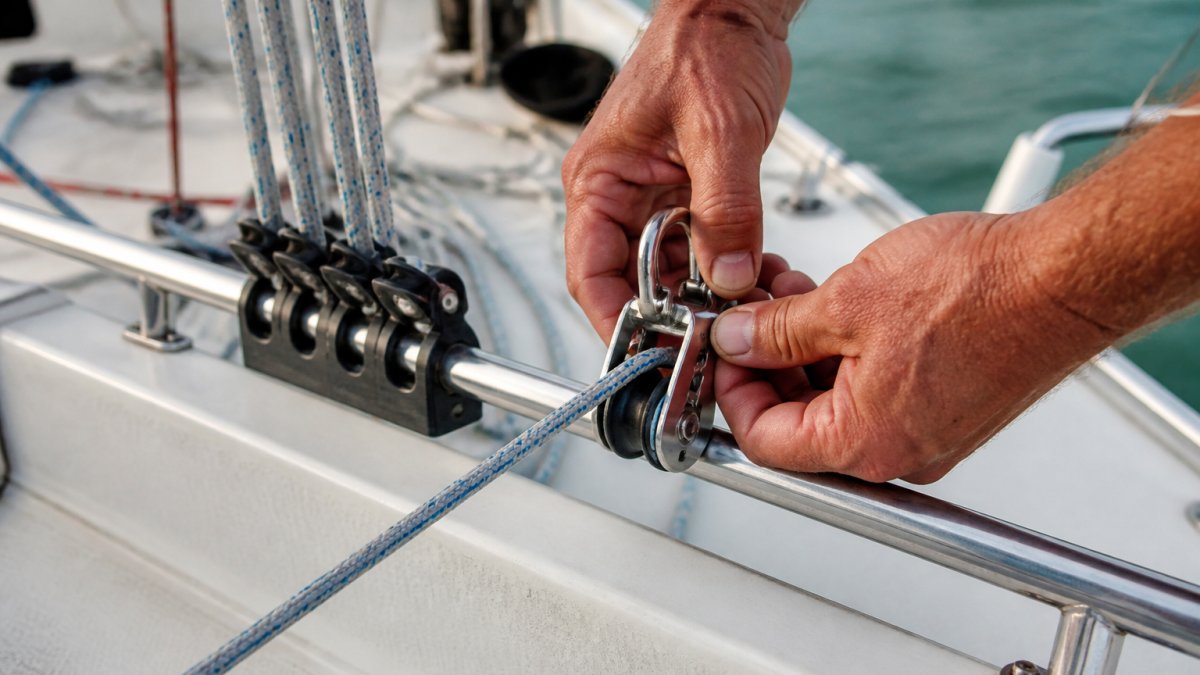
Align the block to the line's natural run so the load sits evenly on the block.
Ordering the Right Sailboat Blocks for Your Boat
The final step is getting the right parts in hand without a second trip. That means matching every spec before you click buy: line size, load rating, bearing type, and attachment head.
A quick reference for common jobs:
| Job | Block Type | Key Spec |
|---|---|---|
| Mainsheet turning | Single, ball bearing | Sheave 6-8x line |
| Spinnaker lead | Snatch block | Opens under load |
| Vang purchase | Double or triple | High working load |
| Mast foot | Soft block | Dyneema loop |
| Barber hauler | Soft block | Working load margin |
Charleston Yachting stocks premium rigging and hardware from names like Ronstan, Wichard, and Barton, with same-day shipping.
Frequently Asked Questions
How do I choose the right size block for a sailboat?
Size a sailboat block around your line first, then confirm the load. The sheave diameter should be large enough that the line runs without pinching, and the block's maximum rope diameter must match or exceed your line size. For example, the Ronstan Series 25 blocks at Charleston Yachting suit lines up to 5/16 inch (8mm). Once the line fits, check that the working load comfortably exceeds the maximum load on that line.
What is the difference between a single, double, and triple sailing block?
The number of sheaves changes the mechanical advantage and the number of lines the block can carry. A single block runs one line; a double or triple runs two or three, which lets you build purchase systems or lead several control lines through one attachment point. More sheaves add weight and cost, so match the count to the job: single blocks for simple leads and turning, multiples where you need a tackle or grouped controls.
How do I calculate the load rating needed for a sailboat block?
Start with the maximum load your line or sail can generate, then add a safety margin. Compare your expected maximum load against the working load and breaking load printed on the block's specification, and build in a safety margin. For high-load, low-speed applications such as mast foot blocks, soft blocks like the Wichard MXLEvo 16 are designed for heavier loads while staying light.
When should I use a ball bearing block instead of a plain bearing block?
Use ball bearing blocks where the line moves fast and often: mainsheet, spinnaker sheets, halyards, and control lines that get adjusted constantly. The Ronstan Series 25 ball bearing blocks, for instance, are built for high-demand dinghy and small boat control systems. Plain bearing or soft blocks suit static or low-speed, high-load points such as mast foot blocks, barber haulers, and furler terminals, where low friction matters less than strength and low maintenance.
Choosing sailboat blocks isn't glamorous work, but it's the difference between a rig that trims cleanly and one that eats lines and fails at the worst moment. Get the type, size, and load rating right, and the rest of your rigging gets easier. Charleston Yachting carries the blocks, shackles, and hardware to finish the job, with same-day shipping and a catalog built for sailors who know what they need. Get started with Charleston Yachting and equip your rig with confidence.
