

Marine Electronics Brand Compatibility Guide

Table of Contents
- Understanding Marine Electronics Brand Compatibility
- NMEA 2000 Network Compatibility Across Brands
- Transducer Compatibility Guide for Mixed Systems
- Gateway and Bridge Solutions for Legacy Hardware
- Marine Electronics Integration Best Practices
- Common Pitfalls in Mixed-Brand Electronics Installation
- Choosing Proprietary vs. Open Architecture Systems
- Mobile App and Cloud Ecosystem Integration
Last Updated: August 20, 2026
Understanding Marine Electronics Brand Compatibility
Marine electronics brand compatibility is the ability of navigation systems, sensors, and instruments from different manufacturers to communicate and function together on a single vessel. Modern standards make multi-brand integration entirely feasible, though success depends on understanding which protocols enable it and which hardware bridges the gaps.
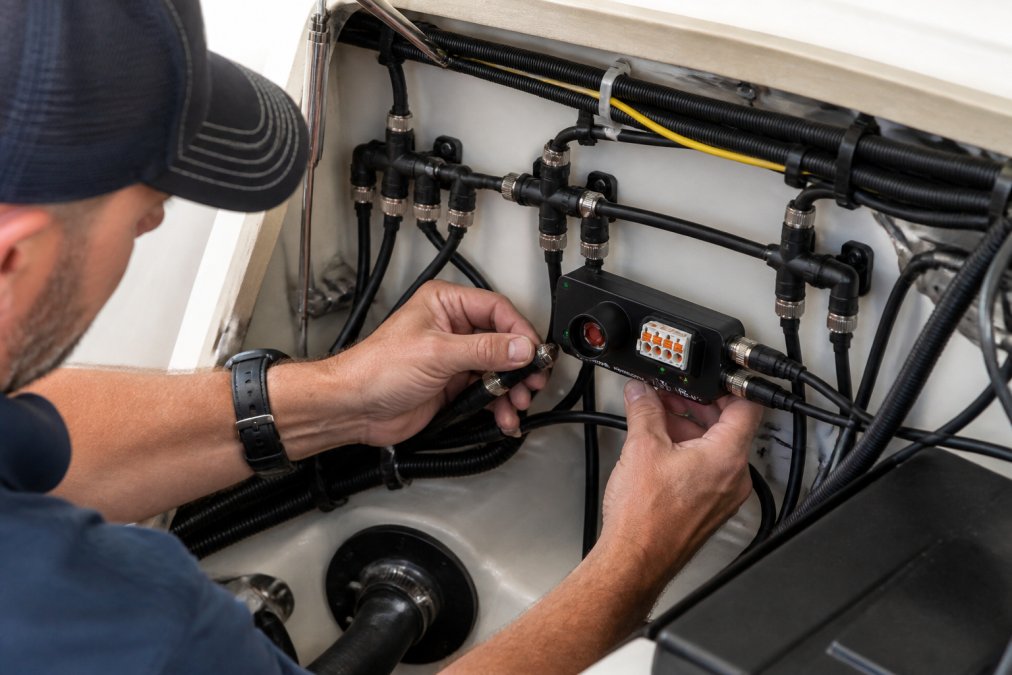
A 15-year-old Garmin chartplotter can coexist with a newer B&G radar or Raymarine autopilot through the right protocols and adapters. Early proprietary systems locked you into a single manufacturer's ecosystem. Today, open standards like NMEA 2000 and NMEA 0183 have democratized integration, allowing you to build a system using the best tool for each job.
![Actisense NMEA 0183 to NMEA2000 Gateway w/WiFi PC Interface - ISO Connection [WGX-1-ISO]](https://cdn.shopify.com/s/files/1/0842/4914/9751/files/111791XL.jpg?v=1775850232)
NMEA 2000 Network Compatibility Across Brands
NMEA 2000 is the industry standard that makes cross-brand marine electronics integration possible. This protocol uses a CAN bus architecture, a backbone network that connects multiple devices and allows bidirectional communication. Unlike older NMEA 0183, which transmits data in one direction only, NMEA 2000 enables true device-to-device conversation.
![Raymarine Devicenet Male ADP Cable SeaTalkng to NMEA 2000 [A06046]](https://cdn.shopify.com/s/files/1/0842/4914/9751/files/33170XL.jpg?v=1775841780)
Garmin, Raymarine, B&G, Lowrance, and dozens of other manufacturers have licensed the protocol, meaning their equipment can connect to a shared network. A Garmin chartplotter can read depth data from a B&G transducer. A Raymarine autopilot can accept course corrections from a Lowrance navigation system. This interoperability separates modern marine electronics from the siloed systems of the past.
How NMEA 2000 Enables Cross-Brand Integration
NMEA 2000 works through a standardized data packet structure. When a device broadcasts information, say, water temperature from a transducer, it packages that data in a format every other NMEA 2000-compliant device understands. The receiving device doesn't care whether the data came from a Garmin or Raymarine sensor; it only cares that the data conforms to the protocol.
The backbone is the physical cable that connects all devices on the network. It's a twisted-pair cable with a 5-pin connector carrying both power and data. Devices tap into the backbone at junction points called T-connectors. The backbone must terminate at both ends with specific terminator resistors, this is non-negotiable for signal integrity.
Backbone Architecture and Device Communication
A proper NMEA 2000 backbone includes a primary power source from your vessel's 12V or 24V electrical system, a main backbone cable running the length of your vessel, T-connectors at strategic points where devices branch off, and terminator blocks at each end. Using 18-gauge or heavier cable for backbone runs longer than 20 feet prevents voltage drop and signal latency that can cripple your entire system.
Device communication on NMEA 2000 happens through message prioritization. Multiple devices can broadcast simultaneously without colliding because the protocol handles collision avoidance. Safety-critical data like collision warnings takes precedence over routine engine parameter updates.
Transducer Compatibility Guide for Mixed Systems
Transducers are the sensory organs of your marine electronics system, measuring water depth, temperature, speed, and other parameters. Transducer compatibility is where many boat owners encounter friction because connector types and electrical specifications vary significantly.
Sonar Transducer Standards and Connectors
Sonar transducers come in several connector types with no universal standard. Garmin, Raymarine, and B&G each use different connectors. A Garmin transducer with a Garmin-specific connector will not physically plug into a Raymarine chartplotter without an adapter.
When selecting a transducer for a mixed-brand system, prioritize NMEA 2000-compliant models. These transducers broadcast their data via the NMEA 2000 backbone, and any NMEA 2000-compatible chartplotter can read them regardless of brand, eliminating connector compatibility issues entirely.
Frequency is another critical specification. Sonar transducers operate at different frequencies: 50 kHz for deep-water scanning, 200 kHz for general purpose use, and 455 kHz for high-definition shallow-water imaging. Your chartplotter must support the frequency of your transducer.
GPS Antenna and Sensor Array Matching
GPS antennas are more forgiving than sonar transducers when it comes to cross-brand compatibility. Most NMEA 2000 GPS antennas output standard NMEA sentences that any compatible chartplotter can read. Antenna placement affects GPS accuracy far more than brand compatibility, mount it as high as possible on your vessel, away from metal structures and electronic interference.
When building a mixed-brand sensor array, ensure each sensor outputs NMEA 2000 data or connects through an appropriate converter. Use shielded cable to prevent electromagnetic interference and route the backbone away from high-current wiring like engine starter cables.
Gateway and Bridge Solutions for Legacy Hardware
Not every boat owner is starting from scratch. Many vessels have older equipment that predates NMEA 2000. Gateway devices solve this problem by translating between different protocols.
NMEA 0183 to NMEA 2000 Conversion
NMEA 0183 is the older standard that many chartplotters, GPS receivers, and instruments still use. It transmits data serially, one sentence at a time, in a single direction. You can integrate legacy NMEA 0183 equipment with modern NMEA 2000 devices using a conversion gateway.
The Actisense NMEA 0183 to NMEA2000 Gateway w/WiFi PC Interface - ISO Connection [WGX-1-ISO] is a popular choice for this conversion. It accepts NMEA 0183 data from your legacy equipment, converts it to NMEA 2000 format, and broadcasts it onto your modern backbone. The device also works bidirectionally, allowing modern NMEA 2000 instruments to send data back to legacy equipment. At $361.35, this gateway costs less than replacing your older chartplotter.
Installation is straightforward: connect your legacy device's serial output to the gateway's input port, connect the gateway to your NMEA 2000 backbone, and configure the data mapping in the gateway's settings.
Proprietary Protocol Bridges
Some manufacturers use proprietary data formats that don't conform to NMEA standards. Raymarine's SeaTalkng protocol can be bridged to NMEA 2000 using adapter cables. The Raymarine Devicenet Male ADP Cable SeaTalkng to NMEA 2000 [A06046] ($49.99) adapts SeaTalkng signals to NMEA 2000 format.
These bridges are typically simpler than full conversion gateways because they're translating between closely related formats. However, they work only in specific manufacturer pairs.
| Gateway Type | Input Format | Output Format | Best For | Typical Cost |
|---|---|---|---|---|
| NMEA 0183 to NMEA 2000 | NMEA 0183 serial | NMEA 2000 CAN bus | Legacy equipment integration | $150-400 |
| Proprietary bridge | Manufacturer-specific | NMEA 2000 | Single-brand legacy systems | $40-100 |
| USB to serial gateway | Serial RS-232 | NMEA 0183 or 2000 | PC software integration | $100-200 |
| WiFi gateway | NMEA 2000 backbone | WiFi data stream | Mobile app connectivity | $250-350 |
Marine Electronics Integration Best Practices
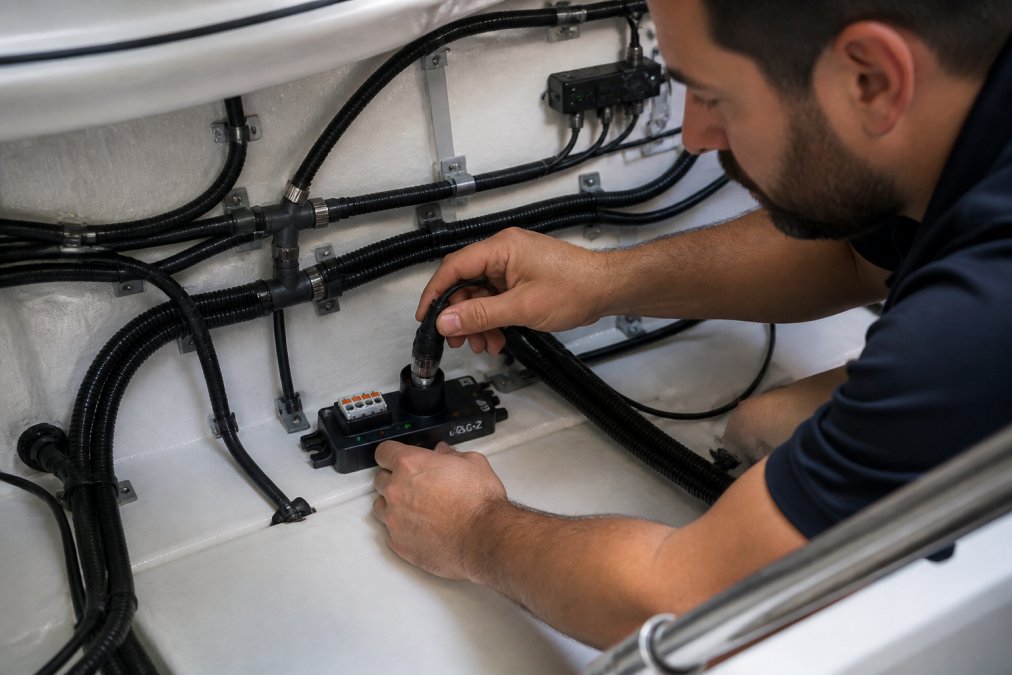
Building a reliable multi-brand marine electronics system requires planning before you buy a single cable. Start with a system diagram sketching your vessel's layout and marking where each device will mount. Note distances between devices and the path the backbone cable will take.
![Actisense NMEA2000 to WiFi Gateway [W2K-2]](https://cdn.shopify.com/s/files/1/0842/4914/9751/files/111790XL.jpg?v=1775850232)
System Architecture Planning
Your system architecture is the overall design of how devices connect and communicate. Star topology using an NMEA 2000 backbone is superior for marine applications. It provides a single point of reference for all devices, makes troubleshooting easier, and allows devices to be added or removed without disrupting the entire network.
Plan your backbone route to minimize cable runs. Avoid routing cables near high-current wiring like alternator output cables or engine starter lines. Electromagnetic interference from these circuits can corrupt NMEA 2000 data. Your NMEA 2000 backbone needs a dedicated power source from your vessel's main battery bank through a breaker.
Installation Steps and Cable Management
Run your backbone cable from the power source location to the farthest device using 18-gauge or heavier cable for runs longer than 20 feet. Install a terminator block at the far end, this is non-negotiable. Install T-connectors at each device location along the backbone. Connect each device to its T-connector using a drop cable kept short, under 10 feet if possible. Label every cable at both ends with the device name and function.
Use cable trays or conduit to protect cables from chafing. If you must cross a high-current cable, do so at a 90-degree angle to minimize coupling.
Firmware Updates and Data Protocol Synchronization
After installation, update the firmware on every device that supports firmware updates. Manufacturers release updates that improve NMEA 2000 compatibility and fix bugs. Review each device's settings to ensure it's configured to accept data from any NMEA 2000 source, not just its own brand.
Common Pitfalls in Mixed-Brand Electronics Installation
Signal Interference and Voltage Drop Issues
Electromagnetic interference (EMI) is the most common cause of intermittent NMEA 2000 problems in mixed-brand systems. High-current circuits like engine starter cables, battery chargers, and windlass motors generate electromagnetic fields that can corrupt the low-voltage signals traveling through your NMEA 2000 backbone.
The symptom is intermittent data loss: your depth sounder works fine for 20 minutes, then drops offline for 30 seconds, then comes back. Keep NMEA 2000 cables away from high-current circuits. If your backbone must cross an engine starter cable, cross at a 90-degree angle and use shielded NMEA 2000 cable.
Voltage drop occurs when your backbone cable is undersized for its length or when too many devices draw power from a single point. For a 40-foot backbone with 10 devices drawing 1 amp each, use 16-gauge or heavier cable to keep voltage drop under 0.5V.
Autopilot and Radar Compatibility Problems
A Raymarine autopilot needs heading data to function. If your heading sensor is a B&G unit, the autopilot must receive that data over NMEA 2000. If the autopilot is configured to accept heading data only from Raymarine sensors, it won't recognize the B&G heading sensor even though both devices are on the same backbone.
Access the autopilot's configuration menu and enable it to accept heading data from any NMEA 2000 source. Radar compatibility issues typically involve display integration. A Garmin chartplotter can display radar data from a Raymarine radar unit if both are on the same NMEA 2000 backbone and properly configured.
Choosing Proprietary vs. Open Architecture Systems
When to Stick with a Single Manufacturer
Single-brand systems offer simplicity and guaranteed compatibility. Every device works with every other device because they're all designed to work together. You avoid bridge devices, compatibility research, and configuration headaches.
The trade-off is flexibility. You're locked into one manufacturer's product lineup. If Garmin doesn't make a wind sensor with the specific features you want, you can't easily buy a B&G wind sensor and integrate it.
Benefits of Open Standards and Interoperability
Open standards like NMEA 2000 give you the freedom to choose the best tool for each job. You can buy a Garmin chartplotter because it has the best chart interface, a B&G radar because it has superior target tracking, and a Raymarine autopilot because it offers the best steering performance.
Open systems also adapt better to future upgrades. If a new technology emerges, you can integrate it into your existing backbone without replacing everything else. Your investment in core infrastructure remains valuable even as individual devices age and get replaced.
Mobile App and Cloud Ecosystem Integration
Modern marine electronics increasingly include mobile app connectivity and cloud-based data logging. A Garmin chartplotter with WiFi can stream data to your smartphone via the Garmin ActiveCaptain app. A Raymarine system uses the Raymarine Helm app. A B&G system uses the B&G Cloud app.
The Actisense NMEA2000 to WiFi Gateway [W2K-2] ($286.27) connects to your NMEA 2000 backbone and streams that data to the cloud. Any compatible app can access the data, regardless of which brand devices are on your backbone.
Cloud integration enables features like remote monitoring, automated data logging, and integration with weather routing services. The trade-off is data privacy and security. Cloud-connected systems transmit your vessel's location and system data to manufacturer servers. Review each manufacturer's privacy policy before enabling cloud features.
Marine electronics brand compatibility has evolved from a luxury to an expectation. Modern open standards make it entirely reasonable to build a system that combines the best features from multiple manufacturers. The key is understanding NMEA 2000, NMEA 0183, and the various bridge devices that make integration possible.
When you're ready to upgrade or expand your system, Charleston Yachting has the gateway devices, adapter cables, and expertise to help you integrate equipment from Garmin, B&G, Raymarine, and other leading brands. Our inventory includes proven solutions like the Actisense NMEA 0183 to NMEA2000 Gateway w/WiFi PC Interface - ISO Connection [WGX-1-ISO], which lets you connect legacy and modern systems without compatibility headaches. Build the marine electronics system that matches your vessel's specific needs.
Frequently Asked Questions
Can I mix different brands of marine electronics on the same network?
Yes, you can mix brands on an NMEA 2000 network because this is an open standard that all manufacturers must support. Garmin, Simrad, Lowrance, B&G, and other major brands all produce NMEA 2000 compatible devices. However, mixing older NMEA 0183 systems requires a gateway device like the Actisense WGX-1 or USG-2 to translate between protocols. Always verify your specific chartplotter, transducer, and autopilot models support the same data protocol before purchasing.
Will a Garmin transducer work with a B&G chartplotter?
It depends on the connection type. Modern NMEA 2000 transducers from Garmin are compatible with B&G chartplotters connected via the NMEA 2000 backbone. However, older NMEA 0183 or proprietary transducers may not work without a gateway. Check your B&G chartplotter's manual for supported transducer protocols. SeaTalkng (B&G's proprietary system) also requires adapter cables like the Raymarine SeaTalkng to DeviceNet cable to connect to NMEA 2000 networks.
What do I need to connect legacy marine electronics to new NMEA 2000 systems?
You need a gateway device that converts between old and new protocols. The Actisense NMEA 0183 to NMEA 2000 Gateway (WGX-1-ISO) bridges NMEA 0183 devices to NMEA 2000 networks and includes WiFi connectivity for mobile apps. For USB connections to a computer, the Actisense USG-2 Isolated USB Gateway ($158.44) handles NMEA 0183, RS422, and RS232 protocols. These gateways let you keep older chartplotters, GPS units, and depth sounders running alongside new equipment without replacing everything.
Are there limitations to mixing marine electronics brands?
Yes, several limitations exist. Proprietary systems like older Raymarine SeaTalk or Garmin's closed networks don't communicate with competitors without adapters. Signal latency can increase when routing data through multiple gateways. Autopilot and radar systems are particularly sensitive to protocol mismatches and may experience reduced functionality. Voltage drop becomes an issue on longer NMEA 2000 backbones with many devices daisy-chained together. Always test your complete system before relying on it for navigation, and maintain firmware updates across all devices to prevent compatibility drift.
How do I know if my radar is compatible with my chartplotter?
Check three things: the data protocol (NMEA 2000, NMEA 0183, or proprietary), the physical connector type, and the firmware version of both units. Most modern radars output NMEA 2000 data packets that any NMEA 2000 chartplotter can receive. Older radars may use NMEA 0183 or proprietary protocols requiring a gateway. Consult your radar and chartplotter manuals for their system architecture specifications, or contact the manufacturers directly with your model numbers to confirm interoperability before purchasing.
What is the role of AIS in integrated marine electronics systems?
AIS (Automatic Identification System) transmits your vessel's position, course, and speed to other ships and shore stations. It integrates into NMEA 2000 networks as a data source, feeding real-time vessel information to your chartplotter and autopilot. AIS receivers also display nearby vessel traffic on your MFD (multifunction display). This cross-brand integration is one of NMEA 2000's strengths: AIS data from any manufacturer flows seamlessly to any compatible chartplotter, improving collision avoidance and situational awareness regardless of your electronics brand mix.
Do I need professional installation for a mixed-brand marine electronics system?
Professional installation is recommended if your system includes autopilot, radar, or extensive NMEA 2000 backbone wiring. Improper cable routing causes signal interference and voltage drop issues that degrade system performance. Firmware synchronization across multiple brands also requires technical knowledge. DIY installation works for simple additions like a second chartplotter or GPS antenna, but complex integration involving gateways, sensor arrays, and autopilot connections should be handled by a qualified marine technician to ensure reliability and warranty coverage.
This article was written using GrandRanker