

Best Marine Electronics for Sailboats: 2026 Guide

Table of Contents
- What Marine Electronics Sailboats Actually Need
- Multifunction Displays and Chartplotters: The Navigation Hub
- AIS Transponders and Radar for Collision Avoidance
- Marine Autopilot Systems Comparison: Single-Handed Sailing
- VHF Radios and Wind Instruments: Completing the Package
- NMEA 2000 Network Setup: Connecting Your Electronics
- Marine Electronics Installation Guide: Retrofitting and Power Planning
- Which Marine Electronics Sailboats Setup Fits Your Budget?
Last Updated: August 14, 2026
Choosing the best marine electronics for sailboats is one of the most consequential decisions you'll make for your vessel. Get it right and you have a fully integrated navigation system that shares data seamlessly across every instrument. Get it wrong and you're staring at a helm full of incompatible black boxes that each demand separate attention at the worst possible moments. At Charleston Yachting, we've put together this complete buyer's guide covering every category from chartplotters to NMEA 2000 networking, with honest assessments of what each piece of kit actually does on the water.
The core argument is simple: the best electronics package is a system, not a collection of individual devices. Every purchase decision should start with interoperability, power budget, and your actual sailing profile.
Quick Picks:
- Best Chartplotter: Garmin GPSMAP 9219, industry's first 4K integrated chartplotter
- Best AIS Transceiver: Garmin AIS 800, Class B/SO with NMEA 2000 integration
- Best Budget AIS: em-trak R300, dual-channel receive-only at an accessible price
- Best Autopilot: Garmin Reactor 40 Hydraulic, Shadow Drive technology for single-handed sailing
- Best Fixed VHF: Garmin VHF 215, plug-and-play NMEA 2000 with 25W transmit
- Best Handheld VHF: Standard Horizon HX210, floating, IPX7, water-activated strobe
What Marine Electronics Sailboats Actually Need
Marine electronics for sailboats serve a fundamentally different purpose than powerboat electronics. Sailboats heel, move slowly through complex tidal patterns, and often sail shorthanded.
A cruising or coastal sailboat needs five categories of electronics: navigation (multifunction display or chartplotter), collision avoidance (AIS transponder or receiver, ideally with radar), autopilot (critical for single-handed sailing), communication (fixed-mount VHF with DSC and handheld backup), and instruments (wind sensor, depth sounder, speed data on the marine network).
The instrument cluster only delivers full value when all devices share a common marine network. NMEA 2000 is the current standard, and every device you buy should support it. A chartplotter that can't receive AIS target data from a separate transceiver, or an autopilot that can't read wind hold commands from your MFD, isn't worth the panel space.
Power consumption is critical. A 19-inch chartplotter running at full brightness, a radar dome in transmit mode, and an autopilot actively correcting course can draw substantial current from a 12V house bank. Before you buy anything, audit your battery capacity and charging setup.
ABYC electrical standards for marine systems
Multifunction Displays and Chartplotters: The Navigation Hub
The multifunction display is the centerpiece of any modern sailboat electronics package. Every other instrument, sensor, and communication device feeds data to it, and the quality of your navigation software determines how useful all of that data actually is.
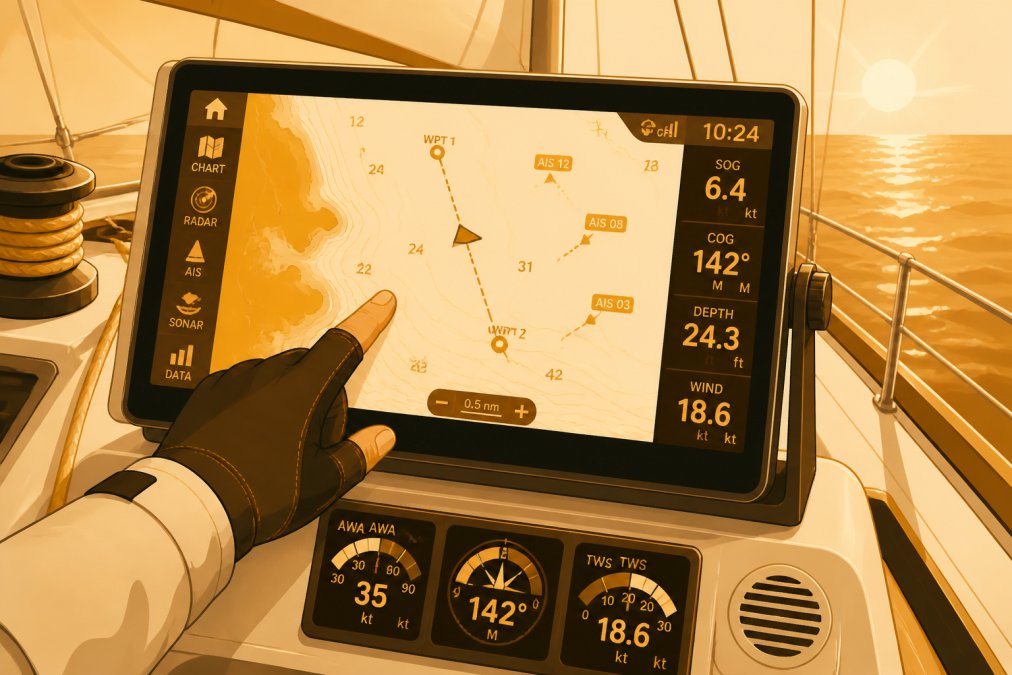
Garmin GPSMAP 9219: 4K Touchscreen Chartplotter
The Garmin GPSMAP 9219 at $10,199.99 is the most capable integrated chartplotter available. This is the industry's first integrated 4K resolution IPS touchscreen chartplotter with 3840 x 2160 pixel display on a 19-inch screen, delivering excellent sunlight readability. Processing power is seven times faster than previous Garmin generations, which matters when calculating Auto Guidance+ routes or overlaying radar on detailed charts.
The GPSMAP 9219 runs on the Garmin BLUENET network, delivering gigabit speeds for connecting multiple chartplotters, cameras, radars, and sonar modules with minimal lag. It supports NMEA 2000 and NMEA 0183 connectivity, integrating with virtually every instrument on the market. Typical current draw at 12V is 4.6A.
Key specs:
- Display: 4K IPS, IPX7 waterproof rating
- Navigation: 5,000 waypoints, 50,000 track points, 100 routes
- Connectivity: 4x BLUENET ports, 1x NMEA 2000, 4x NMEA 0183 input, 2x USB-C
- Includes Garmin Navionics+ charts with Auto Guidance+
Best for: Serious cruisers and racers who want a vessel telemetry hub that won't be outdated in three years.
AIS Transponders and Radar for Collision Avoidance
Collision avoidance is where the gap between "nice to have" and "essential" disappears. AIS and radar serve overlapping but distinct functions: AIS identifies vessels with their name, heading, and speed; radar detects anything that reflects a signal, including unlit vessels, debris, and weather.
Garmin AIS 800 Blackbox Transceiver
The Garmin AIS 800 at $1,099.99 is the correct AIS solution for any sailboat that wants to be seen as well as see others. It's a Class B/SO transceiver, meaning it both transmits your vessel's position and receives other vessels' AIS target data. The 5-watt transmit power with Class B/SO provides faster position reporting than standard Class B units. The internal VHF antenna splitter is practical: VHF and AIS share a single antenna, eliminating the need for a second antenna installation. NMEA 2000 connectivity means AIS targets appear directly on your chartplotter without additional wiring.
![Garmin AIS 800 Blackbox Transceiver [010-02087-00]](https://cdn.shopify.com/s/files/1/0842/4914/9751/files/72007XL.jpg?v=1775845073)
The FCC requires all AIS units sold in the US to be programmed by a qualified technician with a valid MMSI registration or FCC Ship Station License. Charleston Yachting handles this programming at purchase.
Best for: Cruising sailboats, offshore passages, any vessel that sails in commercial shipping lanes.
em-trak R300: Budget-Friendly AIS Receive-Only Option
The em-trak R300 at $299.97 is the right starting point for sailors who want situational awareness without the transceiver cost or FCC compliance requirements. This dual-channel, high-performance AIS receiver receives all AIS messages from vessels in range and outputs them to your chartplotter or PC in real time via NMEA 0183, NMEA 2000, or USB. The IP67 waterproof rating exceeds IPX7 standards, and low power consumption makes it easy to integrate into a tight power budget.
Best for: Day sailors and coastal cruisers who want AIS target data on their chartplotter without transmit capability.
Garmin GMR 24 xHD3 Radar Dome
The Garmin GMR 24 xHD3 at $2,799.99 brings open-array radar performance into a 24-inch dome form factor suitable for most sailboat mast configurations. The 4 kW transmit power covers a 48 nautical mile maximum range. Scan averaging technology filters sea clutter to improve detection of consistent targets. MARPA target tracking handles up to 30 targets simultaneously when paired with a heading sensor. Standby power consumption is 15W; transmitting in normal mode draws 40W.
Best for: Offshore cruisers, anyone sailing in fog, rain, or reduced visibility conditions.
Marine Autopilot Systems Comparison: Single-Handed Sailing
The quality of the autopilot is the single biggest factor in how comfortable and safe single-handed sailing actually is. A mediocre autopilot that constantly hunts for course makes every passage exhausting. A well-tuned system holds a heading through varying conditions and lets you focus on sail trim, navigation, and watch-keeping.
The Garmin Reactor 40 Hydraulic Autopilot at $1,799.99 is the most capable option for hydraulically steered sailboats. The solid-state 9-axis Attitude Heading Reference System (AHRS) mounts in nearly any orientation, which matters on a sailboat where available space below deck is limited. It minimizes heading error, course deviation, rudder movement, and power consumption simultaneously.
![Garmin Reactor 40 Hydraulic Autopilot w/o GHC 20 [010-00705-21]](https://cdn.shopify.com/s/files/1/0842/4914/9751/files/70459XL.jpg?v=1775844744)
The patented Shadow Drive technology is genuinely useful for single-handed sailors. If you take the helm while the autopilot is engaged, Shadow Drive automatically disengages the system. When you hold a steady course again, it re-engages. This prevents the dangerous situation where a sailor overrides the autopilot without realizing it's still trying to correct.
Full integration with compatible Garmin chartplotters means you can control the Reactor 40 from any networked display, execute tack and jibe commands, and access Auto Guidance+ routing. The rudder reference unit provides precise feedback on actual rudder position.
| Feature | Garmin Reactor 40 Hydraulic |
|---|---|
| Steering type | Hydraulic |
| AHRS | 9-axis solid-state |
| Shadow Drive | Yes |
| Chartplotter integration | Full Garmin network |
| Tack/jibe commands | Yes |
| Price | $1,799.99 |
Best for: Hydraulically steered cruising sailboats, offshore passages, single-handed sailing.
Limitation: This corepack does not include the GHC 20 control head. Budget for a compatible Garmin chartplotter or add the GHC 20 separately for standalone autopilot control.
VHF Radios and Wind Instruments: Completing the Package
Your VHF is the primary emergency communication device on the vessel. The difference between a fixed-mount and a handheld isn't just power output, it's the difference between a DSC distress call that reaches the Coast Guard and a radio that goes overboard with the crew.
Garmin VHF 215 Fixed-Mount Radio
The Garmin VHF 215 at $549.99 is the correct fixed-mount solution for any Garmin-equipped helm. The 25-watt transmit power covers all US, Canadian, and international marine channels plus 10 NOAA weather channels. Standard Class D DSC functionality with a built-in GPS means a distress call transmits your precise position automatically. NMEA 2000 plug-and-play integration with compatible Garmin chartplotters and MFDs is the key differentiator. The removable fist microphone can be relocated away from the radio body, which helps with helm ergonomics on a tightly packed sailboat.
![Garmin VHF 215 Marine Radio [010-02097-00]](https://cdn.shopify.com/s/files/1/0842/4914/9751/files/73200XL.jpg?v=1775845271)
Standard Horizon HX210 Handheld VHF
Every sailboat should carry a handheld VHF as a backup, and the Standard Horizon HX210 at $139.99 is the most practical option at this price point. The HX210 floats face-up if dropped overboard. A water-activated emergency strobe light triggers automatically on contact with water, even when switched off. The 1850 mAh lithium-ion battery supports the compact case design. Selectable output power runs at 6W, 2.5W, or 1W, and the IPX7 submersible waterproof rating covers immersion to 1 meter for 30 minutes.
Davis WindTrak 10 Sport Wind Vane
The Davis WindTrak 10 Sport at $44.99 makes the case for a mechanical masthead unit as a complement or backup to electronic wind sensors. The sapphire jewel suspension bearing delivers low-inertia response that electronic sensors at this price can't match. Wind tunnel tested to 80 knots, this 10-inch vane mounts on most dinghies and smaller sport boats via the included glass-reinforced polycarbonate J-Base. At 1.2 ounces, it adds negligible weight aloft.
Best for: Smaller sailboats, as a backup to electronic wind sensors, or racing sailors who want a direct visual reference for sail trim.
NMEA 2000 Network Setup: Connecting Your Electronics
The NMEA 2000 network setup is the backbone of modern sailboat electronics integration. NMEA 2000 is a plug-and-play communication standard that allows instruments, sensors, and displays from different manufacturers to share data on a single network bus. Every device in this guide supports it.
According to NMEA's official NMEA 2000 standard documentation, the standard defines both the physical network and the data messages, ensuring certified devices interoperate regardless of manufacturer.
The network topology is simple: a powered backbone cable runs through the vessel, and each device connects via a T-connector and drop cable. Terminators at each end of the backbone complete the circuit.
Garmin NMEA 2000 Starter Kit
The Garmin NMEA 2000 Starter Kit at $119.99 contains everything needed to build a basic marine network: a 6-meter backbone cable, a 2-meter drop cable, a 2-meter power cable, two T-connectors, and male and female terminators.
What's included:
- NMEA 2000 backbone cable (6m)
- NMEA 2000 drop cable (2m)
- NMEA 2000 power cable (2m)
- Two T-connectors
- Male and female terminators
Maretron GPS200 NMEA 2000 GPS Receiver
The Maretron GPS200 at $395.00 is the dedicated GPS receiver for vessels that want a standalone, high-accuracy position source on the NMEA 2000 network rather than relying solely on the chartplotter's internal GPS. The GPS200 delivers position fixes 10 times per second, boat speed four times per second, and precision time once per second. It automatically decodes WAAS correction signals for better than 3-meter accuracy. The unit is fully NMEA 2000 certified and connects directly to any NMEA 2000 network, feeding data to chartplotters, autopilots, and dedicated instrument displays.
Best for: Vessels with multiple chartplotters or instrument displays that benefit from a dedicated GPS source independent of the main MFD.
Marine Electronics Installation Guide: Retrofitting and Power Planning
Retrofitting older sailboats with modern electronics is where most projects either succeed cleanly or turn into expensive frustrations. The marine electronics installation guide that actually helps addresses power, physical mounting, and cable routing before any device gets purchased.
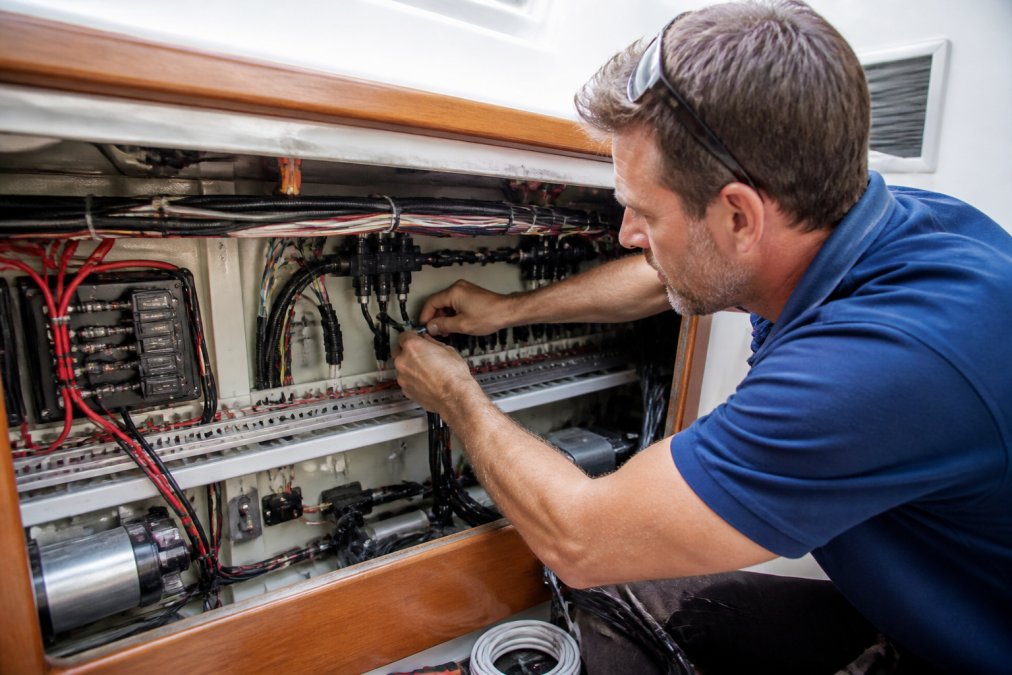
Power Consumption Analysis Before You Buy
Power consumption analysis is non-negotiable for sailboats. Unlike powerboats, sailboats often anchor or sail for extended periods without running an engine to charge batteries. Build your power budget before purchasing any device:
- Garmin GPSMAP 9219: 4.6A typical at 12V (55.2W)
- Garmin GMR 24 xHD3 radar: 40W transmitting, 15W standby
- Garmin Reactor 40 autopilot: varies with sea state and correction frequency
- Garmin VHF 215: minimal draw in receive mode, higher when transmitting
- Garmin AIS 800: low continuous draw
Add the draw figures for all devices you plan to run simultaneously. Compare that total against your house bank capacity and charging sources. Most cruising sailboats need at minimum a 200-400Ah lithium or AGM house bank and a reliable charging solution to run a full electronics package comfortably.
Voltage stability matters as much as raw capacity. Devices like chartplotters and autopilots can behave erratically on a system with poor voltage regulation. Staying above 12V under load is good practice.
As the US Coast Guard's guidance on vessel electrical systems notes, proper electrical installation and load management are fundamental to safe vessel operation.
Mobile Device Integration
Mobile device integration has changed how sailors interact with their onboard electronics. The Garmin GPSMAP 9219 supports wireless connectivity via Bluetooth and ANT technologies, and integrates with the ActiveCaptain app for route planning, waypoint transfer, and firmware updates from a smartphone or tablet.
A sailor who plans passages on a tablet at the chart table, then syncs waypoints directly to the chartplotter via ActiveCaptain, eliminates manual entry errors. Navigation software on mobile devices also serves as a genuine backup if primary electronics fail.
The practical setup for most installations uses ActiveCaptain on iOS or Android for chart updates and route planning, syncs waypoints to the GPSMAP 9219 before departure, keeps a fully charged handheld VHF (Standard Horizon HX210) as a communication backup, and considers a dedicated tablet running navigation software as a secondary chartplotter.
Garmin ActiveCaptain app documentation and features
Which Marine Electronics Sailboats Setup Fits Your Budget?
The best marine electronics for sailboats setup depends entirely on how and where you sail. A weekend coastal sailor has different requirements than an offshore passage maker.
| Setup | Key Components | Approximate Total | Best For |
|---|---|---|---|
| Entry-level coastal | em-trak R300 + Standard Horizon HX210 + Davis WindTrak 10 + NMEA 2000 Starter Kit | ~$605 | Day sailors, protected waters |
| Mid-range cruiser | Garmin AIS 800 + Garmin VHF 215 + Garmin Reactor 40 + NMEA 2000 Starter Kit | ~$3,570 | Coastal cruising, weekenders |
| Full offshore package | GPSMAP 9219 + GMR 24 xHD3 + Garmin AIS 800 + Reactor 40 + VHF 215 + Maretron GPS200 | ~$16,365 | Offshore passages, bluewater sailing |
A common mistake is building a system around a single premium device without budgeting for the supporting network. A $10,000 chartplotter connected to a single-channel AIS receiver and no autopilot is a worse sailing experience than a mid-range MFD with a full integrated package.
The labor cost of running cables through an existing vessel often exceeds the cost of the devices themselves. Plan cable routes before committing to mounting positions. NMEA 2000 drop cables have a maximum length per the standard, and long runs require additional backbone segments.
For sailors upgrading from older Garmin hardware, the NMEA 2000 network is backward-compatible with most devices from the past decade. Your existing transducer, wind sensor, and depth sounder may integrate directly into a new NMEA 2000 backbone without replacement. Verify compatibility using Garmin's device compatibility documentation before assuming a clean retrofit.
A $139.99 floating handheld VHF and a $299.97 AIS receiver represent a small fraction of what most sailors spend on sails, safety gear, and marina fees. The electronics package that keeps you informed and communicating is never the wrong investment.
Frequently Asked Questions
What electronics do you need on a sailboat?
The core marine electronics for any sailboat are a chartplotter or multifunction display for waypoint navigation, a VHF radio for communication, and an AIS transponder for collision avoidance. Beyond that, a depth sounder, wind sensor, and GPS receiver round out a functional instrument cluster. For offshore or single-handed sailing, an autopilot system becomes essential. All of these devices connect through an NMEA 2000 network so data flows between them automatically.
Is it worth upgrading from an older chartplotter that still works?
An older chartplotter may still display charts, but it likely lacks NMEA 2000 interoperability with modern AIS transponders, radar, and autopilot systems. Newer multifunction displays also offer sunlight-readable touchscreen displays, faster GPS receivers, and wireless firmware updates via companion apps. The practical difference shows up in weather routing accuracy, vessel connectivity with mobile devices, and the ability to overlay radar and AIS data on the same chart screen.
How do I make sure different brands of marine electronics will work together?
The NMEA 2000 standard governs data integration between devices from different manufacturers. Any certified NMEA 2000 device, whether a chartplotter, autopilot, depth sounder, or AIS transponder, can share data on the same backbone network. Before buying, confirm each device carries NMEA 2000 certification. Garmin's ecosystem also uses its BLUENET network for higher-speed connections between compatible chartplotters, radars, and sonars, which simplifies multi-device setups considerably.
What should I look for when buying a marine chartplotter?
Prioritize sunlight readability first: a display that washes out at the helm is useless offshore. Check the waterproof rating (IPX7 is the standard minimum), touchscreen responsiveness with wet hands, and processing speed for chart rendering. Confirm NMEA 2000 and NMEA 0183 compatibility so the unit integrates with your existing instruments. Storage for waypoints, tracks, and navigation routes matters for cruising. Finally, check typical current draw at 12V to understand the impact on your vessel's power budget.
Do I need an AIS transponder or just an AIS receiver?
An AIS receiver like the em-trak R300 lets you see other vessels on your chartplotter, which improves situational awareness significantly. However, it does not transmit your vessel's position to other boats or to the Coast Guard. An AIS transponder, such as the Garmin AIS 800, both receives and transmits. For coastal cruising and offshore passages, a Class B transponder is strongly recommended so commercial shipping and other vessels can see you on their displays, not just the reverse.
Outfitting a sailboat with electronics that actually work together requires the right products, the right network architecture, and honest planning around power and installation. Charleston Yachting carries the complete range covered in this guide, from the Garmin GPSMAP 9219 chartplotter to the Garmin NMEA 2000 Starter Kit, with same-day shipping on in-stock items. Shop the full marine electronics catalog and build your system with confidence.
This article was written using GrandRanker