

Essential Marine Electronics for Safety: 2026 Guide

Table of Contents
- Essential Marine Electronics for Safety: Quick Comparison
- 1. VHF Radio: Your Primary Lifeline on the Water
- 2. GPS Chartplotter and Multifunction Displays
- 3. How to Use AIS for Collision Avoidance
- 4. EPIRB and Emergency Signaling Devices
- 5. Depth Sounders, Radar, and Weather Monitoring
- USCG Required Safety Equipment Every Vessel Must Carry
- Marine Electronics Maintenance Tips to Keep Systems Reliable
Last Updated: August 15, 2026
Choosing the right electronics can mean the difference between a manageable emergency and a fatal one. At Charleston Yachting, we provide a comprehensive selection of premium marine electronics for safety, and the pattern is consistent: boats that carry the right gear get rescued faster, navigate more confidently, and avoid the situations that end careers and lives. This guide tells you exactly what belongs on your vessel, how each system works, and what to look for when buying.
Essential Marine Electronics for Safety: Quick Comparison
| System | Primary Function | Best For | Regulatory Requirement |
|---|---|---|---|
| VHF Radio (Fixed-Mount) | Emergency communication, DSC distress calling | All vessels over 26 ft | Recommended; required for offshore |
| VHF Radio (Handheld) | Backup communication, crew overboard | All vessel types | Recommended backup |
| GPS Chartplotter / MFD | Positioning, waypoint navigation, chart display | All vessels | None (but essential) |
| AIS Transponder (Class B) | Vessel tracking, collision avoidance | Recreational and commercial | Required for some commercial vessels |
| AIS Transponder (Class A) | Full SOLAS compliance, high-update rate | Commercial / SOLAS vessels | Required for SOLAS vessels |
| EPIRB | Satellite distress signaling | Offshore and ocean passages | Required for some USCG categories |
| Depth Sounder / Fish Finder | Bottom tracking, grounding avoidance | All vessels in coastal waters | None |
| Radar | Low-visibility navigation, collision avoidance | Offshore, night passages | Recommended |
| Carbon Monoxide Alarm | Cabin safety, gas leak detection | Any vessel with enclosed cabin | Recommended; required in some states |
1. VHF Radio: Your Primary Lifeline on the Water
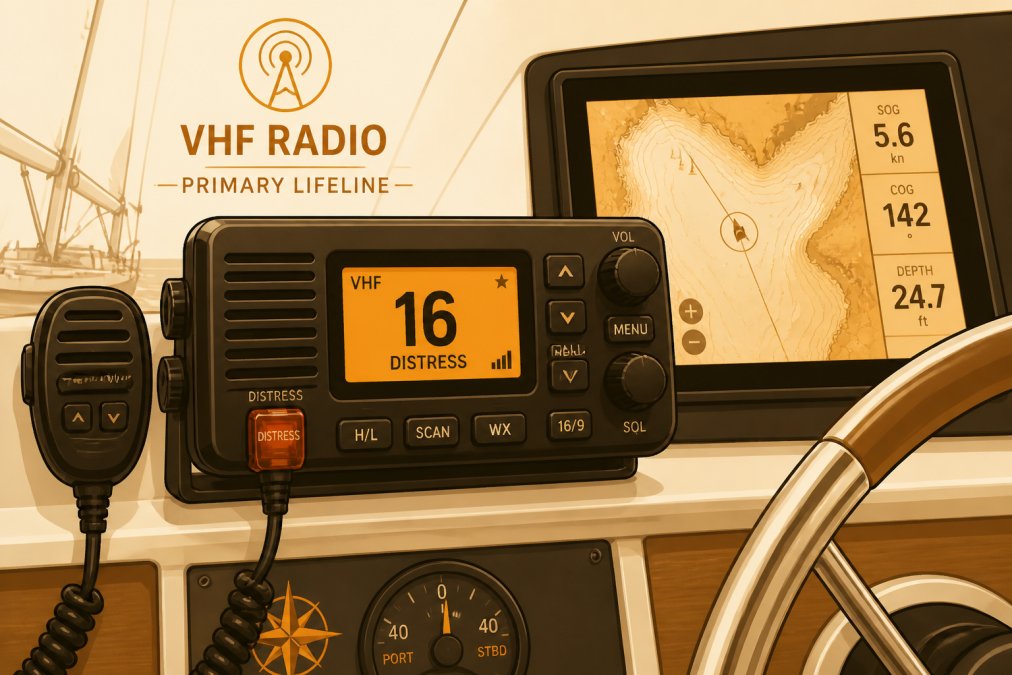
A VHF radio is the single most important communication device on any vessel. Channel 16 is the international distress frequency monitored by the U.S. Coast Guard around the clock, and Digital Selective Calling (DSC) allows a properly registered radio to transmit your GPS position automatically during a mayday.
The Garmin VHF 215 Marine Radio ($549.99) delivers 25 watts of transmit power with full Class D DSC functionality, NMEA 2000 connectivity for integration with compatible chartplotters, and coverage of all U.S., Canadian, and international marine channels plus 10 NOAA weather channels.
![Garmin VHF 215 Marine Radio [010-02097-00]](https://cdn.shopify.com/s/files/1/0842/4914/9751/files/73200XL.jpg?v=1775845271)
Fixed-Mount vs. Handheld VHF: Which Do You Need?
You need both. A fixed-mount radio provides the transmit power and antenna height to reach the USCG or nearby vessels over meaningful distances. A handheld serves as backup if your electrical system fails and goes with crew in a life raft.
The Standard Horizon HX210 ($139.99) floats face-up if dropped overboard, activates an emergency strobe on water contact, and delivers selectable 1W/2.5W/6W output with a 3-year waterproof warranty.
2. GPS Chartplotter and Multifunction Displays
A GPS chartplotter combines positioning data, electronic charting, waypoint navigation, and sensor fusion into a single display. Multifunction displays (MFDs) extend this by integrating radar overlays, AIS targets, depth sounder data, and autopilot control.
When visibility drops and traffic density increases, having AIS targets overlaid on your electronic chart with radar confirming what the AIS shows keeps situational awareness intact. Treat your chartplotter as one navigation source among several. Carry paper charts as backup, and cross-check your chartplotter position against visible landmarks and depth readings.
3. How to Use AIS for Collision Avoidance
AIS (Automatic Identification System) broadcasts your vessel's identity, position, speed, and course to all AIS-equipped vessels within VHF range while receiving the same data from surrounding traffic. A Class B AIS transponder updates your position every 30 seconds at anchor and more frequently underway.
The collision avoidance workflow: your AIS transponder broadcasts your MMSI and position; nearby vessels receive this as a labeled AIS target on their chartplotter; your display shows their data the same way, including closest point of approach (CPA) calculations; when CPA falls below your alarm threshold, the system alerts you; you adjust course or speed and monitor the updated CPA in real time.
Class B vs. Class A AIS Transponders
Class B AIS is standard for recreational and most commercial vessels not SOLAS-regulated. The Garmin AIS 800 Blackbox Transceiver ($1,099.99) delivers 5 watts of transmit power with faster position reporting above 14 knots, NMEA 2000 connectivity, and an internal VHF antenna splitter. The FCC requires all AIS units sold in the U.S. to be programmed by a qualified technician.
Class A AIS is mandatory for SOLAS vessels and provides higher transmit power, faster update rates, and additional messaging. The SI-TEX SAS-900 6" Color Class A AIS Transceiver ($2,599.00) is SOLAS-certified with an integrated high-definition color display, full electronic chart display with AIS overlay, and IPX7 weatherproofing.
| Feature | Class B (Garmin AIS 800) | Class A (SI-TEX SAS-900) |
|---|---|---|
| Transmit Power | 5W | 12.5W |
| Update Rate | 30 sec (anchored), faster underway | 2-10 sec (underway) |
| Display | No (blackbox) | Yes, 6" color |
| SOLAS Compliant | No | Yes |
| Best For | Recreational / light commercial | SOLAS / commercial vessels |
4. EPIRB and Emergency Signaling Devices
An EPIRB (Emergency Position Indicating Radio Beacon) transmits a 406 MHz distress signal through the Cospas-Sarsat satellite rescue system, alerting search and rescue authorities to your position anywhere on earth.
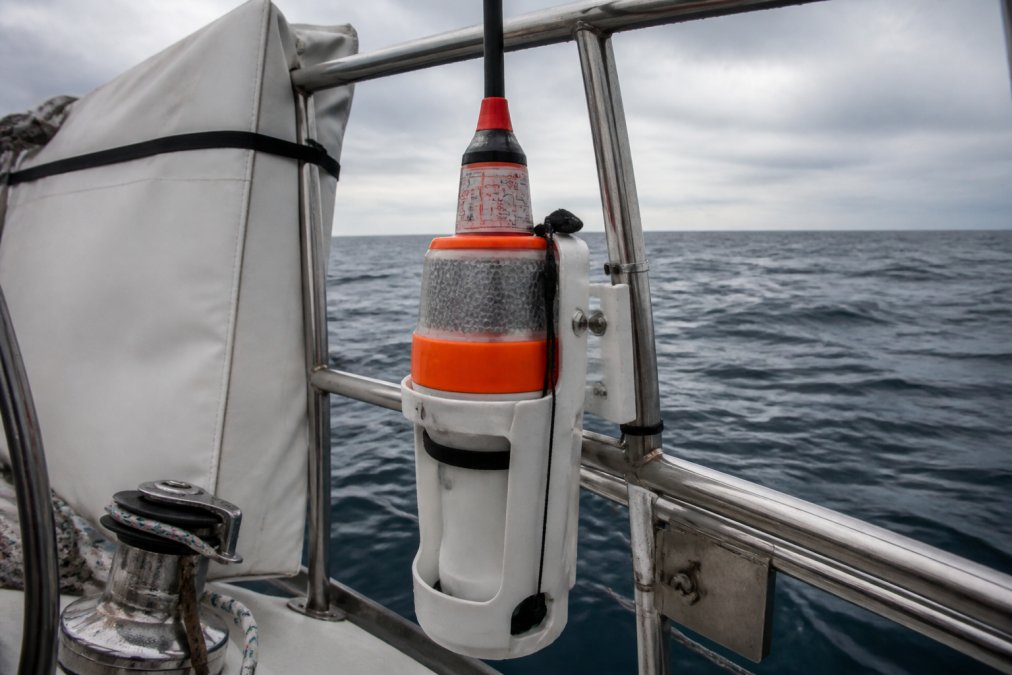
The ACR GlobalFix V5 Cat 2 GPS AIS EPIRB ($919.95) combines 406 MHz Cospas-Sarsat transmission with integrated AIS functionality. When activated, it simultaneously alerts the global rescue satellite network and broadcasts an AIS safety message on VHF frequencies visible to any AIS-equipped vessel nearby. Position accuracy is within 100 meters using GNSS. Return Link Service provides visual confirmation via a flashing blue light that your distress message has been received. NFC connectivity lets you check battery status and fix accuracy through a smartphone app. The operational life is 48 hours minimum at -4°F, with a replaceable battery at the 10-year mark.
![ACR GlobalFix V5 Cat 2 GPS AIS EPIRB w/Return Link Service Mobile App [2852]](https://cdn.shopify.com/s/files/1/0842/4914/9751/files/94451XL.jpg?v=1775847754)
5. Depth Sounders, Radar, and Weather Monitoring
Most groundings happen in familiar waters. A depth sounder with a calibrated transducer gives you continuous bottom-tracking data and can alarm at a preset depth threshold, giving you time to react before the keel touches.
Radar serves a critical function in low-visibility navigation. Fog, rain, and darkness eliminate visual information that VFR navigation depends on. Modern radar units integrate with chartplotters via NMEA 2000, overlaying radar returns directly on the electronic chart.
Weather monitoring means more than checking a forecast before departure. A VHF radio with NOAA weather channel access provides continuous updates from the NOAA National Weather Service Marine Forecasts covering wind, wave height, and storm warnings by zone. Interpreting radar returns takes practice, a rocky headland and a large vessel can look similar at distance on a basic display. Spend time in familiar waters learning what your specific radar returns look like before depending on it in zero visibility.
USCG Required Safety Equipment Every Vessel Must Carry
USCG required safety equipment is defined by vessel length, hull type, and operating area. The core requirements, per U.S. Coast Guard Boating Safety Division equipment requirements, include:
- Personal Flotation Devices (PFDs): One USCG-approved Type I, II, III, or V PFD per person on board. Vessels over 16 feet must also carry a throwable Type IV device.
- Visual distress signals: Required on coastal waters for vessels over 16 feet.
- Fire extinguishers: Required on vessels with enclosed engine spaces, fuel tanks, or living areas.
- Sound-producing device: A horn or whistle audible at 0.5 nautical miles for vessels under 65.6 feet.
- Navigation lights: Required between sunset and sunrise and in reduced visibility.
- Carbon monoxide alarms: Required by ABYC and increasingly by state law for any vessel with an enclosed cabin and a gasoline engine.
For PFDs, Charleston Yachting carries the Onyx MoveVent Dynamic Life Vest ($89.99), a USCG-approved Type III with SOLAS-grade reflective material, and the Mustang HIT Inflatable Work Vest ($439.49), a Type II/V commercial-grade inflatable with Hydrostatic Inflator Technology that activates only when submerged in 4 or more inches of water.
For carbon monoxide protection, the Safe-T-Alert 62 Series Flush Mount CO Alarm ($99.95) is a 12V hardwired unit designed for marine environments with a rapid-recovery sensor.
Marine Electronics Maintenance Tips to Keep Systems Reliable
The most common failure mode for marine electronics is not hardware defect but neglected connections. Salt air attacks every exposed terminal, and a corroded NMEA 2000 connector or a green-tinged VHF antenna connection can degrade or kill a functioning system.
A practical annual maintenance checklist:
- Inspect all antenna connections for corrosion; apply dielectric grease to coax connectors
- Check NMEA 2000 backbone connectors for moisture intrusion
- Test DSC function on VHF radio using USCG test procedure
- Verify EPIRB battery expiration date and self-test LED function
- Update chartplotter charts and firmware
- Test depth sounder transducer for air bubbles affecting signal
- Inspect radar dome mount and cable routing for chafe
- Test all alarm functions: anchor drag, depth, CPA on AIS
- Check CO alarm age (replace any unit over 5 years old)
Power Budgeting and Redundancy Planning
Power management is where most electronics installations fail silently. A vessel with a GPS chartplotter, VHF radio, AIS transponder, radar, and depth sounder running simultaneously draws a meaningful load from the house battery bank. Calculate the amp-hour draw of each device at full operation, total the load, and size the battery bank to handle 50% discharge over your longest expected passage without charging.
Redundancy planning means having a second independent power source for critical safety devices. A handheld VHF with a fully charged battery is your backup communication system when the main electrical system fails. An EPIRB with its own internal battery is independent of vessel power entirely. Separate your safety-critical electronics (VHF, EPIRB, navigation lights) onto a dedicated circuit with its own fuse or breaker to prevent a fault in the entertainment circuit from taking down your distress communication capability.
Cybersecurity for Connected Marine Systems
Connected marine systems are a real attack surface. Modern chartplotters, AIS transponders, and MFDs connect via NMEA 2000 networks, Bluetooth, Wi-Fi, and increasingly via cellular data. AIS spoofing and GPS spoofing have been documented in real-world incidents.
Mitigation steps:
- Keep firmware updated on all networked devices; manufacturers patch known vulnerabilities
- Use WPA2 or WPA3 encryption on any onboard Wi-Fi network
- Disable Bluetooth pairing on VHF radios and instruments when not actively in use
- Cross-check GPS position against radar returns, depth readings, and visual bearings regularly
- Treat any unexpected AIS target behavior as a data integrity issue, not a display glitch
No single electronic system should be your only source of truth for position, collision avoidance, or vessel identity. Sensor fusion, cross-checking data from multiple independent systems, is both a navigation best practice and a cybersecurity countermeasure.
Equipping a vessel with reliable safety electronics is an ongoing commitment to maintenance, redundancy, and situational awareness. Charleston Yachting stocks a full range of safety-critical marine electronics from Garmin, B&G, ACR, Standard Horizon, and SI-TEX, with same-day shipping on in-stock items. From a fixed-mount VHF with DSC to a GPS AIS EPIRB with Return Link Service, the right equipment is available now. Shop All marine safety electronics at Charleston Yachting and outfit your vessel to the standard the water demands.
![Standard Horizon HX210 6W Floating Handheld Marine VHF Transceiver [HX210]](https://cdn.shopify.com/s/files/1/0842/4914/9751/files/63675XL.jpg?v=1775843997)
Frequently Asked Questions
What safety electronics are mandatory on recreational vessels?
The U.S. Coast Guard requires all recreational vessels to carry visual distress signals, a sound-producing device, and a properly fitted life jacket for every person on board. VHF radios are not federally mandated for recreational boats but are strongly recommended. Vessels operating offshore should also carry an EPIRB. State regulations may add requirements, so always verify the rules for your operating area before departing.
What is the difference between a fixed-mount VHF radio and a handheld marine VHF?
A fixed-mount VHF radio transmits at 25 watts, giving it significantly greater range than a handheld unit, which typically outputs 5-6 watts. Fixed-mount radios also connect directly to an external antenna and integrate with NMEA 2000 networks for DSC distress calling with GPS positioning. Handheld VHF radios serve as essential backups because they are portable, float if dropped, and operate independently of the vessel's main power supply.
How do AIS and GPS improve boating safety?
An AIS transponder broadcasts your vessel's positioning data, speed, and heading to all other AIS-equipped vessels nearby, and receives the same information from them. Combined with a GPS chartplotter, this creates real-time situational awareness on your multifunction display. You can see vessel traffic service targets, calculate closest point of approach, and take early action to avoid collisions, especially critical during low visibility navigation in fog or at night.
How often should I test my marine safety electronics?
Test your VHF radio on a non-emergency channel before every trip and verify DSC functionality monthly. Check your EPIRB's battery expiration date and self-test indicator at least annually; the ACR GlobalFix V5 allows NFC-based status checks via smartphone app. Inspect all NMEA 2000 connections and transducer cables at the start of each season. Carbon monoxide and fume detectors should be tested monthly and replaced every five years per manufacturer guidance.
Do I need a depth sounder for safety, or is it just for fishing?
A depth sounder is a genuine safety instrument, not just a fishing tool. It alerts you to shoaling water before you run aground, which is one of the most common causes of recreational vessel damage and injury. In unfamiliar anchorages or when navigating inshore channels, real-time depth data from a transducer paired with your chartplotter gives you a critical second layer of confirmation beyond electronic charting alone.
This article was written using GrandRanker