

Buy Harken Sailing Blocks Online: 2026 Guide

Table of Contents
- Harken Sailing Blocks: What You Need to Know
- Micro Blocks for Small Boats and Dinghies
- Carbo Air Blocks: Lightweight Performance Rigging
- Element Blocks: Strength and Value for Cruising
- Sizing and Load Calculation Guide
- Best Marine Hardware for Saltwater: Maintenance and Refurbishment
- How to Maintain Sailboat Blocks for Long Service Life
- Conclusion
Last Updated: August 19, 2026
Harken Sailing Blocks: What You Need to Know
Harken sailing blocks are foundational hardware that determines how smoothly your sails trim and how safely you handle load. At Charleston Yachting, we stock an extensive selection of Harken blocks for everything from small dinghy rigging to high-performance mainsail systems. The right block reduces friction, distributes load safely, and lasts decades with minimal maintenance.
Selecting the right block means matching sheave diameter, load rating, and sideplate material to your specific rigging application. A micro block works perfectly for light control lines on a dinghy but fails if loaded with mainsheet tension on a cruising boat. Oversizing adds weight and cost without benefit. This guide covers the major Harken block families, explains how to calculate safe working loads, and walks you through maintenance practices that keep blocks performing for 15+ years.
![Harken 22mm Micro Block [224]](https://cdn.shopify.com/s/files/1/0842/4914/9751/files/79034XL.jpg?v=1697833539)
Micro Blocks for Small Boats and Dinghies
Micro blocks are the lightest, most compact harken sailing blocks available, designed for sailboards, smaller dinghies, and lightly loaded control lines. The Harken 22mm Micro Block [224] weighs just 0.5 ounces and handles a maximum working load of 200 pounds, ideal where weight and space are critical.
The 22mm Micro Block costs $14.95 and features a 22mm sheave diameter with a maximum line diameter of 1/4 inch. These blocks excel in racing applications where every ounce matters and in tight spaces where larger blocks won't fit. The composite bearing sheave resists corrosion and requires no lubrication, a major advantage for saltwater sailors.
For slightly heavier loads, the Harken 22mm Triple Micro Block [228] ($53.95) provides three sheaves in a single compact unit with a maximum working load of 550 pounds. It's suitable for multiple control lines on larger dinghies or as a traveler block on small cruising boats.
Micro blocks work best for boats under 25 feet where control lines carry modest tension. They're also ideal for spinnaker handling systems, where light weight aloft improves boat balance and reduces mast compression loads.
Carbo Air Blocks: Lightweight Performance Rigging
Carbo Air blocks represent Harken's middle tier for performance sailing, combining lightweight construction with high working loads at moderate prices. These blocks use composite materials and innovative sideplate design to deliver strength without excess weight, making them the most versatile choice for cruising boats and club racers.
The Harken 29mm Carbo Air Block w/Swivel [340] ($29.95) is the entry point to this family. With a 29mm sheave and maximum working load of 330 pounds, it handles most control lines on boats between 25 and 35 feet. The swivel head reduces twisting and binding. At just 0.9 ounces, it adds minimal weight while delivering reliable performance.
![Harken 29mm Carbo Air Block w/Swivel [340]](https://cdn.shopify.com/s/files/1/0842/4914/9751/files/79079XL.jpg?v=1697833937)
For heavier applications, the Harken 57mm Carbo Air Block w/Swivel [2600] ($55.95) steps up to a 57mm sheave and 792-pound working load. This size handles mainsheet systems on boats up to 40 feet and genoa leads on larger cruising sailboats.
The Harken 75mm Carbo Air Block w/Swivel [2660] ($98.95) is the heavyweight of the Carbo Air line, rated for 1,213 pounds of working load with a 75mm sheave. This block suits mainsheet systems on boats 40 feet and larger, travelers, and applications requiring serious load capacity without the bulk of older aluminum designs.
For triple-sheave applications, the Harken 40mm Carbo Air Triple Swivel Block [2640] ($143.95) delivers three sheaves in a single compact unit, rated for 1,455 pounds working load. This configuration works well for complex rigging systems where multiple lines need to route through a single attachment point.
Carbo Air blocks dominate the market because they balance cost, weight, and performance across the widest range of boat sizes. A typical cruising sailboat between 30 and 45 feet will use Carbo Air blocks for nearly all control lines, genoa leads, and mainsheet applications.
Element Blocks: Strength and Value for Cruising
Element blocks combine forged aluminum sideplates with compound curves for strength, paired with proven journal bearings that deliver long service life at the lowest price point in Harken's lineup. These blocks sacrifice some weight savings compared to Carbo Air designs but deliver unmatched durability for cruising boats.
![Harken 57mm Carbo Air Block w/Swivel [2600]](https://cdn.shopify.com/s/files/1/0842/4914/9751/files/79072XL.jpg?v=1697833883)
The Harken 45mm Single Element Block w/Swivel [6230] ($48.05) features a 45mm sheave, 1,543-pound working load, and hardcoat-anodized sideplates that resist corrosion. At 3.6 ounces, it's heavier than comparable Carbo Air blocks but costs significantly less. The journal bearing design handles shock loads better than composite bearings.
For applications requiring multiple sheaves, the Harken 45mm Triple Element Block w/Swivel [6240] ($135.45) delivers three 45mm sheaves rated for 2,315 pounds working load. This block handles complex rigging systems and travelers on boats 35 feet and larger. The hardcoat-anodized aluminum sideplates extend service life to 20+ years in harsh saltwater conditions.
Element blocks are the pragmatic choice for cruising sailors. The heavier sideplate construction absorbs shock loads from sudden sail fills or accidental jibe events better than lighter designs. The journal bearing system requires no lubrication and tolerates higher friction temperatures without degradation.
Sizing and Load Calculation Guide
Selecting the correct block size requires understanding two critical specifications: sheave diameter and safe working load. The sheave diameter must accommodate your line diameter without excessive friction, while the safe working load must exceed the maximum tension your rigging will experience under normal sailing conditions.
Sheave Diameter and Line Compatibility
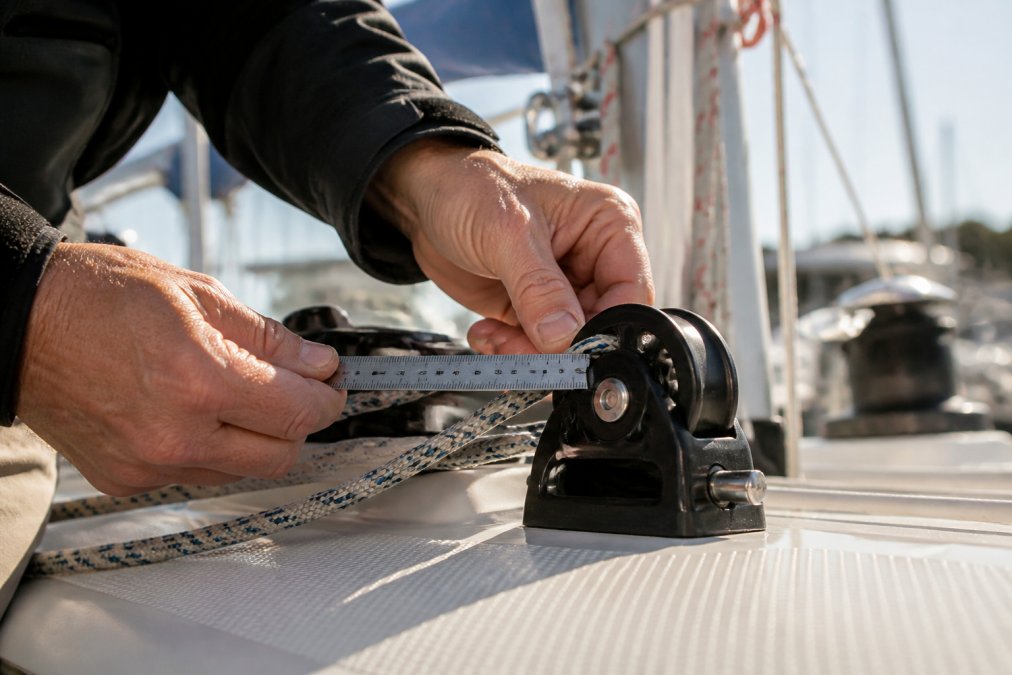
The sheave diameter directly determines which line sizes the block can accommodate. A 22mm sheave accepts line up to 1/4 inch; a 29mm sheave handles up to 5/16 inch; a 45mm sheave accommodates up to 1/2 inch. Match your line diameter to the block's rated capacity, and never force oversized line through an undersized sheave.
Safe Working Load Calculations
Safe working load (SWL) is the maximum tension a block can sustain safely under normal use. To determine whether a block is adequately sized, estimate the maximum tension your line will experience, then select a block with SWL at least 2 times that tension. This safety factor accounts for shock loads and dynamic forces that exceed steady-state calculations.
For mainsheet applications on a 35-foot cruising sailboat, steady-state mainsheet tension might reach 400 pounds in 15-knot wind. However, shock loads from sudden gusts can spike tension to 600+ pounds. A block rated for 800 pounds SWL would be marginal; the Harken 75mm Carbo Air Block [2660] at 1,213 pounds SWL provides comfortable safety.
Load Distribution Across Multiple Blocks
When using multiple blocks in a tackle system, load distributes across all sheaves. A four-part tackle system divides load by four, allowing use of smaller, lighter blocks than a single-sheave application would require.
| Application | Typical Load (lbs) | Recommended SWL | Suitable Harken Block |
|---|---|---|---|
| Control lines (dinghies) | 50-150 | 300+ | 22mm Micro or 29mm Carbo Air |
| Genoa leads (25-35 ft boats) | 200-400 | 800+ | 57mm Carbo Air |
| Mainsheet (30-40 ft boats) | 400-600 | 1,200+ | 75mm Carbo Air or 45mm Element |
| Travelers (40+ ft boats) | 600-1,000 | 1,500+ | 45mm Triple Element |
| Spinnaker handling | 100-300 | 600+ | 29mm or 40mm Carbo Air |
Best Marine Hardware for Saltwater: Maintenance and Refurbishment
Harken blocks are engineered for saltwater environments, but they require regular maintenance to perform optimally and last 20+ years. Saltwater corrosion attacks exposed metal, composite materials degrade under UV exposure, and bearings accumulate salt deposits that increase friction.
The hardcoat-anodized aluminum sideplates on Element blocks resist corrosion better than painted finishes, but they benefit from regular freshwater rinsing. Carbo Air blocks with composite sideplates require less frequent cleaning but need inspection for UV damage or bearing wear.
Refurbishment becomes necessary when bearing friction increases noticeably, when the sheave develops flat spots or scoring, or when sideplates show deep corrosion pitting. Harken offers refurbishment kits for most block models, allowing you to replace worn bearings and sheaves without purchasing new blocks. This approach costs 40-60% less than buying replacement blocks.
How to Maintain Sailboat Blocks for Long Service Life
Proper maintenance extends block service life from 10 years to 20+ years and keeps your rigging system responsive and safe. The maintenance routine requires minimal time and inexpensive materials.
Monthly Freshwater Rinse
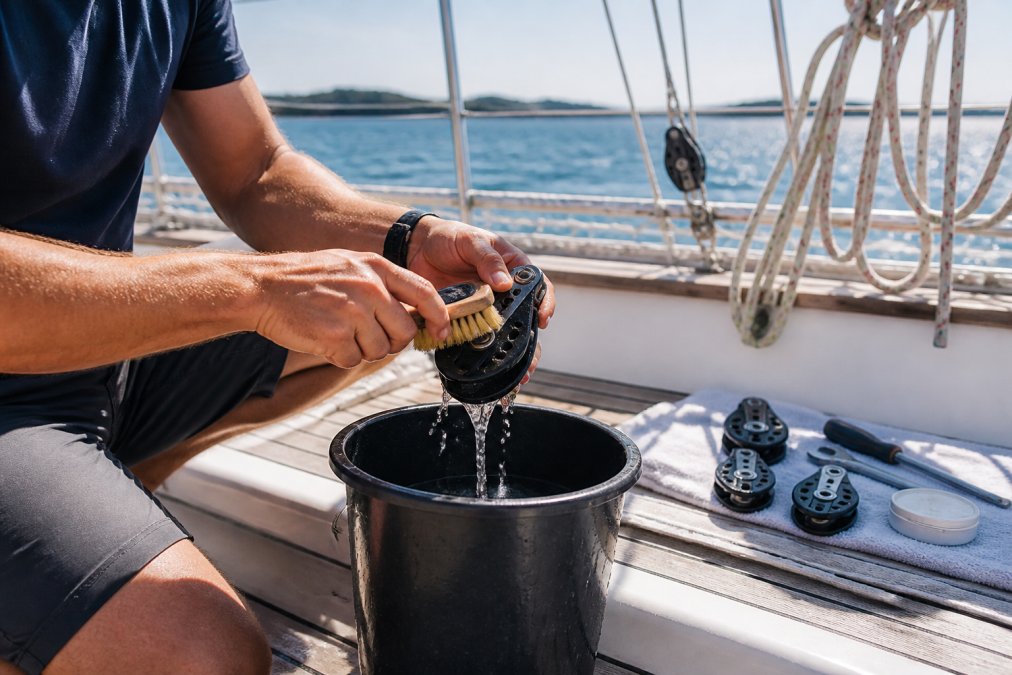
Rinse all blocks with fresh water at least monthly during sailing season. Use a soft brush to remove salt deposits from sideplates and bearing surfaces. Pay special attention to the area where the sheave meets the sideplate, where salt crystals accumulate and increase friction.
Seasonal Deep Cleaning
Before storing your boat for winter or after extended saltwater sailing, perform a deep clean. Remove blocks from the boat if possible, soak them in fresh water for 30 minutes, scrub with a soft brush, and dry thoroughly.
Annual Bearing Inspection
Once per year, spin each sheave by hand and listen for grinding sounds or feel for resistance. A healthy bearing spins freely with minimal friction and produces no noise. If you feel grinding, the bearing should be replaced. Harken bearing replacement kits cost $10-30 per block and take 15 minutes to install.
Replacement Indicators
Replace a block when: the sheave develops flat spots or visible scoring; the bearing produces grinding sounds that don't improve after cleaning; the sideplate shows deep corrosion pitting that compromises structural integrity; or the swivel head becomes stiff and won't rotate freely.
For blocks that fail prematurely or show manufacturing defects, Charleston Yachting processes warranty claims and can ship replacement blocks same-day, minimizing downtime during your sailing season.
Choosing the right harken sailing blocks for your boat requires understanding load capacity, sheave diameter compatibility, and the performance characteristics of each block family. Charleston Yachting stocks the full range of Harken blocks from micro blocks for dinghies through heavy-duty Element blocks for cruising boats, with same-day shipping on most models. Whether you're upgrading your rigging system, replacing worn hardware, or building a new boat, our curated inventory and expert guidance ensure you get the exact blocks your vessel needs. Shop all Harken sailing blocks at Charleston Yachting and experience the difference that premium hardware makes in your sailing performance.
Frequently Asked Questions
How do I choose the right size Harken block for my boat?
Block size depends on your line diameter and load requirements. Micro blocks (22mm) fit dinghies and light control lines; Carbo Air blocks (29-75mm) work for cruising and racing mainsails and headsails; Element blocks (45mm) handle higher loads on larger vessels. Match the sheave diameter to your line diameter, then verify the safe working load exceeds your dynamic load by 50%. Charleston Yachting's product specs list maximum working load and line diameter for each model.
What is the difference between ball bearing and composite bearing Harken blocks?
Ball bearing blocks reduce friction more effectively under constant motion, making them ideal for high-performance racing where every efficiency gain matters. Composite bearing blocks, like those in Harken's Carbo Air and Element lines, cost less, resist corrosion better in saltwater, and require less maintenance. Both deliver excellent performance; choose composite for cruising and saltwater durability, ball bearings for competitive racing.
How often should I replace my sailboat blocks?
Blocks last 5-10 years with proper maintenance and typical cruising use. Replace them sooner if you notice cracked sideplates, seized sheaves, or visible corrosion that doesn't clean off. Inspect blocks annually, especially after winter storage or saltwater exposure. Racing blocks under heavy load may need replacement every 2-3 seasons. Charleston Yachting stocks replacement sheaves and complete blocks for quick refurbishment.
Are Harken blocks compatible with all rigging systems?
Harken blocks work with standard shackles and beckets across most rigging systems, but compatibility depends on shackle pin size and attachment point. The Harken 45mm Element block uses a 6mm pin and fits 12mm line; the 29mm Carbo Air uses a 4-5mm pin for 8mm line. Always verify your existing shackles and attachment points match the block's specifications before ordering. Charleston Yachting's product pages list all dimensions.
What is the benefit of swivel head blocks versus fixed blocks?
Swivel head blocks rotate freely, reducing twisting stress on your rigging and allowing the line to move smoothly as the block angle changes during sail trim. Fixed blocks are simpler and slightly cheaper but can create binding if the line angle shifts. For mainsail and headsail handling, swivel blocks improve performance and reduce wear on both block and line. Most Harken blocks available through Charleston Yachting feature swivel heads.
This article was written using GrandRanker