

Is Professional Marine Gear Necessary? A 2026 Guide

Table of Contents
- Professional vs. Recreational Marine Gear: What Actually Changes
- The Cost of Gear Failure: When Recreational Gear Is Not Enough
- Essential Boat Safety Equipment Checklist for Every Voyage
- Best Foul Weather Gear for Sailing: Layering for the Open Water
- Marine Electronics Return Policy Explained: Protecting Your Investment
- How to Choose Gear Based on Your Sailing Profile
- Sustainability and Repairability: Buying Gear That Lasts
- Conclusion: Matching Gear to Risk
- Frequently Asked Questions
Last Updated: September 8, 2026
Professional vs. Recreational Marine Gear: What Actually Changes
The question of whether professional marine gear is necessary comes down to one variable: the distance between you and the nearest safe harbor. For a day sail inside a protected bay, recreational equipment performs adequately. For coastal cruising or offshore passages, the margin for error shrinks, and the gear you carry becomes part of your survival plan.
Professional marine gear is designed and tested to marine safety standards that recreational products do not always meet. The difference shows up in materials, construction tolerances, and certification. A recreational PFD keeps a conscious adult afloat in calm water. A professional-grade inflatable vest from a brand like Mustang Survival adds automatic inflation, higher buoyancy ratings, and a USCG-approved Type V designation for demanding conditions.
![Mustang HIT Inflatable Work Vest - Orange - Automatic/Manual [MD318802-2-0-202]](https://cdn.shopify.com/s/files/1/0842/4914/9751/files/93323XL.jpg?v=1775847515)
The right choice depends on your sailing profile, not your budget. Below, we break down where professional gear earns its cost and where it is simply overkill.
The Cost of Gear Failure: When Recreational Gear Is Not Enough
Most gear failures do not happen during the first season. They surface after years of saltwater exposure, UV degradation, and repeated stress on seams and hardware. A recreational winch handle that fails during a race costs you time. A harness tether that fails during a man-overboard situation costs you a life.
But to understand whether professional gear is necessary, you need to look at real-world failure points and calculate the return on investment, not just in dollars, but in safety margins.
Case Study: The Harness Tether That Wasn't Certified
In 2015, a sailor on a coastal passage in the Pacific Northwest was clipped to the jackline when a wave washed him over the rail. His recreational harness tether, a model not certified to any recognized standard, snapped at the stitching near the clip. He was wearing a PFD, but without a tether attached, he drifted away from the boat (uscg.mil). The crew recovered him after 12 minutes in 52°F water, but the incident report noted the tether failure was the primary cause of the near-drowning.
A professional-grade tether, such as those meeting the ISO 12401 standard or the newer Offshore Special Regulation (OSR) requirements, is tested to withstand a fall overboard with a dynamic load of several thousand pounds. The stitching is bar-tacked, the webbing is UV-stabilized, and the hardware is corrosion-resistant. The difference is not cosmetic; it is engineered for the exact scenario that killed the recreational tether.
The Cost-Benefit Math: Professional vs. Recreational
Let's put numbers on it. A recreational inflatable PFD with a manual inflation mechanism costs around $80-$150. A professional-grade automatic inflatable PFD, such as the Mustang Survival HIT Inflatable PFD, costs $250-$400. The professional version includes:
- Hydrostatic inflation that triggers automatically upon submersion, even if you are unconscious
- A higher buoyancy rating (typically 33.7 lbs vs. 22.5 lbs for recreational)
- A USCG Type V approval with a higher performance standard
- A serviceable inflation cylinder that can be replaced after deployment
Over a 10-year lifespan, the recreational PFD will need to be replaced at least twice (because the cartridge expires and the fabric degrades), costing $160-$300. The professional PFD, with annual inspections and cartridge replacements (about $20 per year), costs $250-$400 plus $200 in service parts, totaling $450-$600. The professional option is more expensive upfront, but it provides a measurable safety advantage: automatic inflation that works even if you are incapacitated.
The Hidden Cost of 'Good Enough'
Recreational gear is often designed to meet the minimum USCG requirements, but those requirements are not a proxy for safety in demanding conditions. For example, a recreational visual distress signal (a handheld flare) has a shelf life of 42 months. After that, the pyrotechnic composition degrades, and the flare may not ignite or may burn inconsistently. A professional-grade signal, such as an electronic SOS strobe light, has a battery life of 8+ hours and is visible for up to 3 nautical miles. It costs more upfront, but it does not expire and can be tested without burning.
The same logic applies to EPIRBs. A recreational boater might rely on a cell phone and a VHF radio within a few nautical miles of shore. Once you pass the range of shore-based rescue coordination, a registered 406 MHz EPIRB explained by the US Coast Guard becomes your primary link to the Cospas-Sarsat satellite system. A 406 MHz EPIRB costs $300-$500 and has a battery life of 5-10 years. The cost of a rescue operation, if you are found at all, is incalculable.
The Psychological Cost of Gear Failure
Beyond the physical risk, there is a psychological dimension. When you know your gear is certified to a higher standard, you sail with confidence. When you are unsure whether your tether will hold or your PFD will inflate, you hesitate. Hesitation in a man-overboard situation costs seconds, and seconds are what determine survival. Professional gear is not just about materials; it is about reducing the cognitive load of worry so you can focus on seamanship.
The Verdict
The cost-benefit analysis of professional versus recreational gear favors the higher tier the moment you leave sheltered waters. The price difference is often less than the cost of a single tow or a night in a marina. The safety difference is the gap between a tether that holds and one that snaps. When you are 20 miles offshore, that gap is the only thing between you and a mayday call.
Essential Boat Safety Equipment Checklist for Every Voyage
A basic safety inventory is not optional, regardless of vessel size. The US Coast Guard minimum safety equipment requirements mandate specific items based on vessel length, but compliance and preparedness are different standards.
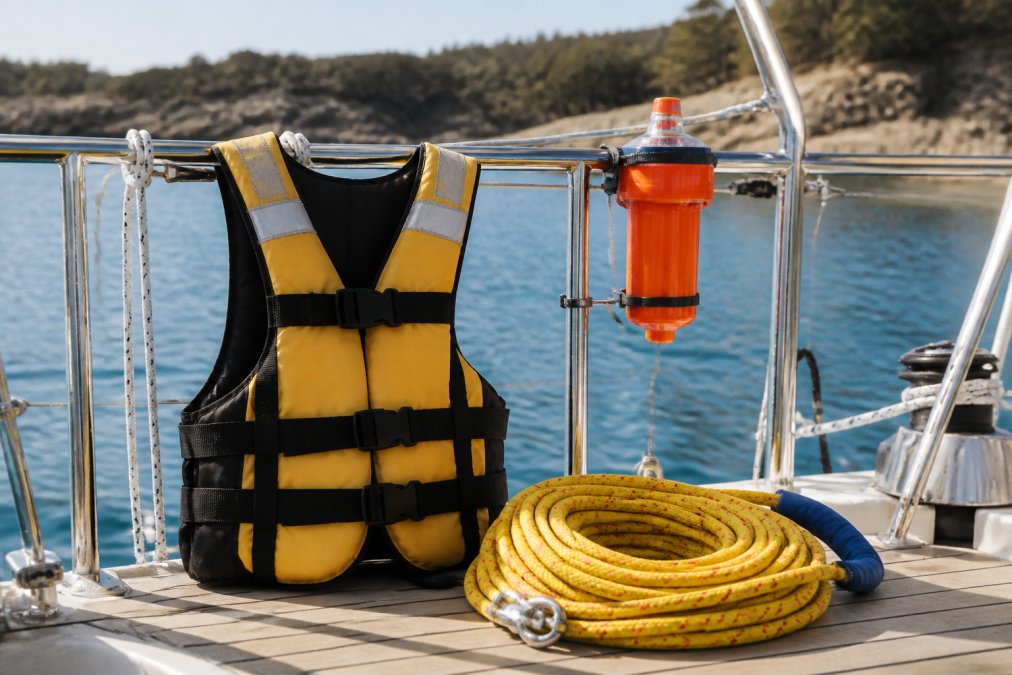
Work through this checklist before every departure:
- USCG-approved PFDs for every person on board, sized correctly and within reach
- A registered EPIRB or PLB for any voyage beyond VHF range
- Visual distress signals with unexpired dates
- A marine VHF radio, not a consumer walkie-talkie
- A throwable flotation device within arm's reach of the helm
- A first aid kit stocked for the trip duration and crew size
- Navigation lights tested before dark
- A secondary means of propulsion and anchoring
For coastal cruising and offshore sailing, add a ditch bag with a handheld VHF, signaling mirror, water, and a personal locator beacon. The ACR ResQLink AIS PLB-450 transmits your GPS position on both satellite and AIS frequencies, alerting nearby vessels as well as rescue authorities.
![ACR GlobalFix V5 Cat 2 GPS AIS EPIRB w/Return Link Service Mobile App [2852]](https://cdn.shopify.com/s/files/1/0842/4914/9751/files/94451XL.jpg?v=1775847754)
Best Foul Weather Gear for Sailing: Layering for the Open Water
Foul weather gear is the most personal piece of safety equipment you will buy, because it determines whether you stay dry, warm, and alert. The layering system mirrors what mountaineers use: a moisture-wicking base layer, an insulating mid layer, and a waterproof, breathable outer shell.
The outer shell matters most. Look for a waterproof rating measured in millimeters and sealed seams. A common mistake is buying a jacket with a high waterproof rating but inadequate seam sealing, which lets water through the stitching within an hour of heavy spray. Breathability matters equally, because trapped sweat causes hypothermia prevention to fail from the inside out.
Professional-grade foul weather gear uses technical apparel fabrics with durable water repellent treatments and abrasion resistance built for constant saltwater exposure. Recreational jackets often sacrifice these properties for lighter weight and lower cost.
Marine Electronics Return Policy Explained: Protecting Your Investment
A marine electronics return policy explained properly starts with understanding that navigation equipment is not a consumer gadget. A chartplotter integrates with radar, AIS, autopilot, and instrument displays, and compatibility issues surface during installation, not at the checkout counter.
The practical concern for most boat owners is integration. A 15-year-old Garmin chartplotter that still works may not communicate with modern NMEA 2000 sensors or support current chart formats. Upgrading electronics is rarely about the display failing; it is about the network around it becoming obsolete.
When you purchase from a specialized retailer rather than a big-box store, you are paying for expertise. Charleston Yachting curates inventory from brands like Garmin and B&G specifically because their products interoperate across a common network standard. Same-day shipping matters when a part fails on a Friday before a weekend passage, and a knowledgeable technician who can confirm compatibility before you order matters more.
How to Choose Gear Based on Your Sailing Profile
Match your gear investment to your actual risk exposure, not your aspirations. A realistic self-assessment prevents both overspending and dangerous under-equipping. But the decision is not just about distance from harbor, it is about the conditions you can encounter, the crew's experience, and the redundancy you need.
Step 1: Define Your Voyage Type
The US Coast Guard classifies voyages by distance from shore, but the sailing community often uses three tiers: inshore, coastal, and offshore. Each tier has different gear requirements.
| Sailing Profile | Typical Distance from Harbor | Gear Tier | Critical Items |
|---|---|---|---|
| Day sailing, protected waters | Under 5 nautical miles | Recreational | PFDs, VHF radio, visual signals |
| Coastal cruising | 5-50 nautical miles | Professional | EPIRB, foul weather gear, marine radio |
| Offshore sailing | Beyond 50 nautical miles | Professional, redundant | EPIRB with AIS, PLB, ditch bag, survival suits |
But distance alone is not the only variable. A 10-nautical-mile crossing of a shipping lane in fog is riskier than a 30-nautical-mile run along a lee shore in clear weather. Consider:
- Water temperature: In water below 60°F, hypothermia can incapacitate you within minutes. If you sail in cold water, a survival suit or dry suit is not optional, it is a life-safety device.
- Weather windows: A forecast of 15-knot winds can become 30-knot gusts in an afternoon. Professional foul weather gear with sealed seams and breathable membranes is not a luxury; it is what keeps you dry and alert when the weather turns.
- Crew experience: A solo sailor needs more redundancy than a crew of four. If you are alone, a PLB with AIS is critical because no one else can activate it for you.
Step 2: Assess Your Gear's Certification
Professional gear is often certified to standards that recreational gear is not. For example:
- PFDs: USCG-approved Type I, II, III, or V. Type V includes hybrid inflatables that require manual inflation, but professional models often have automatic inflation and higher buoyancy.
- Tethers and harnesses: Look for ISO 12401 or OSR compliance. These standards test for dynamic loading and corrosion resistance.
- EPIRBs: Must be registered with NOAA and transmit on 406 MHz. AIS-enabled EPIRBs also broadcast your position to nearby vessels.
- Foul weather gear: Look for a waterproof rating of at least 10,000 mm and fully taped seams. Professional brands like Mustang Survival and Grundéns use proprietary fabrics that are tested for 100+ hours of immersion.
Step 3: Use the 'Two-Is-One, One-Is-None' Rule
For any voyage beyond VHF range, redundancy is not optional. Carry:
- Two means of communication: a fixed VHF and a handheld VHF in a ditch bag
- Two means of signaling: an EPIRB and a PLB, or an EPIRB and visual signals
- Two means of navigation: a chartplotter and paper charts, or a chartplotter and a backup GPS
A common pattern among experienced cruisers is to keep a ditch bag packed and ready, containing a handheld VHF, a PLB, a signaling mirror, water, and a thermal blanket. The ACR ResQLink AIS PLB-450 transmits your GPS position on both satellite and AIS frequencies, alerting nearby vessels as well as rescue authorities.
Step 4: Consider the Total Cost of Ownership
Professional gear is more expensive upfront, but it often lasts longer and can be serviced. A $400 inflatable PFD with serviceable inflation cylinders and replaceable CO2 cartridges outlasts three $150 recreational vests that are discarded when the cartridge expires. The same logic applies to foul weather gear: a $500 jacket with a breathable membrane and taped seams will keep you dry for a decade, while a $150 jacket may delaminate after two seasons.
Step 5: Test Your Gear in Realistic Conditions
Before you rely on any gear, test it. Inflate your PFD in a pool. Set off a flare (if legal in your area) to see how it burns. Wear your foul weather gear in a heavy rain shower. A common mistake is buying gear that looks good in the store but fails in practice. For example, a hood that does not seal around your face while wearing a life jacket is a design failure. Water will run down your neck within minutes, and no amount of layering underneath will fix that.
The Risk-Assessment Framework
To make the decision concrete, ask yourself these questions:
- What is the furthest distance from a safe harbor I will be?
- What is the water temperature in the season I sail?
- How many people are on board, and what is their experience level?
- What is the weather forecast, and what is the worst-case scenario?
- If my primary gear fails, what is my backup?
If you cannot answer these questions with confidence, you are under-equipped. Professional gear is not about status; it is about closing the gap between your skills and the environment. For inshore navigation in protected bays, recreational gear with USCG approval meets the legal requirement. For coastal cruising where you cross shipping lanes or lose sight of land, step up to professional equipment. For offshore passages, carry redundant systems: two means of communication, two means of signaling, and a ditch bag that supports survival for 24 hours or more.
The Bottom Line
Your sailing profile is not static. A day sailor who plans a coastal passage next summer needs to upgrade gear before that trip. A coastal cruiser who sells the boat and buys a trailerable daysailer can step down. Reassess your gear every season, and before any voyage that pushes your limits. The cost of professional gear is a fraction of the cost of a rescue, or the cost of a life.
Sustainability and Repairability: Buying Gear That Lasts
Professional marine gear carries a higher upfront cost, but the total cost of ownership often favors it. A $400 inflatable PFD with serviceable inflation cylinders and replaceable CO2 cartridges outlasts three $150 recreational vests that are discarded when the cartridge expires.
Repairability is the overlooked dimension of sustainability on the water. Marine equipment lives in the harshest environment for any manufactured product: constant UV, salt spray, and mechanical stress. Gear that can be serviced, re-webbed, or re-sealed extends its useful life by years.
Look for brands that publish service intervals and sell replacement parts. Mustang Survival, for example, designs inflatable PFDs with user-serviceable components. The alternative is disposable gear that ends up in a landfill after a single failure or a routine service deadline.
Conclusion: Matching Gear to Risk
Professional marine gear is necessary when the consequences of failure exceed the cost of the equipment. That threshold varies by sailor, vessel, and voyage. A weekend sailor in a protected harbor does not need racing-grade hardware. A coastal cruiser planning a 40-nautical-mile passage absolutely does.
The throughline across every decision is risk assessment. Professional gear does not make you a better sailor, but it ensures your equipment is not the reason a routine situation becomes an emergency. Buy the best your sailing profile justifies, maintain it on schedule, and replace it when it shows wear.
Charleston Yachting stocks the full spectrum, from USCG-approved PFDs to AIS-enabled EPIRBs from ACR Electronics, with same-day shipping when you need a critical component before departure. Shop all marine safety gear and outfit your vessel for the conditions you actually plan to sail in.
Frequently Asked Questions
What is the difference between recreational and professional marine gear?
Professional marine gear is built to stricter standards for durability, water resistance, and performance under sustained use. Recreational gear typically meets minimum safety requirements for occasional coastal cruising. The difference shows in materials, stitching, waterproof ratings, and electronics reliability. For example, a professional inflatable PFD like the Mustang HIT Work Vest is designed for constant wear in harsh conditions, while a basic recreational vest suits calm inshore use. Choose professional gear when your safety depends on equipment performing flawlessly in rough conditions.
What are the must-haves on a boat for safety?
Federal law requires a USCG-approved life jacket (PFD) for each person onboard, a throwable flotation device, visual distress signals, a sound-producing device, and a fire extinguisher. Beyond those legal minimums, an essential boat safety equipment checklist includes a VHF marine radio, a GPS EPIRB or PLB for emergencies, navigation lights, and a first aid kit. For offshore sailing, add a tethering harness and jacklines so you stay connected to the boat in heavy seas.
Is expensive foul weather gear worth the investment?
Expensive foul weather gear is worth it if you sail in exposed coastal waters or offshore. Quality gear uses breathable waterproof membranes and sealed seams to keep you dry without trapping sweat. Hypothermia is a real risk when wet and cold, so reliable gear is a safety item, not a comfort luxury. For casual inshore sailing in mild weather, a less technical jacket may suffice. But for multi-day passages or cold-water sailing, the best foul weather gear for sailing is a layered system with a professional-grade outer shell.
How do I know if my current gear is professional grade?
Check the labels and certifications. USCG-approved flotation devices have approval numbers printed on the inside. Professional electronics list their waterproof rating (look for IPX7 or higher) and are built to NMEA standards for integration. Look at construction details: welded or taped seams, abrasion-resistant fabrics, and corrosion-proof hardware. If gear fails after limited saltwater exposure or shows signs of UV damage within a season, it is likely recreational grade. Professional gear is designed to handle years of harsh marine environment conditions.