

Marine Electronics Return Policy Explained

Table of Contents
- What the Marine Electronics Return Policy Covers
- Marine Electronics Restocking Fees: What to Expect
- How to Return Opened Marine Electronics
- Defective or Damaged Marine Electronics: What to Do First
- Marine Electronics Warranty vs Return Policy
- Exchanges, Store Credit, and Refund Processing
- Open-Box and Pre-Owned Marine Electronics Returns
- Conclusion
Last Updated: August 13, 2026
What the Marine Electronics Return Policy Covers
Marine electronics return policy guidelines protect both buyers and retailers when high-value equipment changes hands. This guide walks you through eligibility criteria, refund timelines, and conditions so there are no surprises if something doesn't work out.
Most retailers structure return policies around core variables: product condition, original packaging, proof of purchase, and return window. Knowing where your situation fits determines whether you get a full refund, store credit, or nothing at all.
Return Eligibility Criteria
A product is generally eligible for return when it meets all of the following conditions:
- Returned within the stated return window from the delivery date
- In original, undamaged condition with all included accessories
- Accompanied by proof of purchase (order confirmation, receipt, or packing slip)
- Not classified as a special order or non-returnable item
- Free of physical damage caused by the customer
Marine electronics, GPS units, sonar transducers, marine displays, chartplotters, and VHF radios, are evaluated more strictly than most consumer goods because they're designed for demanding environments. Units showing signs of water exposure, installation wear, or connector damage typically don't qualify for standard returns.
Serial number verification is standard practice. Retailers cross-reference the serial number against the original order to confirm the correct item is being returned.
Return Window and Timeframes
Most marine electronics retailers set a 30-day return window from the delivery date. Some extend this to 60 days for certain categories, while others shorten it for high-value electronics. The clock starts on delivery, not purchase, so factor in shipping time.
The return window doesn't reset after firmware updates or installation attempts. The delivery date is the fixed reference point.
Marine Electronics Restocking Fees: What to Expect
Marine electronics restocking fees are charges applied when a buyer returns an opened, partially used, or unoriginal-packaged product. These fees exist because opened electronics lose resale value the moment the box is unsealed.
For most marine electronics, restocking fees range from a percentage of the purchase price up to a significant portion, depending on condition and retailer policy. Check the specific policy before completing your purchase.
When Restocking Fees Apply
Restocking fees typically apply when:
- The item has been opened but is otherwise undamaged and complete
- The original packaging is damaged, missing inserts, or resealed poorly
- All accessories, mounting hardware, and documentation are not included
- The unit has been powered on and configured but not installed
Units returned in unopened condition with intact factory seals often qualify for full refunds with no restocking fee. If you're unsure about a purchase, don't open it until you're certain.
Some retailers waive restocking fees for defective merchandise or items damaged in transit.
Special Orders and Non-Refundable Items
Special order items, equipment ordered specifically for your vessel that isn't part of standard inventory, are almost universally non-refundable. This includes custom-configured marine displays, special-frequency transducers, and vessel-specific installation kits.
Before placing a special order, confirm in writing that you understand the non-refundable status.
How to Return Opened Marine Electronics
Returning opened marine electronics requires more preparation than returning standard items. Original packaging is part of the return condition, and marine electronics are fragile in ways that aren't always obvious.
Packaging Requirements for Sensitive Electronics
Marine electronics must be returned in their original packaging whenever possible. Original foam inserts are specifically designed for each unit's geometry. Substituting generic bubble wrap or loose packing materials significantly increases transit damage risk, which affects refund eligibility.
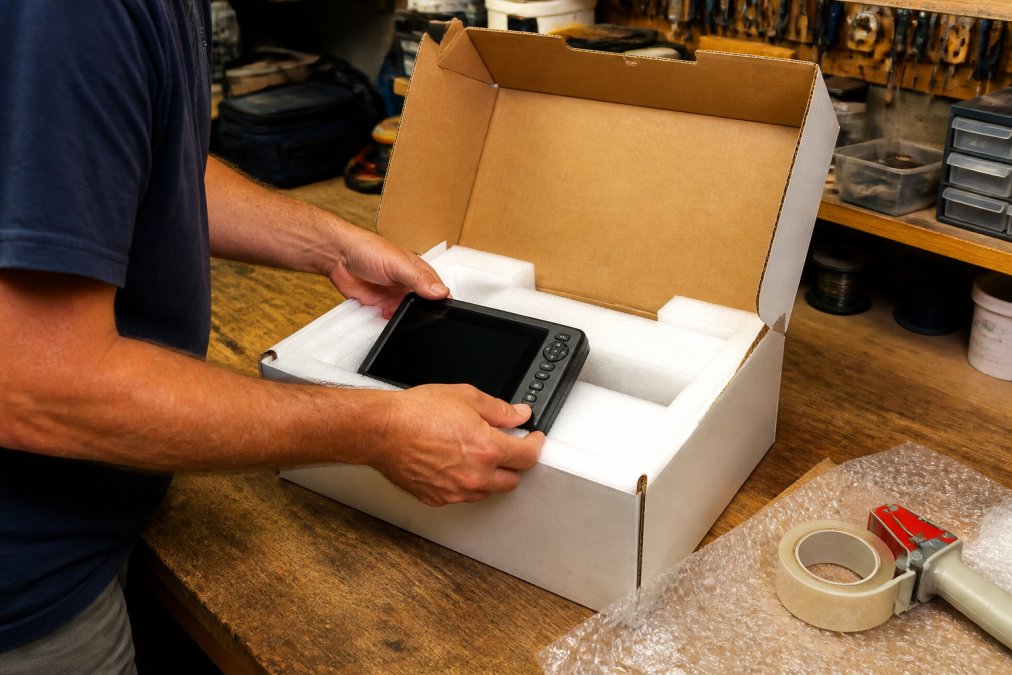
If the original box is damaged or missing, use a rigid outer carton at least 5 cm larger on each side than the unit, with a minimum of 5 cm of cushioning on all sides. Wrap connectors and display screens separately and coil cables loosely so they don't press against the unit during transit.
Include all original accessories: power cables, mounting brackets, transducer hardware, installation manuals, and registration cards. Missing accessories often result in partial refunds or return rejection.
Step-by-Step: Initiating a Return
Follow these steps to initiate a marine electronics return:
- Locate your proof of purchase. You'll need the order number and serial number of the unit.
- Contact customer support. Request a Return Merchandise Authorization (RMA) number via the retailer's preferred channel. Most retailers won't accept returns without a valid RMA number.
- Receive and record your RMA number. Write it on the outside of the return package.
- Package the unit per requirements above. Secure all components, include all accessories, and seal the box.
- Attach the return label. Use a trackable carrier and insure the package for its full value.
- Ship and track. Keep the tracking number until your refund or exchange is confirmed.
- Confirm receipt and refund processing. Most retailers notify you by email when the return is received and when the refund is processed.
Defective or Damaged Marine Electronics: What to Do First
The biggest mistake buyers make with defective marine electronics is initiating a return before troubleshooting. Many apparent defects are configuration issues, compatibility conflicts, or firmware problems, not hardware failures.
Troubleshooting Before You Return
Before contacting customer support, work through these steps:
- Check firmware. Outdated firmware causes a disproportionate share of reported "defects." Download the latest firmware from the manufacturer's website and apply it before drawing conclusions.
- Verify power connections. Marine electronics are sensitive to voltage fluctuations. Confirm the power supply meets the unit's specifications.
- Check compatibility. GPS units, sonar transducers, and marine displays from different product generations don't always communicate cleanly.
- Review the installation manual. Many units have specific mounting orientation requirements, especially transducers.
- Contact the manufacturer's technical support line. Garmin, B&G, and other major manufacturers maintain dedicated technical support teams that frequently resolve issues before they become returns.
According to the FTC's guidance on consumer returns and refunds, retailers are not legally required to accept returns unless the product is defective, so thorough troubleshooting documentation strengthens your case if a genuine defect is confirmed.
Damaged in Transit: Reporting and Next Steps
If your marine electronics arrive visibly damaged, follow this sequence:
- Photograph the outer packaging before opening it.
- Photograph the unit and contents immediately after opening.
- Do not attempt to power on or install a unit you believe was damaged in transit.
- Contact the retailer within 24-48 hours of delivery.
- Retain all original packaging materials. Carriers require inspection of the original box for claims.
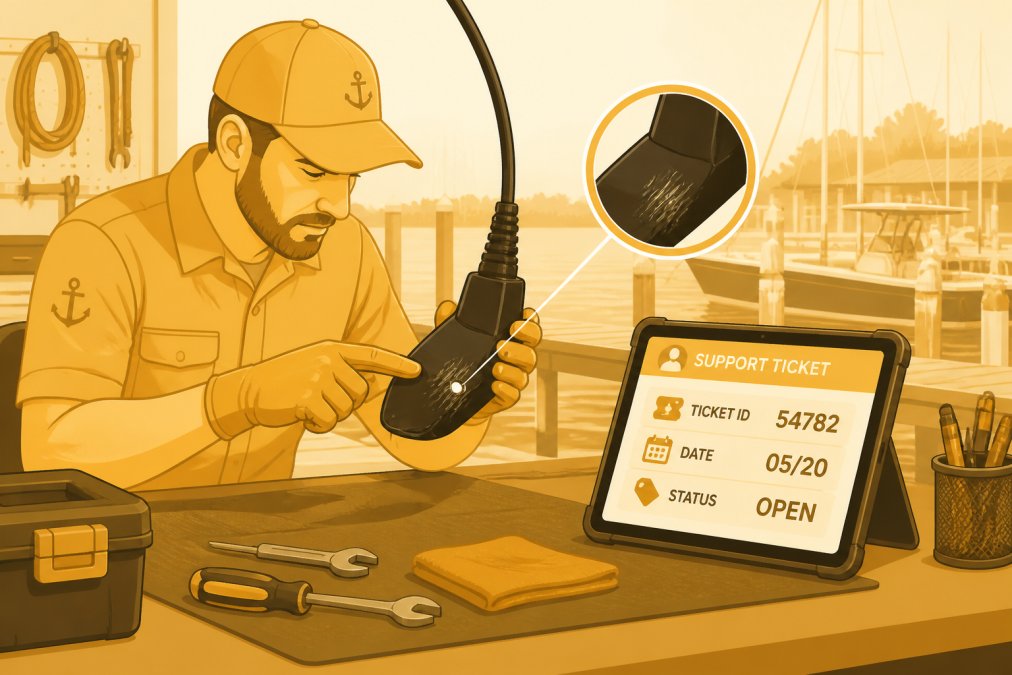
Transit damage claims reported promptly and thoroughly documented are resolved far more reliably than those reported days later. The retailer typically files the carrier claim on your behalf and either replaces the unit or issues a full refund.
Marine Electronics Warranty vs Return Policy
The difference between a warranty and a return policy is one of the most misunderstood aspects of buying marine electronics.
A return policy governs the window immediately after purchase. It allows you to return a product if you change your mind, if it doesn't fit your application, or if it arrives defective. Return policies are set by the retailer and typically expire within 30-60 days of delivery.
A manufacturer warranty covers defects in materials and workmanship for a defined period after purchase, often one to three years. Warranties are administered by the manufacturer and apply after the return window closes.
If your chartplotter fails six months after purchase, you're past the return window. Your remedy is the manufacturer warranty, which means contacting Garmin, B&G, or the manufacturer directly. As noted in NMEA's guidance on marine electronics standards and manufacturer responsibilities, marine electronics manufacturers are expected to maintain accessible warranty service processes.
What a warranty does NOT cover:
- Physical damage from improper installation
- Water intrusion beyond the unit's rated protection level
- Damage from voltage spikes or improper power connections
- Normal wear on connectors and display surfaces
What a return policy does NOT cover:
- Products returned after the return window
- Products with installation damage
- Special order items
- Opened items returned without original packaging
Exchanges, Store Credit, and Refund Processing
Refunds, exchanges, and store credit are not equivalent, and the option available depends on the reason for return and the retailer's policy.
Exchanges are typically the fastest resolution for defective merchandise. The retailer ships a replacement once the defective item is received and inspected. Some retailers offer advance exchanges for verified defects, though this usually requires a credit card hold.
Store credit is often offered as an alternative to cash refunds, particularly for opened items or returns outside the standard window. Store credit is typically issued immediately upon return receipt, while refunds to the original payment method take longer.
Refund processing time varies by retailer and payment type. Credit card refunds generally take 3-10 business days after the return is received and inspected. Debit card and ACH refunds can take slightly longer depending on the issuing bank.
The inspection process affects refund speed. Units returned in clean, complete condition with all accessories and original packaging clear inspection quickly.
| Return Type | Typical Processing Time | Notes |
|---|---|---|
| Exchange (defective) | 3-7 business days | Faster with advance exchange programs |
| Store credit | 1-3 business days after receipt | Issued upon inspection completion |
| Refund to original payment method | 5-10 business days after receipt | Varies by bank and payment type |
| Refund for transit damage | 7-14 business days | Carrier claim must be filed first |
As referenced in the Consumer Financial Protection Bureau's guidance on credit card refund timelines, card issuers are required to post refunds within a specific number of billing cycles, but retailer processing time is separate from the bank's posting time.
Open-Box and Pre-Owned Marine Electronics Returns
Open-box and pre-owned marine electronics operate under different return terms than new equipment.
Open-box units are new products returned by a previous buyer, inspected, and repackaged for resale. They're typically sold at a discount. Most retailers apply a shortened return window to open-box marine electronics, often 15 days rather than 30, and restocking fees may apply.
Pre-owned equipment carries the most restrictive terms. Many retailers sell pre-owned marine electronics on an "as-is" basis, meaning no returns are accepted once the sale is complete.
What to verify before buying open-box or pre-owned marine electronics:
- Confirm the exact return window in writing before purchasing
- Ask whether any manufacturer warranty remains and whether it transfers to a new owner
- Request the serial number and verify it against the manufacturer's warranty database
- Confirm that all original accessories, mounts, and cables are included
- Ask whether the unit has been tested post-return and what the inspection process covered
A common mistake is assuming that a lower price on an open-box unit includes the same return protection as a new unit. The discount reflects the reduced return protection.
Charleston Yachting's inventory of marine electronics from brands like Garmin, B&G, and Harken is curated for quality and backed by manufacturer warranties. For questions about specific product return terms before purchasing, reaching out to our customer support team before completing an order is always the right move.
For a broader understanding of consumer rights when purchasing electronics, the FTC's consumer information on warranties provides a clear breakdown of what retailers and manufacturers are required to disclose.
Returning marine electronics is rarely straightforward, especially when the equipment is complex, expensive, and installed in a demanding environment. The most common friction points, missed return windows, missing original packaging, confusion between warranty and return policy, and undocumented transit damage, are all avoidable with the right preparation. Charleston Yachting offers same-day shipping on a wide selection of premium marine electronics from Garmin, B&G, and Harken, and our team is available to help you confirm return terms, verify compatibility, and resolve any issues before and after your purchase. Shop All marine electronics at Charleston Yachting and buy with confidence.
Frequently Asked Questions
What items cannot be returned in marine electronics?
Special order items, custom-configured units, and products that have been installed or show signs of use beyond inspection are typically non-returnable. Software-activated products, firmware-updated devices, and items missing their original packaging or proof of purchase are also commonly excluded. Always confirm non-returnable categories with your retailer before placing an order, especially for GPS units, sonar transducers, and marine displays that require installation to test.
Do I have to pay for return shipping on marine electronics?
Return shipping responsibility depends on the reason for the return. If the product is defective or was damaged in transit, most retailers cover return shipping costs and provide a prepaid return label. If you are returning an item because you changed your mind or ordered the wrong model, you are generally responsible for shipping charges. Marine electronics are heavy and fragile, so shipping costs can be significant, confirm the policy before initiating a return.
What is a typical restocking fee for marine electronics?
Restocking fees on marine electronics typically range from 10% to 25% of the purchase price, though this varies by retailer and product category. Fees are most common on opened items returned in non-original condition, special order products, and high-value units like chartplotters and marine displays. Some retailers waive the restocking fee entirely if the item is returned unopened within the stated return window. Always check the specific fee structure before purchasing.
How does the manufacturer warranty affect return eligibility?
A manufacturer warranty and a retailer's return policy are separate protections. The return policy governs the window after purchase, typically 30 days, during which you can return or exchange the product through the retailer. The manufacturer warranty, offered by brands like Garmin and B&G, covers defects in materials or workmanship for a defined period after that. Once the return window closes, a defective product must go through the manufacturer warranty process, not a standard return.
This article was written using GrandRanker