

Best Marine Hardware for Saltwater: 2026 Guide

Table of Contents
- Why Material Choice Defines Marine Hardware Saltwater Performance
- 316 Stainless Steel Marine Hardware: The Gold Standard
- Bronze vs Stainless Steel Marine Hardware: Which Wins?
- Top Marine Hardware for Saltwater: Cleats, Fasteners, and Rigging
- How to Prevent Corrosion on Boat Hardware
- Best Marine Sealant for Hardware: Protecting Every Fastener
- Hardware Comparison Table: Stainless, Bronze, and Anodized Aluminum
- Conclusion
Last Updated: August 13, 2026
Choosing the best marine hardware for saltwater is one of the most consequential decisions a boat owner makes. At Charleston Yachting, we see the results every season: hardware showing early pitting, seized fasteners, and corroded deck fittings after a single winter. The material you bolt to your hull matters more than the brand name on the box.
This guide covers the alloys that hold up in chloride-rich environments, top products worth your money, and a practical corrosion prevention protocol for weekend sailors and full-time liveaboards.
Quick Picks:
- Best Overall Deck Hardware: Accon Marine 209 Style Pull-Up Cleats, 316 stainless steel, flush-mount, built for saltwater
- Best Fasteners: KD Fasteners 316 Stainless Steel Marine Fasteners, custom-made, high structural integrity
- Best Rigging Hardware: Seldén AISI316 Stainless Steel Rigging Screws, precision-machined for standing rigging
Why Material Choice Defines Marine Hardware Saltwater Performance
Marine hardware for saltwater fails for one reason: the wrong alloy. A fastener that performs flawlessly in freshwater will corrode within weeks in open ocean.
How Chloride-Rich Water Attacks Metal
Corrosion resistance is determined by alloy composition, surface treatment, and the electrochemical environment. Chloride ions in seawater penetrate the passive oxide layer that protects most metals, initiating pitting: small, deep cavities that compromise structural integrity far faster than surface rust.
Three failure modes dominate saltwater hardware:
- Pitting corrosion: localized attack where chlorides breach the passive layer, creating deep craters that weaken metal from within
- Crevice corrosion: accelerated attack in tight spaces (under bolt heads, inside threads, beneath fittings) where oxygen is depleted and chloride concentration builds
- Galvanic corrosion: electrochemical reaction when dissimilar metals contact each other in seawater, causing the less noble metal to corrode rapidly
The ASTM International salt spray testing standards provide the industry benchmark for evaluating hardware corrosion resistance.
Above vs. Below the Waterline: Different Demands
Hardware above the waterline faces UV radiation, salt spray, and intermittent wetting. Hardware below the waterline is in constant contact with seawater and faces continuous galvanic and crevice corrosion pressure.
Above the waterline, 316 stainless steel performs excellently for cleats, hinges, rail fittings, and deck hardware. Below the waterline, silicon bronze is often better, it resists the continuous immersion that causes crevice corrosion in stainless steel. Anodized aluminum works above the waterline for non-structural components but is inappropriate for load-bearing applications in saltwater.
316 Stainless Steel Marine Hardware: The Gold Standard
316 stainless steel is the most widely specified alloy for above-waterline boat fittings.
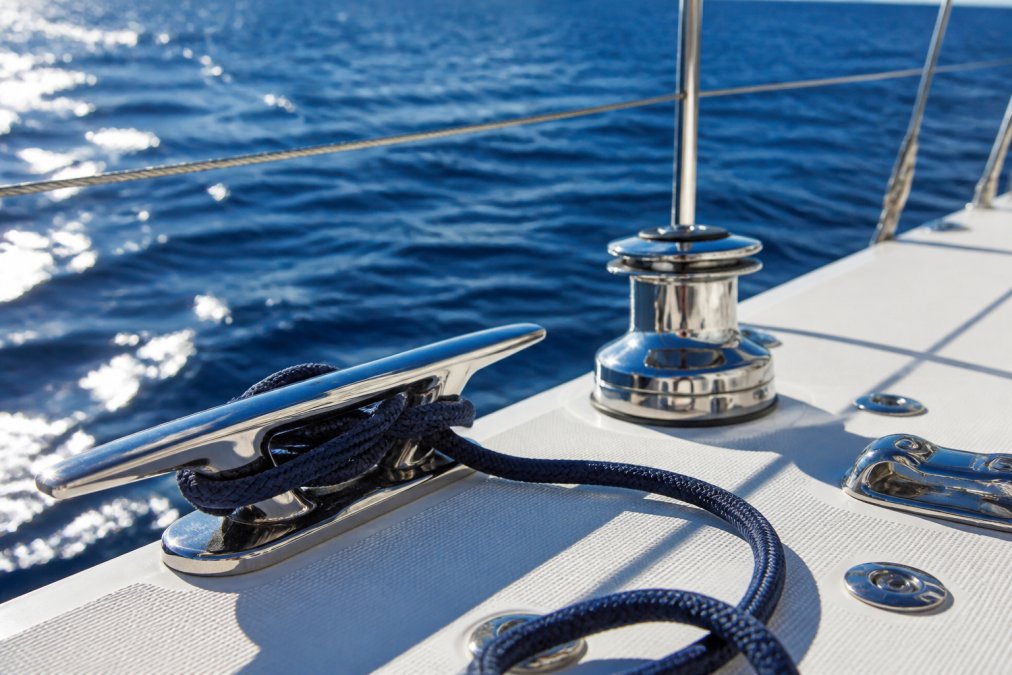
Boat owners who spec 304 hardware to save money typically replace it within two to three seasons.
The Role of Molybdenum in Corrosion Resistance
Molybdenum is the alloying element that separates marine-grade 316 from standard 304 stainless steel. 316 contains roughly 2-3% molybdenum by composition, which stabilizes the passive oxide layer on the steel surface, making it significantly harder for chloride ions to initiate pitting.
When shopping for hardware, look for explicit "316" or "AISI316" designation. "Stainless steel" alone tells you nothing useful, 304 is also stainless steel and will pit in saltwater given enough time and exposure.
Passivation and Salt Spray Testing
Passivation is the chemical process that builds and strengthens the protective oxide layer on stainless steel. Properly passivated 316 hardware has a denser, more uniform oxide film that resists chloride penetration. Many manufacturers passivate finished hardware in a nitric or citric acid bath before shipping.
Salt spray testing (per ASTM B117) is the standard method for validating corrosion resistance. Hardware rated for 1,000+ hours of salt spray testing provides a reliable baseline for saltwater performance.
Bronze vs Stainless Steel Marine Hardware: Which Wins?
Neither bronze nor stainless steel wins outright, they serve different applications.
Silicon bronze is an alloy of copper, silicon, and small amounts of other elements. It is genuinely immune to the crevice corrosion that can affect stainless steel in oxygen-depleted environments. For through-hull fittings, underwater fasteners, and keel bolts, silicon bronze remains the preferred material among traditional boatbuilders and professional riggers.
316 stainless steel offers higher tensile strength than silicon bronze, making it the better choice for load-bearing deck hardware, rigging components, and structural fasteners. It also machines to tighter tolerances, which matters for precision rigging hardware.
Never mix bronze and stainless steel hardware in direct contact without an isolating barrier. Direct contact in seawater will accelerate corrosion of the less noble component. As documented in NACE International's corrosion engineering guidelines, galvanic coupling is one of the leading causes of premature hardware failure in marine environments.
| Material | Best For | Tensile Strength | Crevice Corrosion Risk | Cost |
|---|---|---|---|---|
| 316 Stainless Steel | Deck hardware, rigging, fasteners | High | Moderate (above waterline) | Moderate |
| Silicon Bronze | Below waterline, through-hulls, keel bolts | Moderate | Very low | Moderate-high |
| Anodized Aluminum | Non-structural above-waterline fittings | Moderate | Low | Lower |
| Brass | Interior fittings only, avoid in saltwater | Moderate | High | Low |
Brass deserves a specific warning: it is not a marine metal. Its zinc content makes it highly susceptible to dezincification in saltwater, where zinc leaches out and leaves a porous, weakened copper structure.
Top Marine Hardware for Saltwater: Cleats, Fasteners, and Rigging
The following products represent the best marine hardware for saltwater across three critical categories. All are specified in 316 or AISI316 stainless steel.
1. Accon Marine 209 Style Pull-Up Cleats
The Accon Marine 209 Style Pull-Up Cleat is the right answer for boaters who want a clean deck without sacrificing mooring security. These flush-mount, retractable cleats are machined from marine-grade 316 stainless steel and retract seamlessly into the deck surface when not in use.
The flush-mount design eliminates the snag hazard that traditional fixed cleats create. When deployed, the cleat provides sturdy anchorage with the same load-bearing capacity as a conventional fixed cleat. The design also eliminates the need for a separate waterproofing cup, simplifying installation and reducing potential leak points.
Best for: Boaters prioritizing a clean, uncluttered deck aesthetic without compromising mooring reliability.
What works:
- 316 stainless steel construction with excellent corrosion resistance
- Retractable design reduces tripping hazards and snagged lines
- No waterproofing cup required, simplifying installation
What to know:
- Higher initial cost than traditional fixed cleats
- Requires deck cutouts for installation with proper backing plates
2. KD Fasteners 316 Stainless Steel Marine Fasteners
Fasteners are where most boats develop their first corrosion problems. KD Fasteners addresses this directly with a full range of marine fasteners manufactured from 316 stainless steel, covering hex nuts, bolts, socket caps, screws, lock nuts, rivets, and washers. Custom-made options are available for non-standard applications, which matters for older vessels where original hardware dimensions don't match current standard sizing.
The structural integrity of 316 stainless fasteners under load is a key advantage over lower-grade alternatives. For any hardware experiencing dynamic loading, cleats under mooring load, hinges under door slam forces, rail fittings under crew weight, the higher tensile strength of 316 stainless is essential.
Best for: Boat builders, marine equipment manufacturers, and individuals needing high-performance, corrosion-resistant fasteners for critical marine applications.
What works:
- Outstanding corrosion resistance in saltwater
- Broad product range covers virtually every fastener type
- Custom manufacturing available for non-standard requirements
What to know:
- Pricing requires a quote, not available at fixed retail price
- Custom orders may carry minimum quantity requirements
3. Seldén AISI316 Stainless Steel Rigging Screws
Rigging hardware is where material specification becomes a safety issue. A corroded turnbuckle or rigging screw that fails under load can bring down a mast. Seldén's rigging screws are machined from saltwater-resistant AISI316 stainless steel and cover wire diameters from 3 to 19 mm.
The design prioritizes correct articulation at rigging connection points, which matters because rigging hardware that cannot articulate freely creates stress concentrations that accelerate fatigue failure.
Best for: Sailors and riggers needing corrosion-resistant components for precise rig tuning and long-term standing rigging safety.
What works:
- AISI316 stainless steel machined to precision tolerances
- Full size range for wire diameters 3-19 mm
- Designed for correct articulation, reducing stress concentration at connection points
What to know:
- Pricing available through distributors, not direct retail
- Professional installation strongly recommended for standing rigging applications
How to Prevent Corrosion on Boat Hardware
Corrosion prevention on boat hardware is not a single action but a maintenance protocol that runs year-round. A consistent routine dramatically extends hardware life, even in aggressive saltwater environments.
Galvanic Corrosion Prevention
Galvanic corrosion is the electrochemical reaction that occurs when two dissimilar metals are in electrical contact in the presence of an electrolyte, seawater. The more noble metal is protected; the less noble metal corrodes preferentially.
Practical prevention steps:
- Use isolation bushings and washers between dissimilar metals. A nylon or PTFE washer between a stainless bolt and aluminum fitting breaks the electrical circuit and stops galvanic action.
- Specify compatible metals throughout a hardware run. Mixing 316 stainless hardware with bronze fittings on the same through-bolt creates a galvanic couple.
- Install sacrificial zinc anodes at appropriate locations on the hull and drive system. Zinc sits low on the galvanic series and corrodes preferentially, protecting more noble metals nearby. Replace anodes when they are 50% consumed.
- Inspect electrical bonding systems annually. Stray current corrosion from a faulty bonding system or shore power connection can destroy hardware far faster than natural galvanic action. As noted in ABYC electrical standards for recreational boats, proper bonding and grounding is one of the most important corrosion prevention measures on any vessel with shore power.
Installation Best Practices
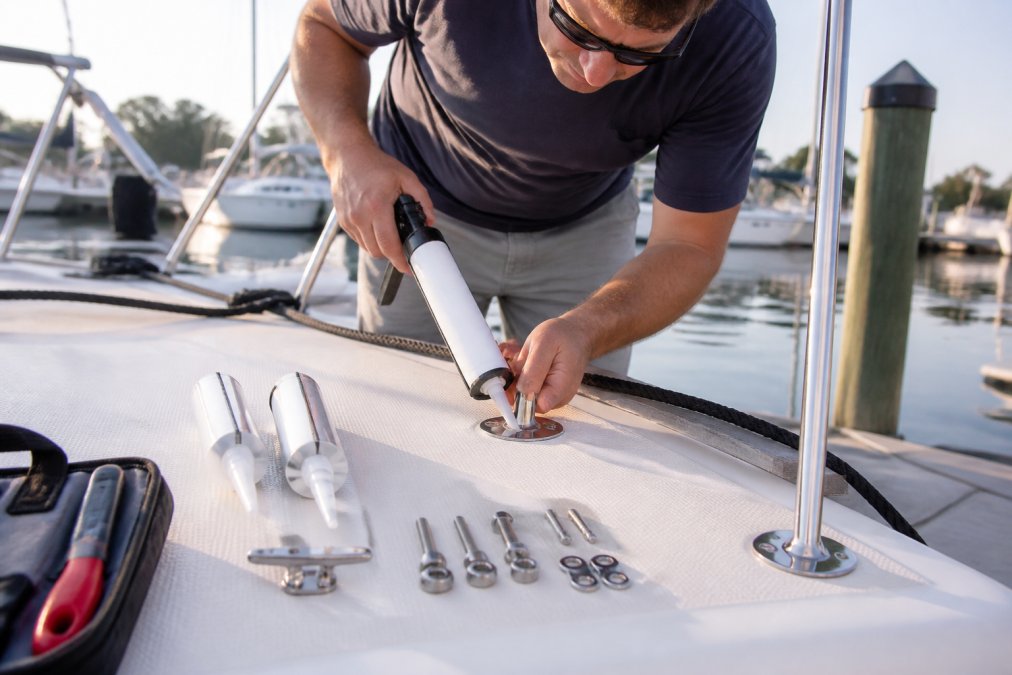
Most corrosion problems start at installation. Crevice corrosion initiates in gaps created by poor fitting, inadequate bedding, and fasteners driven into unsealed holes.
Installation checklist:
- Drill fastener holes slightly oversize and fill with marine sealant before driving fasteners
- Bed all deck hardware in compatible marine sealant; do not rely on hardware contact alone
- Use backing plates for all load-bearing hardware to distribute stress and prevent deck delamination
- Apply anti-seize compound to fastener threads to prevent galling and seizure
- Torque fasteners to specification; overtightening crushes sealant and creates crevice gaps
- Inspect all new installations after the first season and re-torque if necessary
Best Marine Sealant for Hardware: Protecting Every Fastener
The best marine sealant for hardware bonds to both the hardware material and substrate, remains flexible under thermal cycling, and resists UV degradation and saltwater immersion.
Polysulfide sealants (such as 3M 101) are the traditional choice for deck hardware bedding. They cure to a flexible, paintable compound and can be removed without damaging fiberglass. They bond well to wood, fiberglass, and metal.
Polyurethane sealants (such as 3M 4200 and 5200) provide stronger adhesion and better UV resistance. 5200 forms a near-permanent bond, excellent for through-hull fittings and below-waterline applications, but problematic for hardware you may need to remove for maintenance.
Silicone sealants are not appropriate for structural bedding in marine hardware applications. Silicone does not bond reliably to most marine substrates under dynamic load and saltwater immersion.
Hardware Comparison Table: Stainless, Bronze, and Anodized Aluminum
| Hardware Type | Primary Material | Waterline Position | Corrosion Risk | Load-Bearing | Maintenance Frequency |
|---|---|---|---|---|---|
| Deck cleats and fittings | 316 stainless steel | Above | Low | High | Annual inspection |
| Through-hull fittings | Silicon bronze | Below | Very low | High | Biannual inspection |
| Standing rigging hardware | AISI316 stainless | Above | Low | Critical | Annual + post-event |
| Structural fasteners | 316 stainless steel | Above/Below | Low-Moderate | High | Annual inspection |
| Non-structural trim | Anodized aluminum | Above | Low | Low | Seasonal rinse |
| Interior hardware | Brass (acceptable) | Interior only | High if exposed | Moderate | As needed |
| Keel bolts | Silicon bronze or 316 SS | Below | Low-Moderate | Critical | Biannual survey |
This table reflects standard material specifications used by professional riggers and marine surveyors. Hardware that deviates from these specifications, particularly below the waterline, should be flagged in any pre-purchase survey.
The real-world stress test for any marine hardware specification is simple: look at the hardware on boats that have been sailing the same waters for ten or more seasons. The fittings that are still clean, tight, and free of pitting tell you what the local environment actually demands.
For the full range of 316 stainless deck hardware, rigging components, and marine fasteners, Charleston Yachting carries products from industry-leading brands with same-day shipping on in-stock items. Whether you are refitting a cruiser or sourcing hardware for a racing campaign, the inventory is curated for performance in saltwater conditions.
Keeping a saltwater-capable vessel properly fitted requires hardware that matches the environment, not hardware that merely looks the part at the chandlery. The difference between a well-specified boat and an expensive maintenance problem often comes down to alloy selection, sealant choice, and installation discipline. Charleston Yachting stocks premium 316 stainless rigging, deck hardware, and fasteners from trusted manufacturers, with same-day shipping to get you back on the water without delay. Shop All marine hardware at Charleston Yachting and fit your vessel to last.
Frequently Asked Questions
What is the difference between 304 and 316 stainless steel for marine use?
316 stainless steel contains roughly 2-3% molybdenum, which 304 lacks. That addition dramatically improves resistance to pitting and crevice corrosion in chloride-rich saltwater environments. For any hardware exposed to spray, spray-back, or immersion, 316 is the correct choice. 304 can survive in freshwater or very occasional coastal exposure, but it will show rust staining and surface pitting on a saltwater vessel within a single season. Always specify 316 for deck hardware, fasteners, and rigging fittings.
How do you prevent saltwater corrosion on boat hardware?
Start with the right alloy: 316 stainless steel or silicon bronze for all fittings. Bed every fastener in a compatible marine sealant to block moisture from reaching the metal-to-deck interface. Use isolation washers or nylon bushings wherever dissimilar metals contact each other to stop galvanic corrosion. Rinse all hardware with fresh water after every saltwater outing, and inspect annually for pitting or white-powder oxidation on any anodized aluminum parts. Replace zinc anodes on schedule.
What type of screws are best for marine use in saltwater?
316 stainless steel fasteners are the standard for above-waterline saltwater applications because of their corrosion resistance and tensile strength. Silicon bronze screws are preferred for below-the-waterline work and for any application where galvanic compatibility with bronze fittings matters. Avoid 304 stainless and zinc-plated or cadmium-plated fasteners entirely in saltwater environments. For load-bearing structural connections, confirm the fastener grade meets the load-bearing capacity required for the specific application.
How often should you replace marine hardware in saltwater?
Quality 316 stainless steel and silicon bronze hardware does not have a fixed replacement schedule, but it does require annual inspection. Look for pitting deeper than surface discoloration, crevice corrosion at contact points, cracked or brittle sealant, and any signs of electrolysis around dissimilar-metal joints. Standing rigging components, including rigging screws and swage fittings, are commonly replaced every 10 years or after any significant shock load, regardless of visible condition, because internal fatigue is not always visible.
Is silicon bronze or stainless steel better for below-the-waterline hardware?
Silicon bronze is the traditional and widely trusted choice for below-the-waterline hardware because it resists galvanic corrosion in the mixed-metal environment of a boat hull and does not suffer the crevice corrosion that can affect stainless steel when oxygen levels are low. Stainless steel can develop serious pitting below the waterline where it is starved of oxygen. For through-hulls, seacocks, and keel bolts, silicon bronze or specialized marine-grade alloys are the safer long-term choice over stainless.
This article was written using GrandRanker