

Best Fish Finder Transducers for Small Boats

Quick Summary
For a small boat, the best fish finder transducer is one that matches your display's pin count, frequency range and your mounting position, with a transom mount being the simplest choice for most owners. The transducer decides what your screen can show, so choose it before the display.
- Pick the transducer before the screen, since it determines what the display can show.
- Check transom angle before buying, such as the Garmin GT20-TM supporting 0 to 70 degrees.
- The Garmin GT20-TM is the best value at $99.99 with a 4-pin design and 20-foot cable.
- Kayak and inflatable anglers should favor trolling motor or clamp mounts over permanent installs.
- Confirm pin count, frequency and connector against your display before ordering any unit.
Table of Contents
Why the Transducer Matters More Than the Screen on a Small Boat
Most anglers spend their budget on a bright, big-screen display and treat the transducer as an afterthought. On a small boat, that priority is backwards. The transducer is the component that sends and receives the sonar signal, so it decides what the screen can ever show you. A top-tier display paired with a weak or poorly placed transducer produces blurry arches and unreliable depth readings. Pick the transducer first, then match the screen to it. For a broader look at how the whole system fits together, see marine electronics for small fishing boats.
Fish finder transducer choice matters even more when the hull is small, because mounting position, deadrise angle and power draw all shift the picture you get. Anglers often upgrade their displays while keeping an old transducer that was never suited to the way they fish, and the result is usually disappointment, not better fish.
Watch out: A transducer that runs fine at a dock can lose its bottom lock once you add speed. Check the speed rating before you buy.
Transom Mount Transducer for Small Boat Setups
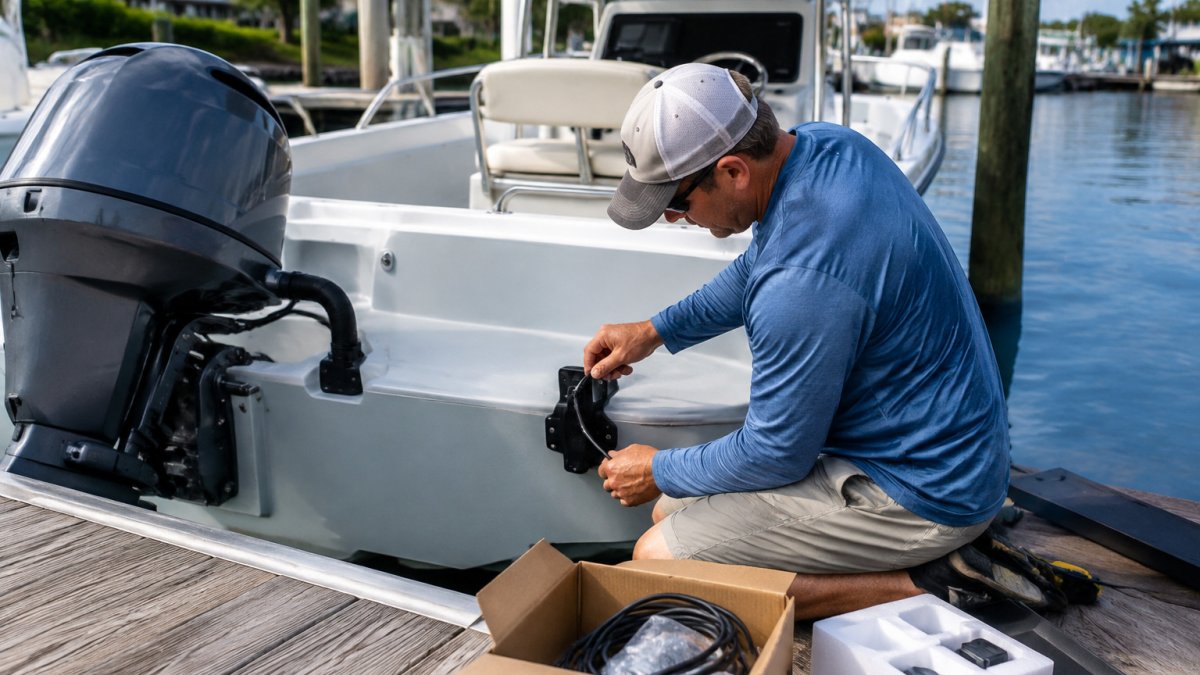
A transom mount transducer is the most common choice for small boats because it attaches to the stern and needs no through-hull installation. For most small-boat owners, a transom mount is the simplest route to working sonar.
Best value: Garmin GT20-TM at $99.99. It is a compact 4-pin unit with a built-in temperature sensor and a 20-foot cable.
Best all-in-one: Garmin GT56UHD-TM at $599.99. It combines CHIRP traditional sonar with SideVü and ClearVü scanning sonar across 455 kHz, 800 kHz and 1 MHz, and includes both transom and trolling motor mounts.
Best for mid-range CHIRP: Garmin GT15M-TM at $229.99. Its 8-pin design offers mid-band CHIRP traditional sonar with a 600 W power rating.
Before buying, confirm your transom angle. Garmin's GT20-TM lists support for 0 to 70 degree transom angles.
Side Scan Transducer for Small Boats: What You Gain and What It Costs
Side imaging shows structure and fish on either side of the boat, not just directly below. For small boats that cover a lot of shoreline, that wider view can save time searching.
The trade-off is cost and power. The Garmin GT52HW-TM, priced at $349.99, adds SideVü and CHIRP DownVü scanning sonar and is ideal for mounting to a trolling motor due to its compact size. The Lowrance Eagle TripleShot, at $181.00, brings side and down imaging into one transom-mounted unit.
Best for: anglers who fish structure along shorelines and want wide coverage. Skip if: you mainly fish open water in a straight line and only need depth and bottom readings.
Portable Fish Finder Transducer Options for Kayaks and Inflatables
Kayak and inflatable anglers need a transducer they can move between boats, so portability matters as much as performance. A transducer that clamps or mounts to a trolling motor usually works better than a permanent transom install in these setups.
The Garmin GT52HW-TM is compact and ideal for mounting to a trolling motor. The Lowrance Eagle SplitShot, at $96.00 with a 20-foot cable, is the lowest-cost option in this list. For a trolling motor mounted option, see the Lowrance trolling motor mount transducer.
Mounting on Kayaks, Inflatables and Tiny Boats
Mounting matters more than the transducer model on a very small hull. A transducer that sits at the wrong depth or angle will show air bubbles and wake interference instead of bottom returns. On a kayak, a trolling motor mount or a dedicated clamp keeps the element in clean water. A practical tie-down option for kayak anglers is the Ritchie kayak tie-down mount. Keep the transducer well below the surface and away from the motor's prop wash. Where a transom or through-hull is not an option, a trolling motor mount is the practical route.
Fish Finder Transducer Compatibility: Connectors, Pins and Frequencies
Compatibility problems usually come from the pin count and the frequency range, not the brand name. Before you buy, check three things against your display:
- Pin count: Garmin's GT20-TM uses 4 pins, the GT15M-TM uses 8 pins, and the GT52HW-TM and GT56UHD-TM use 12 pins.
- Frequency: The Furuno TM275LHW covers a high frequency range of 150-250 kHz, and the Airmar B75HW covers 150 to 250 kHz with a 30 degree beamwidth.
- Connector: The Furuno TM275LHW-12P is listed for use with the TZT3 display. Confirm the connector before ordering.
The Airmar B75HW requires a mix-and-match cable for the appropriate fish finder. Check your display's cable requirements before ordering.
Performance at Slow Trolling Speeds and Power Trade-Offs
Many transducers hold a clean bottom lock at cruising speed but lose it when trolling slowly. Look for transducers that list a speed rating or a fast-response temperature sensor, since both help keep readings stable at low speeds. The Airmar B75HW lists a fast-response water-temperature sensor and a 600 W rating. Higher-power units draw more current, so check that your battery and charging system can support the transducer you choose.
Buying Your Transducer From Charleston Yachting: Next Steps
Choosing the right transducer comes down to matching pin count, frequency, mounting position and power to your boat. Start with your display, then pick the mount that fits your hull. If you are ready to upgrade, browse the full transducer range at Charleston Yachting and order with same-day shipping.
Frequently Asked Questions
What is the best fish finder for small boats?
The right fish finder depends on how you fish, but the transducer usually decides how much you see. For many small boats, a transom-mount transducer paired with a CHIRP-capable display is a common setup. Garmin GT15M-TM ($229.99) and Lowrance Eagle TripleShot ($181.00) are practical starting points, with the GT52HW-TM ($349.99) adding side and down imaging for anglers who need more coverage around the hull. Match the transducer's frequency and power to your typical depth before buying the display.
Is side scan or live sonar better for a small boat?
Side scan imaging shows structure and fish to either side of the boat, which helps when you are covering shoreline, reefs or brush piles. Live or down imaging focuses on what is directly below. Side scan generally costs more and needs a transducer that supports it, such as the Garmin GT56UHD-TM ($599.99) or the Lowrance Eagle TripleShot ($181.00). If you mostly fish open water over a single depth, down imaging alone may be enough and cost less.
How do I know if a transducer is compatible with my fish finder?
Check three things before buying: the number of pins on the transducer connector, the frequencies it supports, and whether the display can read the transducer's imaging type. Garmin's 8-pin GT15M-TM and 12-pin GT52HW-TM are not interchangeable with a 4-pin GT20-TM, and the Airmar B75HW requires a mix-and-match cable for the display it connects to. Confirm the pin count and cable needs against your existing unit's manual before ordering.
Where should I mount a transducer on a small boat?
Transom-mount transducers sit on the back of the boat and are the most common choice for small boats with a flat transom. Trolling-motor mounts such as the GT52HW-TM work well on boats that cannot take a transom mount, and thru-hull units like the Airmar B75HW require a hull opening and a deadrise-matched tilt. Mount the transducer where it stays in clean water, away from the engine's turbulence, and keep the face parallel to the water surface.
Transom-mount transducer prices
