

7 Marine Grade Stainless Steel Blocks and Pulleys Compared

Last Updated: November 22, 2026
Quick Summary
For saltwater, choose marine grade stainless steel blocks in 316 stainless, since its molybdenum content resists chloride attack better than 304. Match the sheave count to your purchase needs, confirm the block's working load sits well above your expected load, and rinse every block with fresh water after each sail.
- 316 stainless steel resists saltwater corrosion better than 304 because of its molybdenum content.
- A double sheave can build a 4:1 purchase system and a triple sheave a 6:1 system.
- The Wichard single block lists a 610 lb working load and an 880 lb breaking load.
- Aim for a sheave diameter at least six to eight times your rope diameter.
- Rinse every block with fresh water after each saltwater sail to extend service life.
Table of Contents
- How to Choose Marine Grade Stainless Steel Blocks and Pulleys
- 304 vs. 316 Stainless Steel for Saltwater
- The 316 Stainless Steel Pulley Block Range at Charleston Yachting
- Single, Double, and Triple Sheave Configurations
- Sailboat Block Load Rating: Working Load, Breaking Load, and Safety Factors
- Stainless Steel Pulley for Wire Rope: When Blocks and Rope Type Must Match
- Maintenance, Inspection, and Service Life in Saltwater
- Shop Marine Grade Stainless Steel Blocks at Charleston Yachting
- Frequently Asked Questions
How to Choose Marine Grade Stainless Steel Blocks and Pulleys
Choosing marine grade stainless steel blocks and pulleys comes down to four decisions: the stainless grade, the sheave count, the load rating, and how the block attaches to your boat. Get those four right and the hardware will outlast the line running through it.
Most buyers fixate on price first. That is backwards. A block that fails in a blow costs far more than the few dollars saved at checkout.
Below, we walk through each decision in order, with real specifications from the blocks we stock. The goal is simple: you leave knowing exactly which block belongs on your deck.
304 vs. 316 Stainless Steel for Saltwater
The short answer: for saltwater, choose 316 stainless steel. The longer answer explains why 304 keeps showing up in marine catalogs anyway.
The difference is molybdenum. Molybdenum is what gives 316 stainless steel better resistance to saltwater corrosion than 304, which is why marine-grade hardware usually specifies 316. Both grades resist rust.
| Feature | 304 Stainless Steel | 316 Stainless Steel |
|---|---|---|
| Molybdenum content | None | Present |
| Saltwater corrosion resistance | Moderate | High |
| Typical use | Freshwater, inland, budget fittings | Coastal and offshore hardware |
| Cost | Lower | Higher |
| Best for | Trailered dinghies, freshwater lakes | Saltwater mooring, offshore sailing |
Why 316 Stainless Steel Is the Saltwater Standard
316 stainless steel is the saltwater standard because its molybdenum content resists chloride attack, the mechanism behind pitting corrosion in salt spray. For boats kept in coastal waters, that resistance is the difference between hardware that lasts and hardware that stains and pits.
No stainless alloy enjoys sitting in salt water indefinitely. Salt crystals trap moisture against the surface and starve it of oxygen. A fresh-water rinse after every sail does more for block life than any grade upgrade. For a wider look at hardware built for salt exposure, see our guide to marine hardware for saltwater.
The 316 Stainless Steel Pulley Block Range at Charleston Yachting
Our 316 stainless steel pulley block range covers small-boat applications from stanchion leads to dinghy control lines. The Wichard Stainless Steel Single Block is a good example of 316L construction in this range.
It pairs 316L stainless steel cheeks with a composite sheave, measures 25mm across the sheave, and takes 8-10mm rope. Working load is listed at 610 lb, with a breaking load of 880 lb.
The rest of our 25mm range comes from SeaSure, using marine-grade stainless steel side plates and rivets with an arnite sheave. The sheaves are arnite (plastic), which is hard-wearing and light.
Single, Double, and Triple Sheave Configurations
Sheave count sets your mechanical advantage. A single sheave gives you a simple redirect. A double sheave can build a 4:1 purchase system. A triple sheave can build a 6:1 system, which is how you lift heavier loads without overloading the rope.
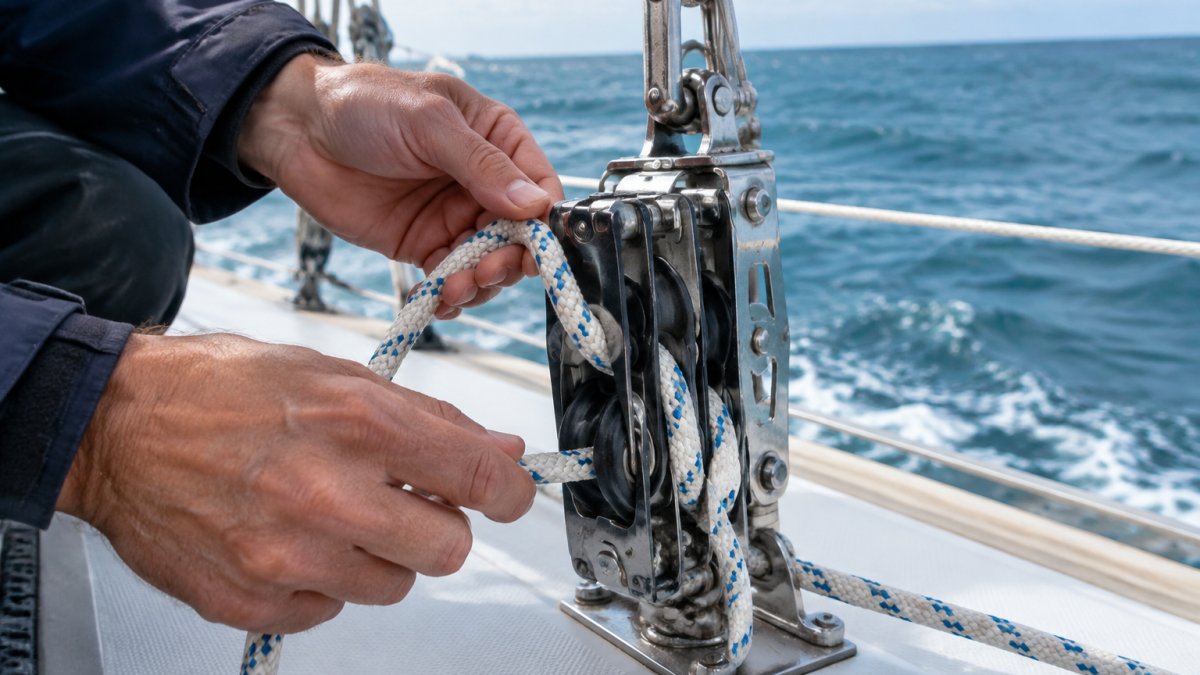
Here is how the SeaSure 25mm range breaks down:
| Block | Purchase System | Breaking Load | Price |
|---|---|---|---|
| Single Block w/Becket | Single | 500 kg | $34.72 |
| Double Block w/Shackle | 4:1 | 1000 kg | $46.96 |
| Treble Block w/Shackle | 6:1 | 1250 kg | $66.52 |
| Treble Block w/Center Becket | 6:1 | 1250 kg | $71.21 |
Breaking Load
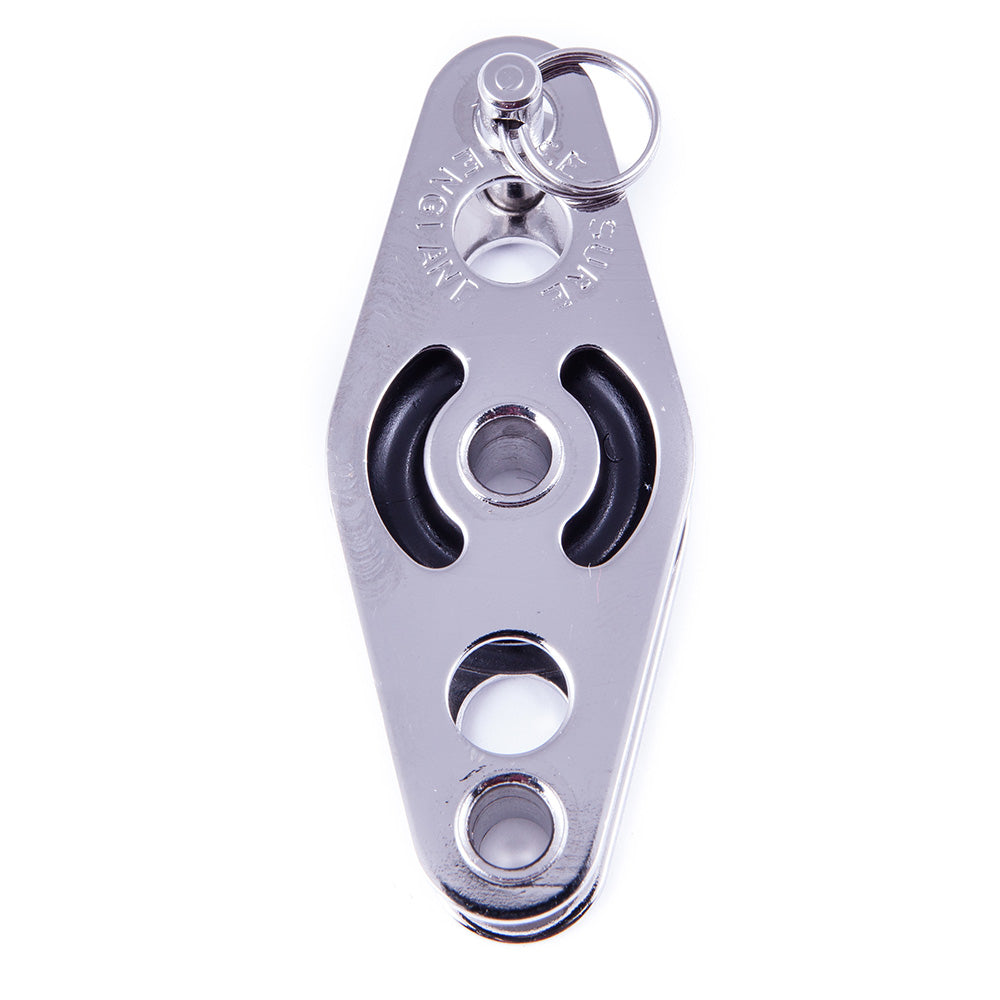
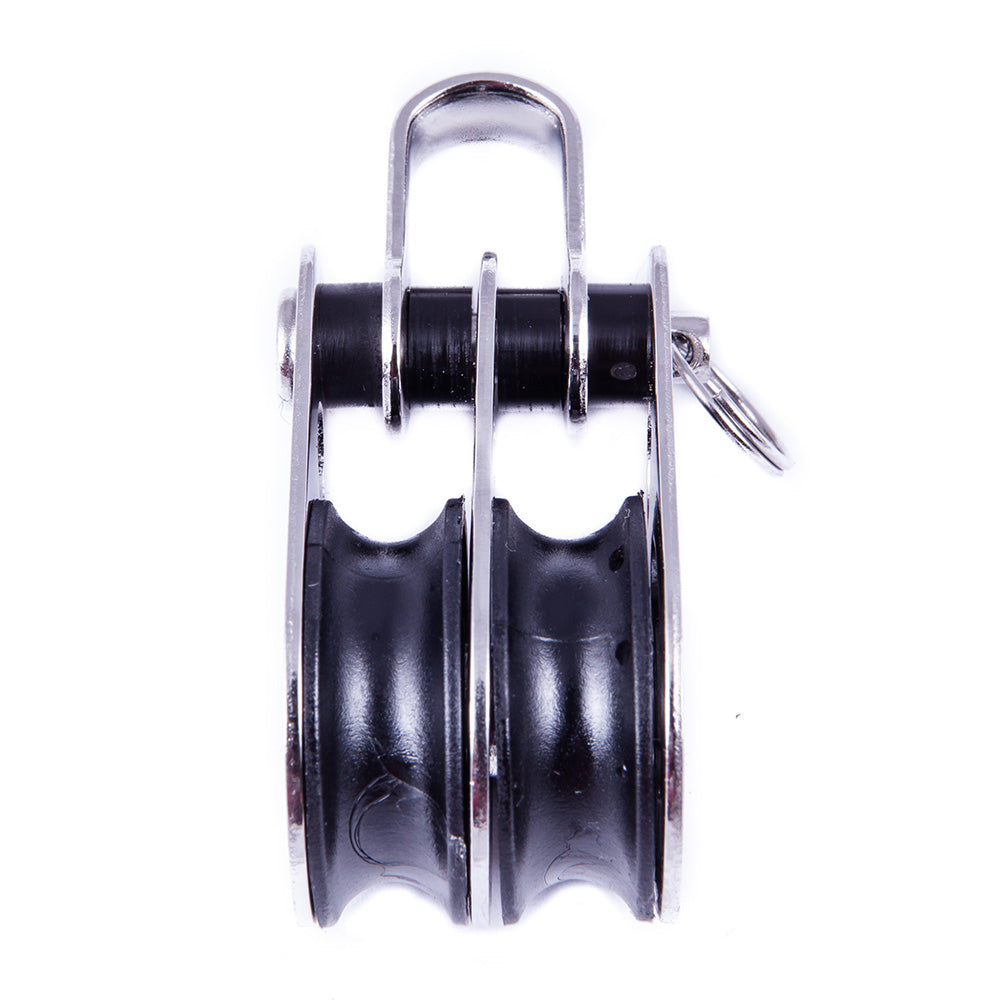
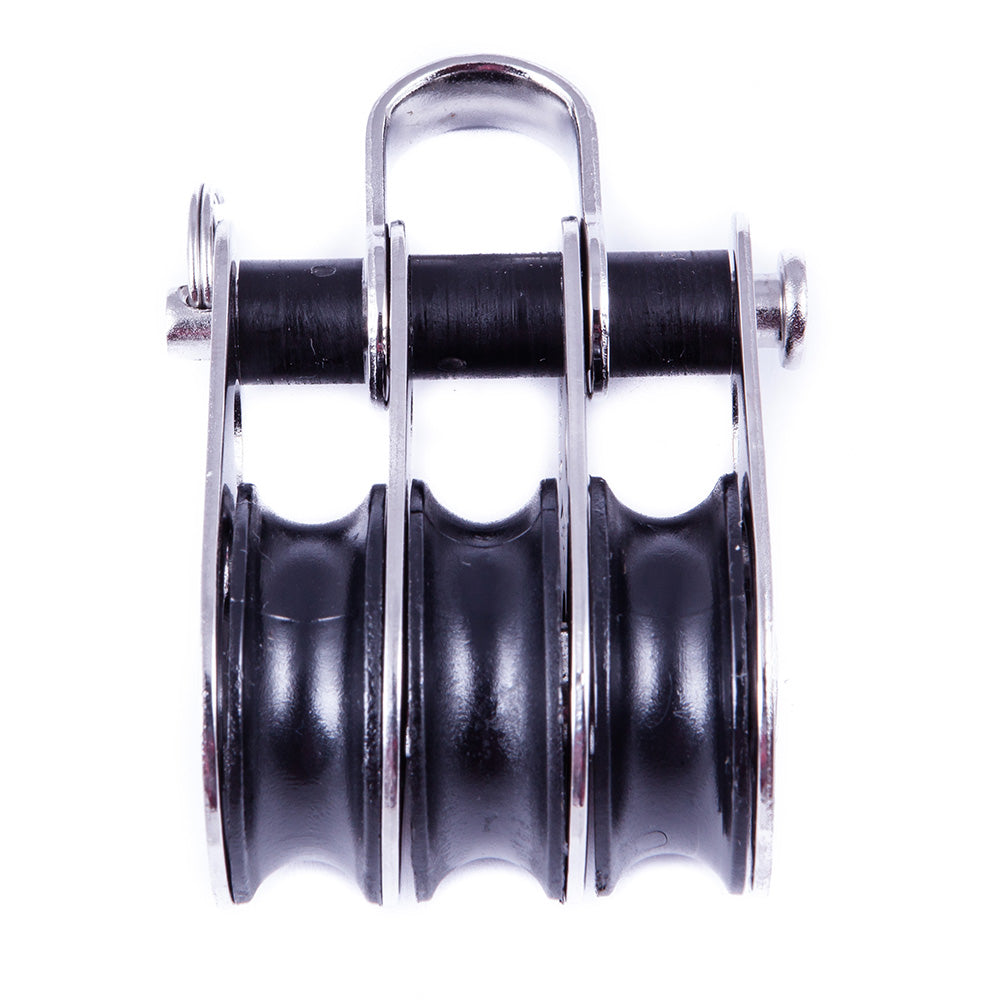
All four take 8mm maximum rope. The becket versions give you a tie-off point at the block itself. For a triple-sheave setup with a swivel head, the Ronstan Series 20 ball bearing block is worth a look, and the Series 30 orbit block suits heavier control lines.
How to Match Sheave Count to Rope Diameter and Task
Sheave count is not a free upgrade. Each added sheave increases purchase but also adds friction, weight, and cost, and it changes how much line you must tail. Use this decision order:
- Start with the line. Confirm the block's maximum rope diameter exceeds your line. The 25mm SeaSure range tops out at 8mm rope, so a 10mm control line needs a larger frame.
- Set the purchase you need. A single block redirects a line or gives a 2:1 purchase when paired with a becket. A double gives 4:1, a triple 6:1. Choose the lowest count that keeps your expected load under the working load.
- Pick the attachment. A shackle head pins to a pad eye or chainplate. A swivel eye lets the block align with the line under load. A becket gives a tie-off point for the dead end of the purchase.
- Check the sheave ratio. Aim for a sheave diameter at least six to eight times the rope diameter.
Single, Double, and Triple in Practice
A single block with a becket is the workhorse for dinghy vangs, cunninghams, and outhauls where a 2:1 or 3:1 purchase is enough. A double block shines in mainsheet systems and backstay adjusters where 4:1 is the target. A triple block is for heavier control loads: keelboat mainsheets, halyard tensioners, and applications where a 6:1 purchase lets one person tail and trim.
Watch out: stacking sheaves to chase a higher purchase without checking the working load can overload the frame even though each sheave is individually rated. The block's working load applies to the assembly, not to each sheave.
Sailboat Block Load Rating: Working Load, Breaking Load, and Safety Factors
Sailboat block load rating is the maximum load a block is designed to carry in normal use, and it is always lower than the breaking load.
Every block we sell lists both figures. The Wichard block, for instance, lists a 610 lb working load and an 880 lb breaking load.
For industrial applications, the working load limit is calculated as breaking load divided by five.
Two rules we give every customer:
- Size the block so your expected load sits well under the working load, not near the breaking load
- Match the block's breaking load to the line's breaking strength so neither is the weak link
A block rated far above your line wastes money. For a broader look at maintenance and service life, our guide to maintaining sailboat blocks and lines covers the inspection routine.
Stainless Steel Pulley for Wire Rope: When Blocks and Rope Type Must Match
A stainless steel pulley for wire rope is not the same block you run rope through. Wire rope needs a sheave sized to its diameter and a frame built for the load, and the sheave groove profile differs from a rope block's.
The supplier range we draw from includes 304 and 316 stainless-steel blocks for both rope and wire rope across swivel-eye, twin, surface-mount, seine, and snatch configurations, according to Stainless Steel Marine's block catalog. Matching the block to the line type is the whole game.
How Wire-Rope Sheaves Differ from Rope Sheaves
A rope sheave has a deep, rounded groove that cradles the line and spreads bend stress across the cover. A wire-rope sheave has a shallower groove with a flatter bottom and tighter tolerances, sized so the wire sits in the groove without pinching or flattening. The groove radius is typically matched to the wire diameter, and the sheave material is usually metal or a hardened composite because wire rope abrades a soft sheave quickly.
Three compatibility checks before you buy:
- Rope diameter: the block's maximum rope size must exceed your line diameter, never equal it
- Sheave diameter: aim for a sheave at least six to eight times your rope diameter to reduce bend fatigue; wire rope often calls for a larger ratio than synthetic rope because its strands work-harden and crack when bent too tightly
- Line material: wire rope needs a metal or hardened sheave; synthetic rope runs fine on composite or arnite sheaves
Wire-Rope Construction and Block Choice
A block rated well above the load but fitted with an undersized sheave will still fatigue the wire. Size the sheave first, then confirm the load rating clears your working load.
Watch out: a wire-rope block used with synthetic rope will let the line sink into the shallow groove and chafe against the sheave cheeks.
If your setup mixes rope and wire, keep separate blocks for each. For a broader look at matching blocks to line and load, see our guide to maintaining sailboat blocks and lines.
Maintenance, Inspection, and Service Life in Saltwater
Saltwater blocks fail from neglect more often than from load. A five-minute rinse and a seasonal inspection will carry most hardware well past a decade of service.
Our inspection routine, in order:
- Rinse every block with fresh water after each saltwater sail
- Spin the sheave by hand and listen for grinding or roughness
- Check the cheeks for pitting, staining, or white corrosion deposits
- Inspect rivets and shackle pins for looseness or elongation
- Look for flat spots or grooves worn into the sheave
- Replace any block with a stiff sheave or visible frame cracks
Watch out: a sheave that spins freely on the dock can seize under load. Test rotation with the line under tension, not slack, or you will miss a failing bearing.
Store blocks dry and off the boat during winter layup. Trapped moisture is what drives crevice corrosion around rivets, and that damage is invisible until the frame lets go.
Shop Marine Grade Stainless Steel Blocks at Charleston Yachting
The right block is the one that matches your grade, your line, and your load. Everything else is preference.
Charleston Yachting offers same-day shipping and carries premium rigging hardware alongside electronics from brands like Garmin, B&G, and Harken.
If you are unsure between two sheave counts, start with the load rating and work backward. The math rarely lies.
Ready to replace the hardware that has been quietly letting you down? Charleston Yachting offers same-day shipping on premium rigging and sailing hardware, a curated selection of blocks from trusted brands, and expert support to help you pick the right sheave count and stainless grade.
Frequently Asked Questions
Is 304 stainless steel good for saltwater?
For occasional splash exposure, 304 stainless steel holds up reasonably well. For blocks and pulleys that live on a boat and see regular saltwater, 316 or 316L is the better choice. The molybdenum in 316 stainless steel gives it better resistance to saltwater corrosion than 304, which is why marine-grade hardware usually specifies 316. If a block will stay mounted on deck through a full season, pay the small premium for 316 and skip the pitting that shows up on 304 after a few months of salt spray.
What load rating should a sailboat block have?
Start with the working load, not the breaking load. A block's working load is the number you rig to, and the breaking load should sit several times higher as a safety margin. For example, the Wichard 25mm single block lists a 610 lb working load against an 880 lb breaking load, while the SeaSure 25mm treble block carries a 1,250 kg breaking load. Size the block so your expected sheet or halyard tension stays well under the working load, and never rig to the breaking figure.
Can stainless steel pulleys be used with wire rope?
Yes, but the sheave and block must be rated for wire rope, which is stiffer and less forgiving than fiber line. A stainless steel pulley for wire rope needs a sheave sized to the wire diameter and side plates that keep the wire captured under load. The Wichard 25mm single block takes 8-10mm rope and the SeaSure 25mm blocks take up to 8mm rope, so match the block to your actual line diameter before ordering. Running wire on a block built for soft line wears both parts quickly.
How should stainless steel blocks and pulleys be maintained in saltwater?
Freshwater rinsing after every sail is the single best habit. Flush the sheave and shackle with fresh water, then let the block dry before stowing. Check the sheave for free rotation and look for salt crust or pitting around the rivets and cheeks each month. Replace any block with a seized sheave, visible cracks, or deep pitting rather than trying to free it up. A few minutes of rinsing per outing extends service life far more than any coating or lubricant.
