

Which Marine Instruments Do You Need for Offshore Sailing?

Quick Summary
The marine instruments that matter most offshore are navigation displays, wind, depth and speed sensors, a reliable compass, and an autopilot. Sensors feed every other device, so they should be chosen alongside the display. Build the set in tiers that match your passage length and budget.
- Start with a chartplotter or multi-function display for position, charts and routing.
- Wind, depth and speed sensors drive sail trim and hull protection, so buy them early.
- Keep a flush-mount or digital compass as a backup heading source.
- Size the autopilot to the boat's fully laden displacement, not its designed weight.
- Check total power draw against your battery bank before you buy.
Table of Contents
- What Marine Instruments Matter Most Offshore
- Chartplotters and Multi-Function Displays for Navigation
- Wind, Depth and Speed Instruments You Cannot Skip
- Compasses and Autopilot Steering for Long Passages
- Power, Redundancy and Installation Trade-Offs
- Building a B&G Sailboat Package on a Budget
- Planning Your Sailboat Electronics Package Order
- Frequently Asked Questions
What Marine Instruments Matter Most Offshore
Last Updated: November 16, 2026
Offshore sailing puts a boat far from help, which is why the marine instruments you carry matter more than almost any other gear. For a boat crossing open water, the core set is navigation, depth and speed readings, wind data, a reliable compass, and an autopilot to share the workload. Charleston Yachting stocks instruments from Garmin, B&G, and Raymarine, so you can build that core set from those brands.
Start with the instruments you rely on every hour of a passage. A dedicated wind sensor, a log for boat speed, and a depth reading sit at the top of the list because they drive every sail trim and course decision. A chartplotter comes next, since it ties position, charts, and routing together on one screen.
A common mistake is buying the most expensive display first and leaving the sensors for later. Sensors feed everything else, so a bright screen showing bad wind data is of little use.
Chartplotters and Multi-Function Displays for Navigation
Position fixing and charting are the centre of offshore navigation. A chartplotter shows where you are, where you are going, and what lies ahead. Multi-function displays (MFDs) add wind, speed, depth, and engine data to the same screen, which reduces the number of screens you must scan.
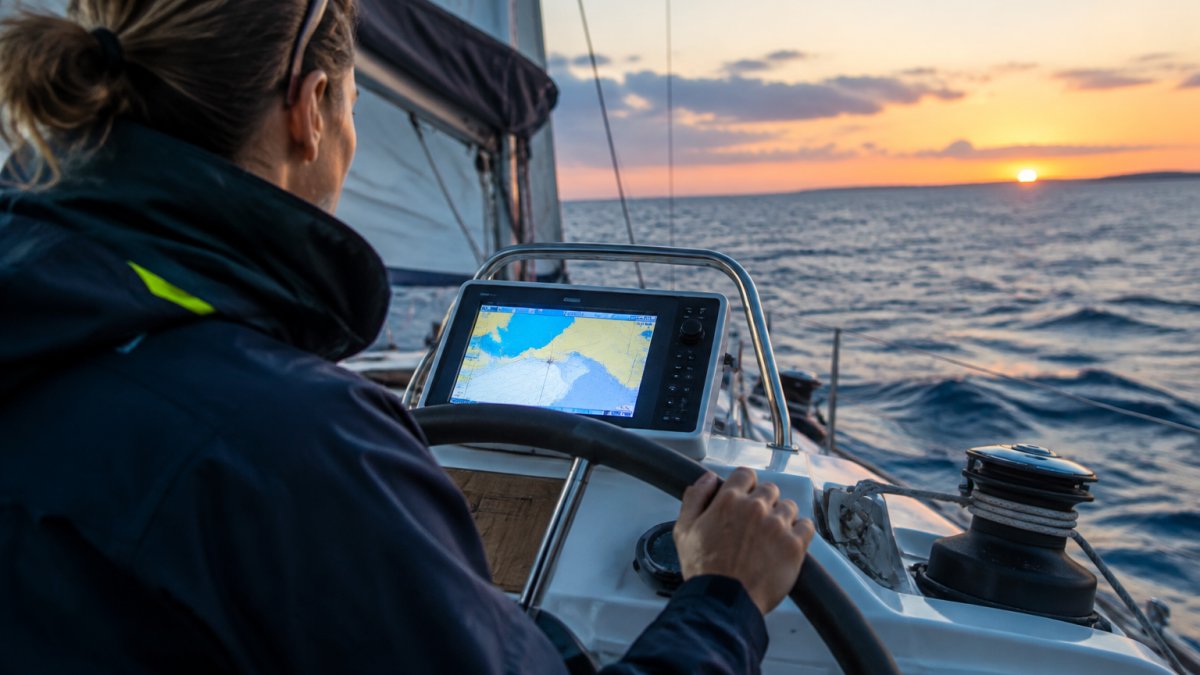
The B&G Zeus 3S 9 ($1,599.00) is a 9-inch display built for sailing. It includes sailing features such as SailSteer, Laylines, and RacePanel. The B&G Zeus 3S 12 Combo ($2,499.00) offers a larger 12-inch screen.
Choose the 9-inch unit for a smaller cockpit or a tighter budget. Choose the 12-inch unit if you want more data on one screen during a long passage. To weigh a multifunction display against dedicated instruments for your boat, see MFD vs Dedicated Sailing Instruments: What to Choose.
Best for: sailors who want one display for charts, routing, and sailing data. Skip if: your boat has no room for a screen of this size and you can work with a smaller unit.
Wind, Depth and Speed Instruments You Cannot Skip
These three instruments form the core of any offshore set. Once they are installed, you can learn how to calibrate marine wind instruments for better performance. Wind data drives sail trim, the depth reading protects the hull in shoaling water, and boat speed shows how the boat is performing.
The BG WS320 Wireless Wind Sensor Pack ($849.99) is a wireless wind sensor pack. Before mounting it, follow a marine wind sensor installation guide for sailboats step by step. The WS320 is designed for accurate wind data without a cable through the mast, and outputs wind data five times per second. The Raymarine i70s System Pack, Wind, Depth, Speed ($1,759.99) is a multifunction display system for wind, depth and speed data. The Raymarine i60 Wind Display System ($604.99) is a dedicated wind instrument display.
The i70s pack is the strongest choice if you want all three core readings in one purchase. Buy the i60 when you already have a display and only need wind data.
Compasses and Autopilot Steering for Long Passages
A compass remains a backup for every electronic system aboard. On a long passage, a reliable heading source keeps you on course when a screen or network fails.
The Ritchie SS-1002W SuperSport Compass ($330.99) is a flush-mount compass with a PowerDamp Plus dial, developed for and tested on offshore race boats. It has built-in deviation compensators and an exclusive five-year Ritchie warranty. The Raymarine T060 Micro Compass ($519.99) is a digital compass with no wires to run and a tactical scale. It is submersible to 10 metres and weighs 153 grams.
For steering, the Raymarine ST2000 Plus Tiller Pilot ($749.99) is designed for tiller-steered boats up to 10,000 lb (4,500 kg). Take the fully laden displacement weight of the vessel into account, which is often 20% above the designed displacement.
Watch out: an autopilot's rated boat weight refers to the fully laden displacement, so a boat near the limit on paper may be over it once loaded for a passage.
Power, Redundancy and Installation Trade-Offs
Every instrument on an offshore boat draws from the same finite battery bank, so the buying decision is really an energy decision. A practical way to size it is to build a daily amp-hour budget for the instrument set, not just a wattage glance at each display.
Start with realistic duty cycles. A chartplotter and MFD typically run continuously on passage, while wind, depth, and speed sensors draw around the clock once the network is powered. A tiller pilot only draws heavily while it is actively steering, but on a long passage that can be most of the day. Multiply each device's rated draw by the hours it actually runs, add the totals, and compare that against your house bank's usable capacity, for lead-acid, plan on roughly half the rated amp-hours as usable, and for lithium, closer to 80 percent. If the daily total exceeds what your charging (engine, solar, or hydro) can replace, you either cut instruments or add charging capacity before you leave the dock. If adding charging capacity means relying on shore power or a generator to run AC loads, account for the inverter's draw as well, and Victron Guy can help you weigh whether a pure sine wave inverter suits those needs.
Redundancy is the second half of the plan. Work through each failure mode:
- Chartplotter or MFD failure: carry paper charts and a plotting tool, and know your latitude and longitude from a second source. A handheld GPS or a tablet with offline charts is a cheap independent backup.
- GPS failure or jamming: a magnetic compass and a log for dead reckoning are the classic fallback. Keep a written log of course and speed so you can plot a DR position without any electronics.
- Wind sensor failure: a masthead windex or a handheld anemometer restores apparent wind data; sail trim can also be judged from telltales and boat speed.
- Depth failure: a lead line or a handheld sounder covers shoaling water, and paper chart contours plus a careful DR position are the offshore substitute.
- Autopilot failure: a wind vane self-steering gear or a sheet-to-tiller arrangement keeps the boat sailing while you repair the pilot.
- Network failure: if the NMEA 2000 backbone or a brand-specific network module dies, individual instruments that can display their own sensor data directly (rather than only through the MFD) keep working. Check before you buy whether each display can run standalone.
Compatibility is the third trade-off. NMEA 2000 is a common backbone standard, but brands layer their own protocols on top, so confirm compatibility for each product before you buy. The practical rules are to pick one brand ecosystem where you can, confirm the specific adaptor or module you need before purchase, and keep the backbone powered and terminated correctly. Wireless sensors such as the B&G WS320 remove the mast cable run, which is a real installation saving on an existing rig, but they still need a stable power source and a compatible display.
Watch out: an autopilot rated to a boat's designed displacement can be overloaded once the boat is provisioned for a passage, so size the pilot to the fully laden weight and confirm the drive unit's current draw against your energy budget.
Building a B&G Sailboat Package on a Budget
A B&G package can be built in stages. Start with the Zeus 3S 9 as the navigation hub, then add the WS320 wireless wind sensor.
If budget is tight, begin with the sensor and a basic display, then add the chartplotter later.
A sailboat electronics package works best when each piece talks to the others. Confirm networking before you buy, and keep the total within the power your battery bank can supply.
Planning Your Sailboat Electronics Package Order
The right package depends on the passage you are actually planning, not on buying the biggest screen first. A useful way to decide is to sort instruments into three tiers by passage type, then build up from the tier that matches your sailing.
Tier 1, Coastal and near-shore: a chartplotter or MFD for position and charts, a depth sounder with an alarm, a magnetic compass, and a VHF radio. This covers navigation, hull protection, and the ability to call for help within range of shore stations.
Tier 2, Bluewater cruising: add wind instruments for sail trim, a log for boat speed and dead reckoning, an autopilot sized to the laden boat, AIS for collision avoidance and vessel identification, and an EPIRB. This is the tier where the boat can be sailed and navigated independently for days.
Tier 3, Offshore racing and long passages: add radar for visibility and squall detection, a second independent heading source, redundant communications, and a wind vane or backup steering system. This tier is about keeping the boat moving and safe when a single failure would otherwise end the passage.
Within each tier, buy in this order:
- Choose the navigation display that fits your cockpit and power budget.
- Add the wind, depth, and speed sensors that feed it, and confirm they share a network standard.
- Add a compass and a backup heading source.
- Add an autopilot sized to your boat's fully laden weight.
- Check total power draw against your battery bank and charging capacity.
- Confirm network compatibility and the adaptors or modules each brand requires.
Budget tiers matter as much as passage tiers. An entry-level setup built around a single MFD and a combined wind/depth/speed pack covers Tier 1 and much of Tier 2. A mid-range setup adds AIS, a larger display, and a more capable autopilot. A premium setup adds radar, redundant displays, and independent backup systems. Installation, cabling, and any haul-out labor are separate costs that can rival the hardware on a retrofit, so price the whole job rather than the boxes.
| Instrument | Price (USD) | Best for |
|---|---|---|
| Chartplotter | $1,599.00 | Navigation and routing |
| Chartplotter (large) | $2,499.00 | Larger screen, more data |
| Wind sensor (wireless) | $849.99 | Wind data, smaller boats |
| Core system pack | $1,759.99 | All three core readings |
| Wind display | $604.99 | Dedicated wind readout |
| Compass (flush mount) | $330.99 | Backup heading |
| Compass (digital) | $519.99 | Tactical heading display |
| Tiller autopilot | $749.99 | Tiller-steered boats |
Price (USD)
Shop the full range at Charleston Yachting to build the package that suits your passage.
Frequently Asked Questions
Do I need radar for offshore sailing?
Radar is not a legal requirement for most recreational sailboats in U.S. waters, but many offshore sailors fit it because it shows targets in fog, rain and darkness when visibility fails. Compare its cost against your typical passage length and night sailing frequency. The B&G Zeus 3S 12 Combo is available at $2,499.00.
What instruments are essential on an offshore sailboat?
Most offshore sailors prioritize a chartplotter for position and routing, a wind instrument for apparent wind data, a depth display and a speed display. A compass is the fallback heading reference if electronics fail. The Raymarine i70s System Pack covering wind, depth and speed is priced at $1,759.99.
Is an autopilot essential for offshore sailing?
An autopilot is not strictly essential, but it reduces fatigue on long passages where crews stand watches around the clock. A tiller pilot suits smaller boats, while a fully integrated system suits larger keel boats. The Raymarine ST2000 Plus Tiller Pilot at $749.99 is rated for tiller-steered sailboats up to 10,000 pounds, and remember that fully laden displacement is often about 20% higher than the design figure.
How do you choose between Garmin and B&G sailing instruments?
The Garmin GNX 120 Marine Instrument is priced at $949.99 and features a 7-inch large format display. The B&G Zeus 3S series includes sailing features such as laylines, SailSteer and RacePanel. Match the brand to your sailing style, existing network and budget before you buy.
