

How to Choose a Marine VHF Radio for Beginners

Table of Contents
- What You Need to Know Before Buying a Marine VHF Radio
- Fixed Mount vs. Handheld VHF Radio: Which Type Fits Your Boat
- Marine VHF Radio FCC Licensing Requirements and Channel Rules
- How to Use DSC on a Marine Radio for Distress and Calling
- Marine VHF Radio Antenna Selection and Installation Basics
- Key Features to Evaluate When Selecting Your Radio
- Recommended Marine VHF Radios for Beginners
- Common Mistakes to Avoid When Choosing a Marine VHF Radio
- Frequently Asked Questions
Last Updated: September 28, 2026
What You Need to Know Before Buying a Marine VHF Radio
A marine VHF radio is your primary communication tool for safety at sea, emergency distress calls, and routine vessel-to-vessel contact. Whether you're navigating coastal waters or heading offshore, choosing the right radio depends on your boat size, intended use, and budget. At Charleston Yachting, we help boat owners select marine electronics that match their specific needs.
Fixed-mount radios deliver higher transmit power and better antenna integration. Handhelds offer portability and backup capability. Understanding both options before committing is essential.
You'll also need to understand FCC licensing, DSC functionality, and antenna selection, these directly impact whether your radio works when you need it most.
Fixed Mount vs. Handheld VHF Radio: Which Type Fits Your Boat
The choice between fixed-mount and handheld radios is the foundational decision in selecting your marine VHF radio. Each type serves different purposes, and many experienced boaters carry both.
Fixed Mount Radios: Power and Integration
Fixed-mount radios deliver 25 watts of transmit power, roughly 10 times stronger than handhelds, reaching 20+ nautical miles versus 5-10 nautical miles for handhelds.
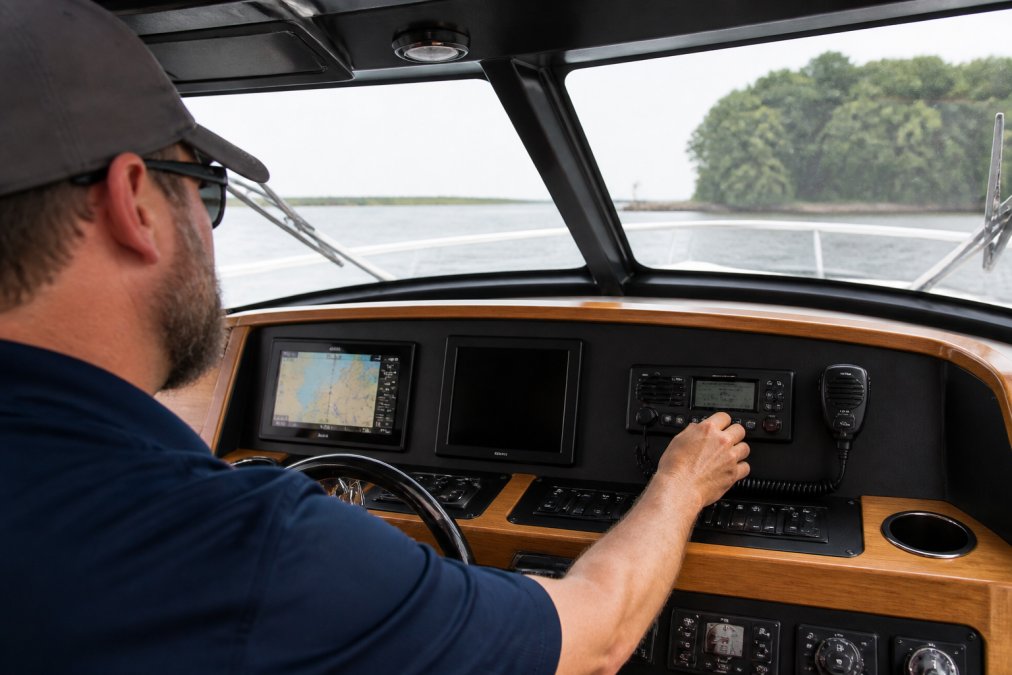
Fixed-mount units connect to your boat's power system and integrate with NMEA 2000 networks, allowing your marine VHF radio to share position data with chartplotters and autopilots. DSC automatically transmits your GPS coordinates during distress calls.
The Standard Horizon GX1410GB Eclipse Series ($269.99) includes built-in 66-channel GPS, Class D DSC, and high-resolution display. The E2O menu system simplifies setup.
The Icom IC-M330 ($319.00) is a compact fixed-mount option for tight spaces, delivering full DSC capability and Class D compliance.
Handheld Radios: Portability and Backup
Handheld radios prioritize portability and resilience, they float, flash, and alarm if dropped overboard. They serve as backup when primary systems fail and are essential for dinghy operations.
Most handhelds transmit 5-6 watts, limiting range to 5-10 nautical miles. This suits coastal cruising but isn't sufficient for offshore work.
The Icom IC-M25 EVO ($264.00) floats with Float'n Flash, offers 14 hours battery life in Eco Mode, and features USB Type-C charging. It's ideal for recreational boaters wanting a reliable backup handheld.
![Icom IC-M25 EVO Handheld VHF Radio - Black [M25 EVO BLACK 61 USA]](https://cdn.shopify.com/s/files/1/0842/4914/9751/files/108689XL.jpg?v=1775849655)
The Standard Horizon HX210 ($139.99) transmits at 6 watts with water-activated emergency strobe, 3-year waterproof warranty, and oversized display, the budget entry point without compromising reliability.
Marine VHF Radio FCC Licensing Requirements and Channel Rules
Operating a marine VHF radio beyond 3 nautical miles requires an FCC Ship Station License.
The Ship Station License is obtained through the FCC's online system. Without it, operating beyond territorial waters is illegal.
Channel 16 is the international distress and calling frequency monitored continuously by all marine VHF radios. Once contact is established, vessels move to a working channel to keep Channel 16 clear for emergencies.
Weather channels (WX1-WX10) broadcast National Weather Service forecasts. Most radios include weather alert functionality that runs in the background.
According to FCC maritime regulations, vessels operating a marine VHF radio must maintain proper radio watch on Channel 16 during sea operations. Failure to monitor Channel 16 violates federal maritime law.
How to Use DSC on a Marine Radio for Distress and Calling
DSC transforms a marine VHF radio into a targeted communication system, sending digital distress alerts with your vessel's identity and position to all vessels monitoring Channel 70.
Every DSC-capable marine VHF radio requires an MMSI number (Maritime Mobile Service Identity), a 9-digit identifier. Program it during setup, it's the foundation of DSC functionality.
Icom IC-M25 EVO Handheld VHF Radio →
Activating the DSC distress button transmits your MMSI, GPS position, time, call sign, and name to all vessels monitoring Channel 70. Unlike voice calls, DSC automatically alerts any equipped vessel without requiring an operator to listen.
Non-distress DSC calls work similarly. You can send an "Individual" call to a specific vessel (if you know their MMSI), an "All Ships" call to any vessel in range, or an "Urgent" call for safety-related situations that don't rise to distress level. Each call type triggers different alarm protocols on receiving radios.
Both the Standard Horizon GX1410GB (built-in 66-channel GPS) and Icom IC-M330 (external GPS via NMEA) include Class D DSC and monitor Channel 70 continuously, alerting you immediately to incoming DSC calls.
![Standard Horizon HX210 6W Floating Handheld Marine VHF Transceiver [HX210]](https://cdn.shopify.com/s/files/1/0842/4914/9751/files/63675XL.jpg?v=1775843997)
Marine VHF Radio Antenna Selection and Installation Basics
Your antenna determines effective range more than any other factor, a 25-watt radio with a poor antenna underperforms a 5-watt handheld with optimal antenna placement.
Antenna gain (measured in dBi) quantifies efficiency.
Key Features to Evaluate When Selecting Your Radio
Beyond the fixed vs. handheld decision, several features differentiate marine VHF radios and affect usability and safety.
Transmit Power and Coverage Range
Fixed-mount radios transmit 25 watts; handhelds transmit 5-6 watts. Transmit power matters most for ocean cruising and offshore work. Coastal cruising within 10 nautical miles rarely requires maximum power. Lower power settings extend battery life significantly during short trips, provided you take the time to program handheld radios correctly before leaving the dock.
Waterproofing Standards and Battery Life
IPX7 (1 meter immersion, 30 minutes) is adequate for deck operations; IPX8 (4 meters, 1 hour) is preferable for wet conditions. The Icom IC-M25 EVO achieves IPX8 with Float'n Flash. The Standard Horizon HX210 includes a 3-year waterproof warranty.
![Standard Horizon GX1410GB Eclipse Series 25W Fixed Mount VHF/GPS - White [GX1410GW]](https://cdn.shopify.com/s/files/1/0842/4914/9751/files/108197XL.jpg?v=1775849652)
Weather Alerts and Dual Watch Capability
Weather alert functionality monitors National Weather Service frequencies and alerts you to severe weather. This runs passively in the background while you monitor other channels.
| Feature | Importance | Impact |
|---|---|---|
| Transmit Power | Critical for offshore | Determines effective range |
| DSC Capability | Critical for safety | Enables automatic distress alerts |
| Waterproofing | Important for handhelds | Protects against water damage |
| Weather Alerts | Valuable for cruising | Automatic severe weather notification |
| Battery Life | Important for handhelds | Determines operational duration |
| Dual Watch | Useful for active boating | Monitors multiple channels simultaneously |
Recommended Marine VHF Radios for Beginners
Charleston Yachting stocks four marine VHF radio options covering different vessel types and budgets. Each represents the best choice for its category.
Best Handheld Option: Icom IC-M25 EVO
The Icom IC-M25 EVO ($264.00) features Float'n Flash (floats face-up with alarm if dropped), improved grip, USB Type-C charging, and 14-hour battery life in Eco Mode. It's ideal for backup communication and dinghy operations on coastal cruises and day trips.
Budget-Friendly Handheld: Standard Horizon HX210
The Standard Horizon HX210 ($139.99) transmits at 6 watts with water-activated emergency strobe, oversized display, and 3-year waterproof warranty. It's the budget entry point without sacrificing essentials.
Best Fixed Mount: Standard Horizon GX1410GB Eclipse Series
The Standard Horizon GX1410GB Eclipse Series ($269.99) includes built-in 66-channel GPS and Class D DSC. The E2O menu simplifies setup. NMEA connectivity integrates with chartplotters and autopilots. Ideal for upgrading from analog systems.
Premium Compact Fixed Mount: Icom IC-M330
The Icom IC-M330 ($319.00) is a compact fixed-mount option (6.2 × 2.6 × 4.3 inches) with full Class D DSC and excellent receiver performance. Clear speaker design and NMEA connectivity make it ideal for smaller vessels and retrofit situations.
Common Mistakes to Avoid When Choosing a Marine VHF Radio
New boaters often make predictable mistakes when selecting marine VHF radios. Understanding these pitfalls helps you make better decisions.
Frequently Asked Questions
Do I need an FCC license to operate a marine VHF radio?
Yes. The FCC requires all vessel operators to obtain a Ship Station License before transmitting on a marine VHF radio. You must also have an MMSI number (Maritime Mobile Service Identity), which is a unique nine-digit identifier used for DSC calls and distress signals. Licenses are available through the FCC and are valid for 10 years. Operating without proper licensing can result in significant fines.
What is the difference between fixed mount and handheld marine VHF radios?
Fixed mount radios are permanently installed in your boat's cabin or wheelhouse and typically deliver 25 watts of transmit power, providing greater range and integration with your navigation system. Handheld radios are portable, usually 5-6 watts, and ideal for backup communication or when you're away from the helm. Fixed mounts are better for primary communication; handhelds work well as secondary units or for smaller vessels where space is limited.
What is DSC and why is it important on a marine radio?
DSC (Digital Selective Calling) allows you to send automated distress alerts and position reports with your vessel's location and MMSI number. Instead of broadcasting a voice mayday on Channel 16, DSC sends a digital distress signal that reaches the Coast Guard and nearby vessels instantly. It also enables one-to-one calling with other equipped boats and automatic channel switching. DSC is essential for modern boating safety and is required on most commercial vessels.
How far will a marine VHF radio transmit?
A 25-watt fixed mount radio typically transmits 20-25 nautical miles in ideal conditions, while a 5-6 watt handheld reaches approximately 5-10 nautical miles. Range depends on antenna height, water conditions, and obstacles. Higher antennas improve range significantly. These distances assume line-of-sight communication; radio waves don't bend over the horizon, so a radio on a tall mast reaches farther than one at deck level.