

Garmin vs B&G Marine Navigation Systems

Table of Contents
- Garmin vs B&G: Quick Comparison
- User Interface and Touchscreen Performance
- Autopilot Performance and Reliability
- Sailing-Specific Features and Sailing Polars
- Best Marine Chartplotter for Sailboats: Display Quality and Cartography
- Marine Electronics Integration Best Practices: NMEA 2000 and Third-Party Connectivity
- Installation, Setup, and Long-Term Maintenance Costs
- Which System Should You Choose?
Last Updated: August 16, 2026
Garmin vs B&G: Quick Comparison
When choosing between Garmin and B&G marine navigation systems, you're comparing two philosophies about how sailors interact with their boats. Garmin dominates the market with integrated systems prioritizing ease of use and broad compatibility. B&G, owned by Navico, takes a specialized approach engineered specifically for sailing, with deep integration into wind data, polars, and racing features.
The core tension: Garmin offers accessibility and ecosystem breadth. B&G offers sailing-specific depth. For most cruising sailors, Garmin wins on simplicity and price. For competitive racers and serious sailing enthusiasts, B&G's sailing polars and layline calculations are worth the learning curve.
Charleston Yachting stocks both platforms because different boats need different solutions. Here's how to decide which one belongs on your helm.
| Feature | Garmin | B&G | Winner |
|---|---|---|---|
| Touchscreen Interface | Excellent, intuitive | Good, sailing-focused | Garmin |
| Autopilot Integration | Multiple brands supported | Native H5000 system | B&G |
| Sailing Polars | Added later, basic | Native, advanced | B&G |
| NMEA 2000 Support | Full, extensive | Full, but proprietary | Garmin |
| Starting Price | $1,800-$6,300 | Generally higher | Garmin |
| Best For | Cruisers, mixed use | Racing, serious sailors |
User Interface and Touchscreen Performance
Garmin's touchscreen interface prioritizes speed and accessibility, menus are logical, icons are clear, and first-time users can navigate basic functions within minutes. The IPS display technology on larger units like the GPSMAP 1243xsv and 1643xsv delivers excellent sunlight readability and wide viewing angles.
![Garmin GPSMAP 1243xsv Combo GPS/Fishfinder GN+ [010-02367-61]](https://cdn.shopify.com/s/files/1/0842/4914/9751/files/97020XL.jpg?v=1775847911)
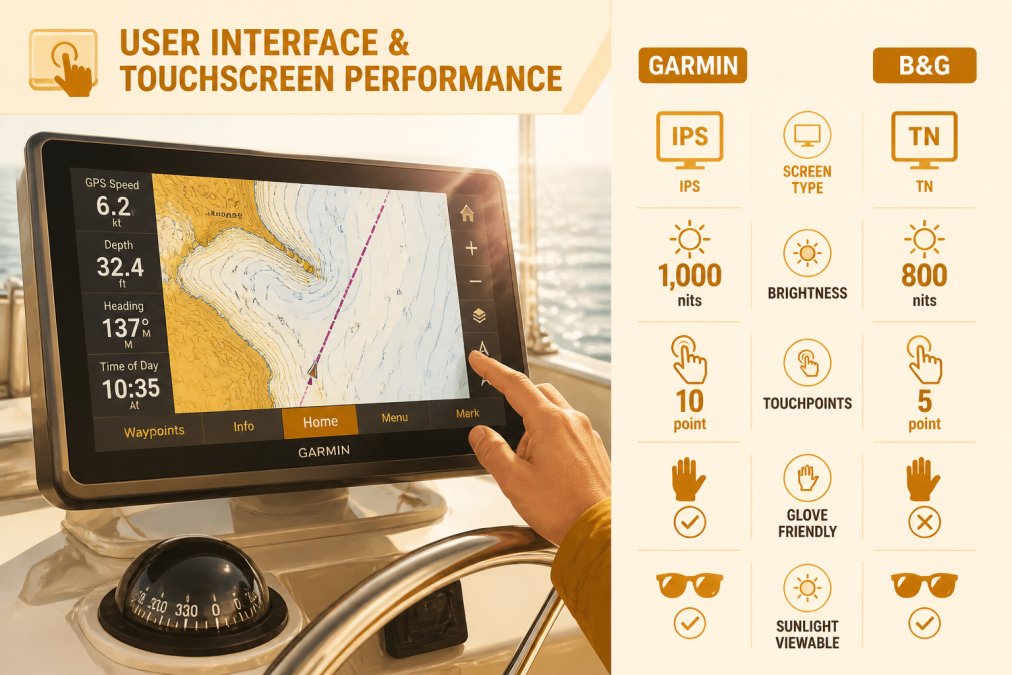
B&G's interface is designed for sailors who already understand marine electronics. The menu structure assumes you know what you're looking for. Touchscreen responsiveness is solid, but the logical flow favors function over simplicity. Upgrading from older B&G equipment feels natural; coming from Garmin requires a learning curve.
Display brightness matters practically. Both offer high-brightness IPS displays, but Garmin's larger units (12-inch and 16-inch screens) provide more screen real estate, allowing more information without crowding. On a 7-inch B&G display, critical sailing data gets compressed. B&G assumes you'll use multiple smaller displays networked together rather than one large multifunction display.
For casual cruising, Garmin's interface wins decisively. For racing teams, B&G's sailing-centric layout becomes an asset once learned.
Autopilot Performance and Reliability
Garmin's autopilot support is broad but shallow, the chartplotter can control compatible autopilots from multiple manufacturers via NMEA 2000 networks. This flexibility is valuable if you already own an autopilot or want to choose your own, though you're managing two separate systems communicating through a data bus.
B&G's H5000 autopilot system integrates directly with the navigation display. The autopilot "knows" about your sailing polars, wind data, and course, executing sophisticated maneuvers like tacking under sail or maintaining optimal angle to wind. Native integration means fewer wiring complications and more intelligent steering logic.
Real-world reliability favors both systems equally. The difference is in capability. A Garmin-controlled autopilot holds a compass heading reliably. A B&G H5000 system optimizes your heading based on wind angle and boat performance data, reducing manual trimming and improving boat speed.
For sailors who hand-steer frequently, the difference is academic. For sailors depending on autopilot for long passages or racing, B&G's integrated system reduces workload and improves performance.
Sailing-Specific Features and Sailing Polars
B&G's DNA as a sailing electronics company shows here. Sailing polars, performance data telling you how fast your boat should go at a given wind angle and sail configuration, are native to B&G systems. You input your boat's specifications, and the system calculates optimal angles and speeds based on wind conditions.
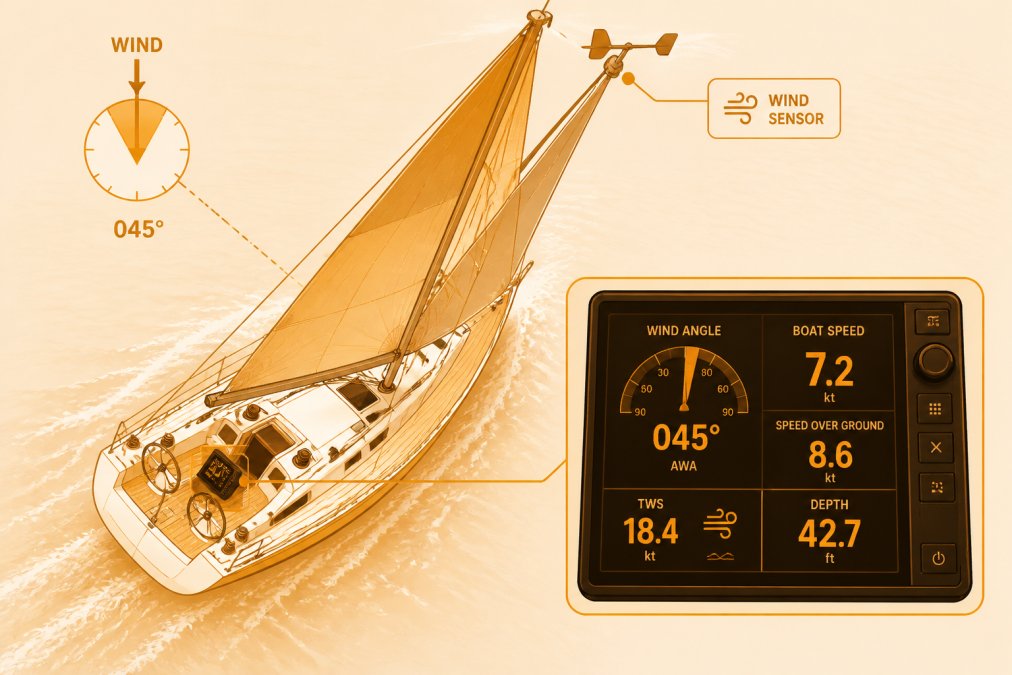
Garmin added sailing polars to their SailAssist feature later and remains less integrated into core navigation. You can view polars on a Garmin display, but they're not woven into autopilot logic or tactical layline calculations like they are on B&G.
Laylines, theoretical course lines taking you directly to a mark at optimal angle, are calculated differently. B&G's layline calculations incorporate wind shifts and boat polars, giving a dynamic picture of whether you can fetch a mark. Garmin's layline feature is more static, showing the geometric line without factoring in performance data or wind variability as deeply.
For racing sailors, this difference matters enormously. B&G's system optimized for your boat's polars can gain several boat lengths over a 10-mile race compared to Garmin's basic laylines.
Best Marine Chartplotter for Sailboats: Display Quality and Cartography
Cartography quality is nearly equivalent between the two. Both use Navionics data as their foundation. For cruising, the practical difference is negligible, you get detailed coastal charts, bathymetry, and port information on both systems.
Display quality favors Garmin's larger units. The GPSMAP 1243xsv and 1643xsv offer 12-inch and 16-inch screens respectively, with excellent sunlight readability and wide viewing angles. These larger displays are easier to read at a glance and allow multiple data panels simultaneously without crowding. B&G's largest standard display is typically smaller, though they support multiple networked displays for complex installations.
For sailboats, the question isn't just screen size but how much sailing-relevant information you can display at once. Wind data, polars, laylines, and compass heading all compete for screen real estate. Garmin's larger displays give you room to show everything. B&G's displays require more menu navigation to access the same information.
Both platforms excel in brightness and angle visibility. Garmin's IPS technology on newer units gives a slight edge in glare reduction and color accuracy under polarized sunglasses.
Marine Electronics Integration Best Practices: NMEA 2000 and Third-Party Connectivity
NMEA 2000 is the standard data bus for marine electronics, and both Garmin and B&G support it fully. They diverge in how they use that connectivity.
Garmin's approach is inclusive. Your GPSMAP chartplotter can network with compatible autopilots, wind sensors, depth sounders, VHF radios, and audio systems from multiple manufacturers. This flexibility is valuable if you have legacy equipment or prefer mixing brands, though you're managing multiple vendors' reliability.
B&G's network is tighter. Their H5000 system integrates their own wind sensors, autopilots, and radar into a cohesive ecosystem. Third-party devices connect via NMEA 2000, but native integration is with Navico products. This creates a unified experience but less flexibility for non-B&G components.
For integration best practices:
- Use quality NMEA 2000 cabling and connectors; cheap connectors cause intermittent failures
- Keep your data bus organized with a clear T-connector layout; avoid daisy-chaining more than 3 devices on a single drop
- Test all network connections before heading offshore
- Document which device is on which NMEA 2000 address
- Update firmware on all networked devices regularly
Garmin's OneHelm feature allows you to control third-party digital switching systems from the chartplotter. B&G offers similar integration through their H5000 system. Garmin's broader third-party support gives more options.
NMEA 2000 networks are more reliable than older NMEA 0183 serial connections. If you're installing new equipment, prioritize NMEA 2000 compatibility.
Installation, Setup, and Long-Term Maintenance Costs
Installation complexity is similar for both systems. A basic chartplotter installation takes a professional 4-6 hours. Real cost differences emerge when you add networked devices.
Garmin systems are generally easier for DIY installation because menu logic is more intuitive. If you're comfortable with basic marine wiring, you can handle physical installation and software setup yourself.
B&G systems require more familiarity with marine electronics concepts. Installation is no more complex, but software setup and calibration demand more technical knowledge. Professional installation labor costs more.
Long-term maintenance costs favor Garmin slightly. Replacement transducers, antennas, and cables are widely available and reasonably priced. B&G components are available but sometimes cost more with longer lead times.
Software updates are free for both platforms, but Garmin's update process is more user-friendly. You can update via Wi-Fi on many newer units. B&G updates often require a computer connection and more manual steps.
Power consumption is comparable between the two, a typical installation draws 2-4 amps at 12V. Neither system is a significant power drain.
Which System Should You Choose?
Choose Garmin if: You want simplicity, broad compatibility with third-party electronics, and a system that rewards intuitive menu navigation. The GPSMAP 943xsv at $1,809.98 or the larger 1243xsv at $3,099.99 offer excellent value for cruising sailors. If you're upgrading from older electronics or mixing brands, Garmin's NMEA 2000 flexibility is invaluable. For weekend sailors and cruisers, Garmin is the practical choice.
![Garmin GPSMAP 943xsv Combo GPS/Fishfinder GN+ w/GT23-TM [010-02366-61/GT23M]](https://cdn.shopify.com/s/files/1/0842/4914/9751/files/97017XL.jpg?v=1775847909)
Choose B&G if: You're a serious racing sailor or spend significant time optimizing boat performance. B&G's native sailing polars, layline calculations, and integrated autopilot logic give measurable advantages in competitive situations. If you're building a racing-focused electronics suite from scratch, B&G's ecosystem makes sense. The learning curve is steeper, but the payoff is better tactical information and less manual steering.
For most recreational sailors, Garmin's ease of use and broad compatibility win. For racing teams and performance-focused cruisers, B&G's sailing-specific engineering justifies the complexity.
At Charleston Yachting, we stock both platforms because the right choice depends on how you sail. We carry Garmin's full range, from the compact 943xsv to the large-format 1643xsv, because Garmin's flexibility and user-friendly interface suit most sailors' needs. If you're upgrading existing electronics or want a system that works seamlessly with multiple brands of autopilots and sensors, Garmin is the practical recommendation.
Choosing between Garmin and B&G comes down to your sailing priorities. For most sailors, Garmin's intuitive interface and broad third-party compatibility make it the best choice. For racing and performance optimization, B&G's sailing-specific features justify the steeper learning curve. At Charleston Yachting, we provide expert guidance on both platforms and carry premium Garmin chartplotters including the GPSMAP 943xsv and GPSMAP 1243xsv to ensure you have the navigation system your boat deserves. Shop all our marine electronics and get same-day shipping on your order.
Frequently Asked Questions
What are the primary differences between Garmin and B&G marine navigation systems?
Garmin systems emphasize user-friendly touchscreen interfaces, extensive cartography options, and broad third-party device compatibility through NMEA 2000 networks. B&G systems focus on advanced sailing-specific features, particularly for racing, with strong autopilot integration and real-time performance data. Garmin offers more display size options and aggressive pricing; B&G specializes in professional-grade marine electronics integration for serious sailors.
Which marine navigation system offers better integration with autopilot?
B&G has traditionally led in autopilot integration, with their Seapilot autopilot systems designed to work seamlessly with their multifunction displays for synchronized sailing data. Garmin systems support autopilot integration through NMEA 2000 networks, allowing connection to various autopilot brands. For racing applications, B&G's native integration provides tighter feedback loops; for cruising flexibility, Garmin's open architecture supports more third-party autopilot options.
Is B&G better than Garmin for offshore sailing?
B&G excels for serious offshore racers who need advanced sailing polars, layline calculations, and weather integration. Garmin is better for cruising sailors and mixed-use boaters due to superior cartography, easier user interface, and lower entry cost. For offshore navigation alone, both systems provide reliable waypoint management and chart accuracy. Your choice depends on whether you prioritize racing optimization (B&G) or overall navigation simplicity and value (Garmin).
Are Garmin and B&G systems compatible with third-party sensors and transducers?
Both systems support NMEA 2000 and NMEA 0183 networks, allowing integration with third-party wind sensors, depth sounders, and AIS receivers. Garmin offers broader third-party compatibility through ANT+ wireless technology and OneHelm digital switching for legacy devices. B&G systems prioritize their own sensor ecosystem but do support standard marine data buses. Before purchasing, verify that your existing transducers and sensors meet NMEA 2000 standards for seamless integration.
Which marine navigation system is more user-friendly for recreational boaters?
Garmin systems are generally more intuitive for recreational boaters, with responsive touchscreen interfaces, straightforward menu navigation, and comprehensive onboard tutorials. Their ActiveCaptain mobile app simplifies software updates and user data management. B&G systems have steeper learning curves but reward time invested with deeper sailing-specific functionality. For weekend cruisers doing basic navigation, Garmin wins on accessibility; for sailors willing to master advanced features, B&G offers greater depth.
This article was written using GrandRanker