

Depth Sounder vs Fish Finder for Sailboats

Table of Contents
- Depth Sounder vs Fish Finder: Core Differences
- Transducer Installation for Sailboats
- NMEA 2000 Depth Sensor Integration
- Power Consumption of Marine Electronics
- Display Readability and Situational Awareness
- Comparison Table and Product Selection
- Frequently Asked Questions
Last Updated: September 23, 2026
Depth Sounder vs Fish Finder: Core Differences
When considering depth sounder vs fish finder, it's important to recognize these are fundamentally different tools, even though they both use sonar. Understanding which one serves your sailboat comes down to knowing what each system actually measures and why that matters for navigation safety.
A depth sounder measures one thing: how deep the water is beneath your hull. It sends a sonar pulse straight down, receives the echo, and displays the numerical depth. The system is built for precision and reliability in shallow-water navigation, anchoring, and avoiding groundings.
A fish finder detects objects suspended in the water column, fish, structure, vegetation, and creates a visual representation showing a scrolling graph or image of the water column using multiple frequencies and wider beam angles.
What Each System Measures
A depth sounder delivers a single, highly accurate number: your current water depth, updated typically once per second. The system measures the round-trip time from transducer to bottom and calculates depth by dividing by the speed of sound in water, producing a number you can trust for navigation decisions.
A fish finder measures the entire water column, showing a continuous graph of the seafloor, suspended objects, and density changes. The goal is information density, not depth precision. You see structure, thermoclines, and potential fish locations, but pinpointing exact depth requires interpretation.
For sailboats, the depth sounder's simplicity is an advantage. You glance at the display and instantly know if you're in safe water without interpreting graphs or worrying about false echoes.
Sonar Frequency and Beam Width Explained
Sonar frequency determines how sound waves behave underwater. Lower frequencies (50 kHz) penetrate deeper but produce less detail; higher frequencies (200+ kHz) deliver sharper returns but don't travel as far. Depth sounders typically operate at 235 kHz, balancing penetration depth with accuracy for coastal and offshore sailing.
Beam width is the cone angle of the sonar pulse. A narrow beam (10-12 degrees) concentrates the signal straight down for accurate readings directly below the hull. A broad beam (20+ degrees) spreads the signal wider, creating confusion in shallow water or over uneven bottoms by measuring depth at an angle.
Sailboats with deadrise benefit from transducers with tilted elements. The Airmar DT800 uses a tilted ceramic element that compensates for hull deadrise, orienting the beam straight down regardless of hull shape.
![Airmar DT800 NMEA 2000 Bronze Retractable Long Stem Thru-Hull w/Depth Temperature [DT800L-235-N2]](https://cdn.shopify.com/s/files/1/0842/4914/9751/files/114597XL.jpg?v=1787003911)
Transducer Installation for Sailboats
Installing a depth sounder transducer requires understanding your hull and choosing solutions that work with your boat's design.
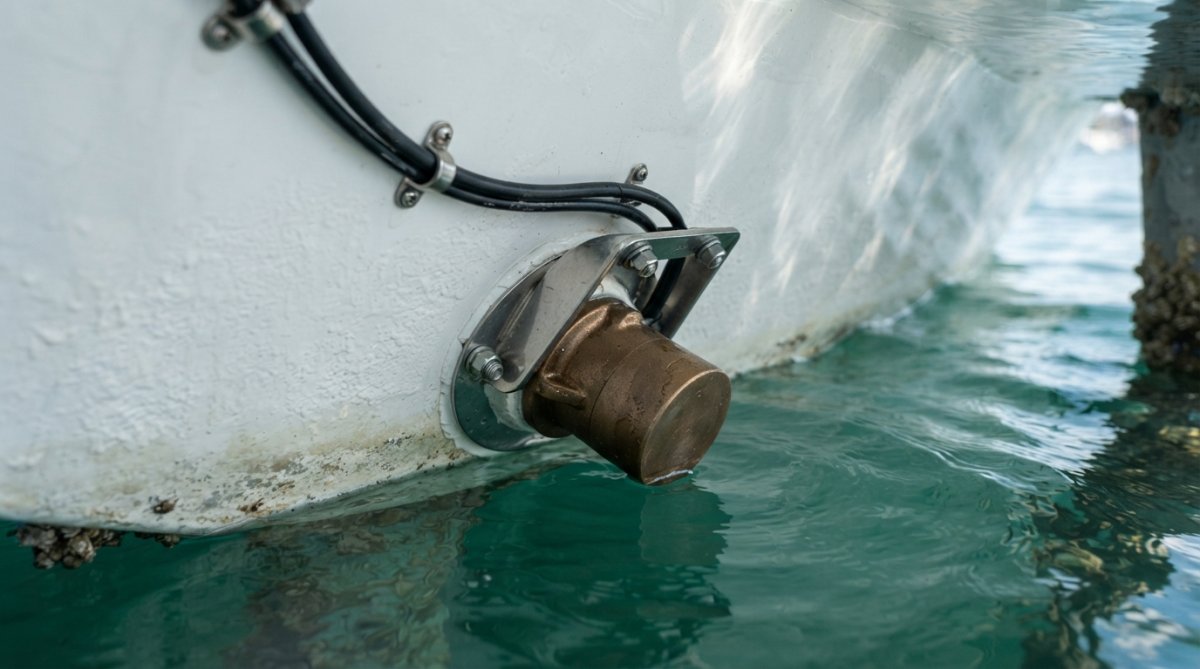
A thru-hull transducer passes through the hull below the waterline for direct water contact and maximum accuracy. The tradeoff: drilling a hole in your boat requires careful planning and proper sealing to prevent leaks.
Retractable transducers protect the sensor during haul-outs and reduce marine growth when the boat sits idle. The Airmar DT800L and Maretron DST110 offer retractable designs ideal for cruising sailboats.
Hull Deadrise and Mounting Challenges
Deadrise, the angle between your hull's bottom and a horizontal plane, creates the biggest installation challenge. A pronounced V-shaped bottom causes the sonar beam to angle downward rather than straight down, distorting depth readings.
Manufacturers solve this with tilted elements: the ceramic transducer is positioned at an angle mirroring your hull's deadrise, orienting the sonar beam straight down. The Airmar DT800 handles deadrise, covering many cruising sailboats.
Mount the transducer on a smooth section of the hull away from turbulence and prop wash. The transducer needs clean water flow to avoid aeration and false readings. Optimal locations are on the keel or amidships where water flow remains laminar at cruising speeds.
Retractable vs Fixed Transducers
Fixed transducers stay in place year-round and are slightly more accurate. The downside: you can't inspect the sensor without hauling out, and the transducer is vulnerable if you beach or hit shallow water hard.
Airmar DT800 NMEA 2000 Bronze →
Retractable transducers protect the sensor from damage, reduce marine growth, and allow regular inspection. The tradeoff is added complexity and moving parts. For cruising sailboats that spend time hauled out, a retractable design like the Airmar DT800L ($853.53) or Maretron DST110 ($495.00) is worth the investment.
NMEA 2000 Depth Sensor Integration
NMEA 2000 is the marine industry standard for networking electronics (NMEA 2000 Standards - National Marine Electronics Association (NMEA)). Instead of running separate cables to each instrument, a single backbone cable connects all your electronics, depth sensor, chartplotter, wind sensor, and autopilot, allowing them to share data.
A depth sounder with NMEA 2000 connectivity sends data to every device on the network, chartplotter, autopilot, and navigation software on tablets. One sensor feeds multiple displays and systems.
Network Compatibility and Data Sharing
NMEA 2000 offers simplicity and redundancy. If your primary depth display fails, you can view depth on your chartplotter or tablet. Adding wind sensors or AIS receivers later requires no separate wiring.
The Digital Yacht iSeaSense Wireless Speed Depth Temp Pack ($929.95) connects to NMEA 2000 and broadcasts depth, speed, and temperature data to any compatible display. View data on your chartplotter, phone via web interface, or dedicated display, with wireless connectivity for tablets and smartphones.
![Digital Yacht iSeaSense Wireless Speed Depth Temp Pack [ZDIGISSPK1]](https://cdn.shopify.com/s/files/1/0842/4914/9751/files/99663XL.jpg?v=1775848395)
For sailors upgrading older electronics, NMEA 2000 compatibility matters. An older Garmin chartplotter from 2010 that supports NMEA 2000 can receive depth data from a modern sensor without replacing your entire electronics suite. Integrating these disparate components requires careful planning, a process detailed further in our offshore electronics guide to ensure your vessel remains fully capable for long-range navigation.
Power Consumption of Marine Electronics
Depth sounders draw modest power compared to other marine electronics. This matters if you're running on battery power during offshore passages or at anchor.
Display Readability and Situational Awareness
A depth sounder display shows a single number: your current depth. This simplicity is its strength. You glance at the display and instantly know if you're in safe water. No interpretation needed. No graph to read. Just a number.
Comparison Table and Product Selection
| Product | Type | Starting Price | Best For | Key Features |
|---|---|---|---|---|
| Airmar DT800 NMEA 2000 | Depth/Temperature | $853.53 | Cruising sailboats with deadrise | Retractable, tilted element, 235 kHz, up to 28° deadrise |
| Airmar DST820 | Depth/Speed/Temperature | $584.75 | Racing and cruising | Gen2 paddlewheel, 5.7 Hz speed output, attitude sensor, Bluetooth calibration |
| Maretron DST110 | Depth/Speed/Temperature | $495.00 | Budget-conscious sailors | Retractable, wide beam, tolerant of deadrise, no calibration needed |
| Digital Yacht iSeaSense Pack 1 | Wireless System | $929.95 | Sailors wanting wireless displays | Depth/speed/temp, web interface, 5Hz updates, NMEA 2000 compatible |
| Digital Yacht iSeaSense Pack Plus Wind | Wireless System | $1,649.95 | Racers and performance sailors | Includes wind sensor, mast-top unit, wireless connectivity, full NMEA 2000 integration |
Recommended Options for Different Sailing Profiles
For coastal cruising sailors who want a simple, reliable depth sounder without complexity, the Maretron DST110 ($495.00) is the entry point. It's retractable, tolerant of hull deadrise, and requires no calibration. It delivers accurate depth readings and integrates with NMEA 2000 networks. The lower price leaves budget for other upgrades.
![Airmar DST820 Bronze Thru Hull - NMEA 2000 - 235kHz [DST820-BV-N2]](https://cdn.shopify.com/s/files/1/0842/4914/9751/files/114231XL.jpg?v=1779817112)
Frequently Asked Questions
What is the difference between a depth sounder and a fish finder?
A depth sounder displays water depth and temperature using a single narrow or broad beam at high frequency (typically 235 kHz). A fish finder operates at lower frequencies (50-200 kHz) to detect objects like fish in the water column and displays detailed underwater imagery. For sailboats, depth sounders provide navigation safety and situational awareness, while fish finders prioritize fish detection and detailed bottom structure visualization.
What are the power consumption differences between depth sounders and fish finders?
Depth sounders are efficient for long-range cruising. Fish finders often use more power due to continuous imaging and higher processing demands. The Airmar DT800 has a power rating of 100 W, while the Digital Yacht iSeaSense packs operate within similar ranges but include wireless connectivity. For sailboats relying on battery power, a dedicated depth sounder is the better choice for extended passages.
Can a fish finder replace a dedicated depth sounder on a sailboat?
Technically yes, but not ideally. Modern fish finders can display depth and temperature, but they consume more power and may introduce information overload in tight sailing conditions. Sailboats benefit from the simplicity and efficiency of a dedicated depth sounder, which provides fast, reliable depth readings without the complexity of fish detection features. However, a fish finder works if you prioritize multi-function capability over power efficiency.
What should I consider when installing a transducer on a sailboat?
Check your hull deadrise angle. Choose between retractable and fixed housings based on your sailing profile and haul-out frequency. Bronze, stainless steel, and plastic housings each suit different hull materials. Ensure the thru-hull location avoids high-turbulence areas near the keel or rudder. NMEA 2000 integration simplifies multi-sensor networks, allowing one cable to connect depth, speed, and temperature data.
Does my sailboat need NMEA 2000 integration for a depth sounder?
NMEA 2000 integration is optional but valuable. It allows your depth sounder to share data with chartplotters, autopilots, and other marine electronics via a single backbone cable. The Airmar DST820 and DT800 both support NMEA 2000, enabling seamless data sharing. If you operate standalone or plan minimal future upgrades, a conventional depth sounder works fine. NMEA 2000 becomes essential when building a comprehensive navigation system.