

How to Maintain Sailboat Winches for Longevity

Table of Contents
- What You'll Need to Service Your Winches
- Step 1: Disassemble the Winch Safely
- Step 2: Clean and Degrease Every Component
- Signs of Worn Winch Pawls and Springs
- How Often to Service Sailboat Winches
- Best Marine Grease for Winches and How to Apply It
- Common Mistakes That Shorten Winch Life
- Reassembly and Final Checks
- Frequently Asked Questions
Last Updated: September 22, 2026
What You'll Need to Service Your Winches
Learning how to maintain sailboat winches for longevity starts with the right tools and a clean workspace.
Gather these before you start:
- A winch handle (you'll need it to remove the drum)
- A servicing kit with spare pawls and springs
- Marine-grade winch grease and light winch oil
- A soft brush and lint-free cloths
- A small flathead screwdriver and pick
- A container for small parts
Step 1: Disassemble the Winch Safely
Remove the winch handle, then take off the drum, most winches release it with a single top screw or circlip. Work slowly and photograph each layer as you lift it off.


Here's the sequence for most standard winches:
- Ease all lines off the drum
- Remove the winch handle
- Take out the top screw or circlip
- Lift the drum straight up
- Set aside the bearing cage and thrust washer
- Note the pawl and spring positions before removing them
Step 2: Clean and Degrease Every Component
Old grease mixed with salt turns into a grinding paste that kills bearings and gears. Cleaning is the step most owners rush, and the one that matters most.
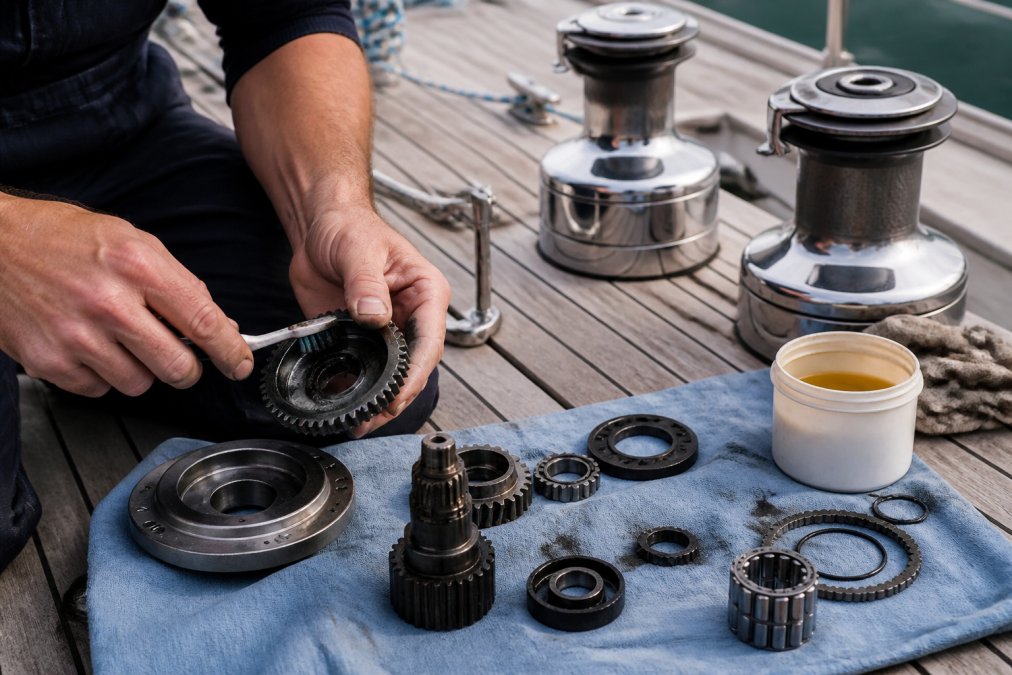
Check these areas closely:
- Gear teeth for pitting or flat spots
- The bearing cage for bent or missing rollers
- The spindle for corrosion or scoring
- The drum interior for salt buildup
Signs of Worn Winch Pawls and Springs
Worn pawls and springs are the number one cause of winch failure and cost almost nothing to replace. Inspect them every service, even if the winch feels fine.
Replace a pawl if you see:
- Rounded or flattened tips
- Cracks along the body
- Uneven wear on one side
- Any sign of corrosion
How Often to Service Sailboat Winches
Most guides give a frequency table and stop. The better question: how do you know when your winch needs service, and what stretches the interval between teardowns?
The baseline schedule
Service winches at least once in the preseason, twice a season in salt water, and before every regatta if you race hard.
| Sailing Pattern | Full Service Frequency | Key Reason |
|---|---|---|
| Weekend cruising, freshwater | Once per season | Low salt exposure |
| Weekend cruising, saltwater | Twice per season | Salt and corrosion |
| Regular racing | Before each regatta | High load-bearing stress |
| Offshore or liveaboard | Every 2-3 months | Constant exposure |
The in-season quick service (the part most owners skip)
Between full services, a five-minute routine keeps salt and grit from turning into grinding paste:
- Flush with fresh water. A quick rinse of the drum and the gap around the spindle washes salt out before it can crystallize. Do this after any wet or salty passage.
- Spin the drum by hand. It should turn freely and quietly. Grinding, catching, or a gritty feel means grit has worked into the bearings.
- Listen for the pawls. A healthy winch clicks cleanly in both directions. A weak or missing click is your earliest warning that a pawl or spring is failing.
- Check the drum for lift. Grab the drum and try to lift it. Any vertical play means the top screw or circlip is loose or the bearing stack has worn.
- Wipe the drum exterior. Salt and dirt on the outside migrate inside over time.
Preventative vs. reactive: the real cost comparison
A winch serviced on schedule costs an hour and a small tub of grease. One that fails under load costs far more:
- A slipping winch mid-trim can mean a lost race or a dangerous situation in heavy weather.
- A seized drum often means a haul-out or a rigger's visit to free it.
- Corrosion that reaches the spindle can require replacing the whole winch, not just the pawls.
Signs it is time to service early
Do not wait for the calendar if you notice any of these:
- The drum turns roughly or with a grinding feel.
- The winch slips under load, even briefly.
- You hear a weak or inconsistent click from the pawls.
- The drum wobbles or lifts.
- You see rust streaks or salt crust around the spindle.
- The winch has been submerged or drenched in a storm.
A note on storage
If your boat is laid up for winter, service the winches before storage, not after. Grease applied before layup protects the metal through the off-season, so you start the next season clean and lubricated, spring servicing means the winch sat all winter with old grease and leftover salt.
Best Marine Grease for Winches and How to Apply It
Winch lubrication is two products for two load regimes. Getting this split right is the biggest factor in how long pawls, springs, and bearings survive.
What actually separates a winch grease from automotive grease
A marine winch grease is defined by three things:
- Thickener type. Most winch greases use a lithium-complex or calcium-sulfonate thickener. Calcium-sulfonate is the more water-resistant of the two and is what many purpose-built marine greases use. Lithium-complex is common and works well but can emulsify if water sits in the winch for long periods.
- Base oil viscosity. A winch grease needs enough viscosity to stay on a gear tooth under load but not so much that it channels away from the contact patch. This is why heavy wheel-bearing grease is a poor substitute.
- Water resistance and washout. The grease should resist being rinsed out by spray and rain. A grease that turns milky or runs out of the drum after a wet passage is the wrong grease.
Grease vs. oil: the split that matters
| Component | Lubricant | Why |
|---|---|---|
| Gears and gear teeth | Marine winch grease | High load, needs a persistent film |
| Roller or ball bearings | Marine winch grease | Slow rotation, load-bearing |
| Spindle and bearing races | Marine winch grease | Corrosion protection plus load film |
| Pawls | Light winch oil | Must move freely and snap back |
| Pawl springs | Light winch oil | Same, grease makes them sluggish |
If you only remember one rule: grease the things that carry load, oil the things that move.
Choosing a grease without overthinking it
You don't need the newest formula, just a grease (1) labeled for marine winch use, (2) compatible with your winch's existing thickener, and (3) thin enough to apply in a see-through coat.
A note on marine-safe options
Most conventional winch greases are petroleum-based and slowly wash out over a season. For sensitive waters, look for a biodegradable base oil and marine-safe thickener. These perform well but usually mean a slightly shorter service interval, so inspect more often.
How to apply it correctly
- Apply a thin, even coat to gear teeth and bearing surfaces. You should still be able to see the metal through the grease.
- Do not pack the winch. Excess grease traps grit, adds drag, and squeezes out where you do not want it.
- Add one drop of light winch oil to each pawl and each spring. One drop, not a puddle.
- Wipe away any grease that squeezes out during reassembly. Grease on the drum exterior collects dirt and salt.
- Re-check after the first sail of the season. New grease will migrate slightly as the winch works, and a light touch-up on the gears is normal.
Over-greasing is the most common servicing error and the easiest to avoid, one small tub of winch grease typically lasts several seasons of full service.
Common Mistakes That Shorten Winch Life
Most winch damage comes from a handful of avoidable errors. Fix these and your hardware outlasts your boat.
The biggest offenders:
- Over-greasing. Thick grease on pawls makes them stick and slip.
- Skipping the freshwater flush. Salt left in place becomes corrosion.
- Reusing worn springs. They fail under load, often at the worst moment.
- Mixing grease types. Different formulas can break each other down.
- Losing the circlip. A missing circlip lets the drum lift under load.
- Forcing stuck parts. Prying bends the spindle and ruins the drum fit.
Reassembly and Final Checks
Reassembly is disassembly in reverse: follow your photo order, work bottom up, and grease each layer as you build it.
Once it's together, test it:
- Spin the drum by hand. It should turn smoothly with no grinding.
- Load a line and grind slowly. Listen for clicks from the pawls.
- Check that the drum doesn't lift or wobble.
- Confirm the winch handle locks in and releases cleanly.
Frequently Asked Questions
How often should you service sailboat winches?
Service winches at least once during the preseason. If your boat lives in salt water, twice a season is best. Racers should maintain winches before every regatta. Freshwater flushing after each sail extends intervals, but annual disassembly and greasing remains essential for longevity.
What is the best grease for sailboat winches?
Use a marine-grade winch grease designed for high-load, saltwater environments. Charleston Yachting offers High Performance Winch Grease (White) for $13.95, which protects pawls, springs, and bearings from corrosion and friction. Avoid standard marine grease on pawls; it can gum up and cause sticking.
What are the signs that a sailboat winch needs servicing?
Watch for grinding noises, stiff rotation, visible corrosion, or a winch handle that binds. Worn pawls may fail to lock, causing the drum to slip under load. If you notice these signs, disassemble, clean, and relubricate immediately to prevent mechanical failure.
Can you use standard marine grease on winch pawls?
No. Pawls and springs require a light, non-gumming lubricant. Standard marine grease is too thick and can cause pawls to stick, leading to slippage. Use a dedicated winch grease or a light oil for pawls, and apply grease sparingly to gears and bearings only.
Servicing your own winches is one of the highest-value skills a boat owner can learn, and the payoff is years of reliable hardware. The catch is sourcing the right parts and grease before the job starts. Charleston Yachting stocks marine-grade winch grease, pawls, springs, and Harken winch handles, all with same-day shipping so your service doesn't stall waiting on a box. Shop All and get your winches running smooth before the next sail.