

10 Long Range Marine Communication Devices Explained

Table of Contents
- How Marine Communication Devices Extend Your Range at Sea
- Quick Comparison: 10 Long Range Marine Communication Devices
- 1. Icom IC-M803 SSB Radio: HF Radio for Boats That Cross Oceans
- 2. Garmin inReach Messenger Plus: Marine Satellite Communication in Your Pocket
- 3. Garmin GPSMAP 86sci: Handheld Navigation and Satellite Messaging Combined
- 4. Icom IP-M60 Hybrid LTE Plus: Dual-Network Communication for Coastal Waters
- 5. Icom IC-M94D: The Best Handheld Marine Radio with Built-In AIS
- 6. ACR SR303 Survival Radio Kit: GMDSS-Certified Emergency Communication
- 7. em-trak X100: Fixed VHF with Class B AIS That Transmits
- 8. Icom IC-M510 EVO: NMEA 2000 Fixed VHF for Integrated Helms
- 9. Garmin Signal 220: VHF Radio with Built-In AIS Receiver
- 10. Ocean Signal rescueME EPIRB3: Global Distress Alerting
- How to Choose and Build Redundancy
- Frequently Asked Questions
Last Updated: October 6, 2026
How Marine Communication Devices Extend Your Range at Sea
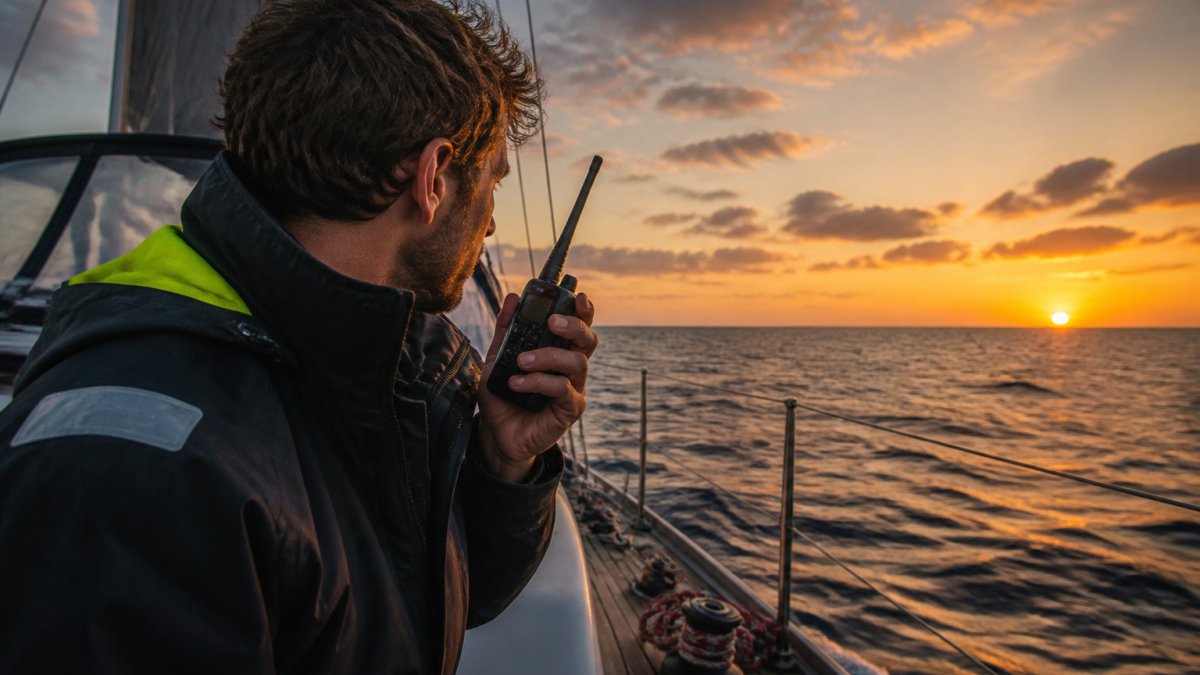
Marine communication is the practice of sending voice, data, or distress signals between vessels, shore stations, and rescue services using radio and satellite networks. The device you choose decides how far that signal reaches: a handheld VHF radio covers line-of-sight distances, while an HF radio for boats or a satellite communicator can reach across oceans.
Range is not a single number. It depends on antenna height, frequency band, and weather. That is why two radios with the same power rating can perform very differently offshore.
Below, we rank ten long-range marine communication devices and explain what each does beyond the coastline.
Quick Comparison: 10 Long Range Marine Communication Devices
The figures below are realistic planning ranges under typical conditions, not marketing maximums. Actual range depends on antenna height, frequency band, weather, and terrain.
| Device | Type | Network | Realistic Range | Best For |
|---|---|---|---|---|
| Icom IC-M803 SSB Radio | MF/HF SSB | HF (0.5-29.99 MHz) | Thousands of miles, ocean-crossing with propagation | Bluewater cruisers |
| Garmin inReach Messenger Plus | Satellite messenger | Iridium | Global, pole-to-pole | Offshore safety backup |
| Garmin GPSMAP 86sci | Handheld GPS + satellite | Iridium | Global messaging, coastal charts | Backup navigation |
| Icom IP-M60 Hybrid LTE Plus | VHF + LTE hybrid | Marine VHF + cellular | Coastal and inland, roughly cellular coverage plus VHF line-of-sight | Ports, rivers, races |
| Icom IC-M94D | Handheld VHF with AIS | Marine VHF | Line-of-sight, typically a few miles handheld-to-handheld, farther to a tall shore station | Cockpit and dinghy carry |
| ACR SR303 Survival Radio Kit | GMDSS survival VHF | Marine VHF | Line-of-sight, optimized for rescue aircraft and nearby vessels | Liferaft and abandon-ship |
| em-trak X100 | Fixed VHF + Class B AIS | Marine VHF + AIS | Coastal, AIS transmit and receive | Safety-conscious cruisers |
| Icom IC-M510 EVO | Fixed VHF | Marine VHF | Coastal, 25W fixed with mast-height antenna | Integrated helm setups |
| Garmin Signal 220 | Fixed VHF + AIS receive | Marine VHF + AIS | Coastal, single antenna | Simple installation |
| Ocean Signal rescueME EPIRB3 | 406 MHz EPIRB | Cospas-Sarsat | Global distress alert | Offshore emergency beacon |
What actually limits range
- Antenna height: VHF is line-of-sight. A handheld at deck level and a fixed radio with a mast-top antenna on the same 25W can differ by many miles. Raising the antenna is often more effective than raising the power.
- Frequency band: VHF works over short coastal distances but does not bend over the horizon. HF refracts off the ionosphere, which is why an SSB radio can reach across an ocean, and why its range changes with time of day and solar conditions.
- Atmospheric and solar conditions: HF propagation varies by band, time of day, and solar activity. A frequency that works at noon may be dead at midnight.
How to read the table
Use the range column as a planning floor, not a guarantee. If your voyage goes beyond the realistic range of your primary device, add a second device on a different network, not a higher-power version of the same one.
![Icom IC-M803 SSB Radio [M803 21 USA]](https://cdn.shopify.com/s/files/1/0842/4914/9751/files/114525XL.jpg?v=1781606134)
1. Icom IC-M803 SSB Radio: HF Radio for Boats That Cross Oceans
The IC-M803 is our recommendation for open-ocean passages: a 150W SSB transceiver covering 0.5 to 29.99 MHz, with Class E DSC MF/HF certification and 830 channels.
Built-in GPS feeds position data into distress calls, and the dedicated DSC watch receiver scans six distress channels, with Multiple Task Mode switching between them mid-call.
What most guides miss is the two-minute instant replay.
Price: $2,999.95 at Charleston Yachting.
2. Garmin inReach Messenger Plus: Marine Satellite Communication in Your Pocket
Satellite messaging is the cheapest insurance you can carry offshore. The inReach Messenger Plus sends text, photo, and voice messages over the 100% global Iridium network beyond cellular range.
![Garmin inReach Messenger Plus SOS Satellite Communicator w/Photo Voice Messaging [010-02887-00]](https://cdn.shopify.com/s/files/1/0842/4914/9751/files/105880XL.jpg?v=1775849293)
The interactive SOS button routes to Garmin Response, a 24/7 coordination center.
It also charges your phone, minor until your handset dies mid-passage and the messenger becomes your only link home.
Price: $399.99 at Charleston Yachting.
3. Garmin GPSMAP 86sci: Handheld Navigation and Satellite Messaging Combined
For sailors who want one handheld that navigates and communicates, the GPSMAP 86sci pairs preloaded BlueChart g3 coastal charts with built-in inReach satellite technology on the same Iridium network.
![Garmin GPSMAP 86sci Handheld w/inReach BlueChart g3 Coastal Charts [010-02236-02]](https://cdn.shopify.com/s/files/1/0842/4914/9751/files/80409XL.jpg?v=1775845977)
The 3-inch sunlight-readable display floats if you drop it, and boat data streams from compatible chartplotters so your handheld mirrors the helm. It also remotes Garmin autopilots and select FUSION marine products, with battery life up to 35 hours in 10-minute tracking mode.
Price: $699.99 at Charleston Yachting.
4. Icom IP-M60 Hybrid LTE Plus: Dual-Network Communication for Coastal Waters
The IP-M60 combines marine VHF and LTE cellular in a single handheld, the first hybrid IP radio of its kind. That dual-network design suits ports, rivers, and canals, where you need to reach both vessels and shore contacts.
Cellular and marine modes run simultaneously, with audio mixed and separate PTT buttons. Adaptive PTT switches automatically to marine mode in a preprogrammed area, and the unit is tested to MIL-STD-810 and rated IP67.
Price: $1,100.00 at Charleston Yachting.
5. Icom IC-M94D: The Best Handheld Marine Radio with Built-In AIS
The IC-M94D is our top handheld pick, packing an integrated AIS receiver and Class-H DSC into a 6W radio with a 2400 mAh battery good for roughly 10 hours.
AIS traffic shows on the display, and the target call function sets up a DSC individual call in a few presses. Float'n Flash keeps a flashing LED on the surface if you drop it overboard.
Price: $399.95 at Charleston Yachting.
6. ACR SR303 Survival Radio Kit: GMDSS-Certified Emergency Communication
The SR303 is built for the worst case: abandoning ship. This GMDSS survival radio is certified to IMO and SOLAS regulations and designed to be operated while wearing survival suit gloves.
The kit includes a primary lithium battery with a witness label, a rechargeable lithium-ion battery, a charging base, and a 12V supply plug.
Battery replacement interval on the primary cell is five years. Mark the date.
Icom IC-M803 SSB Radio [M803 21 USA] →
Price: $1,409.95 at Charleston Yachting.
7. em-trak X100: Fixed VHF with Class B AIS That Transmits
The X100 pairs a Class D VHF/DSC radio with a high-powered Class B AIS transceiver that receives and transmits, so other vessels see you, not just the other way around.
An integrated zero-loss antenna splitter means one VHF antenna serves both AIS and radio. The CONNECT-X app turns up to 10 phones or smartwatches into wireless command mics, and the MOB function alerts every connected device if someone leaves the boat.
Price: $1,682.01 at Charleston Yachting.
8. Icom IC-M510 EVO: NMEA 2000 Fixed VHF for Integrated Helms
The IC-M510 EVO is a 25W fixed VHF with built-in Class D DSC and NMEA 2000 connectivity, sharing GPS position, DSC calls, and channel data with your multifunction display.
The RS-M500 app lets up to three smart devices act as wireless mics, intercoms, or remote controls, while the built-in 25W hailer and 20W RX hailer sound foghorn patterns through an optional horn speaker.
Price: $799.95 at Charleston Yachting.
9. Garmin Signal 220: VHF Radio with Built-In AIS Receiver
The Signal 220 keeps installation simple: VHF, DSC, and AIS receive all run off a single VHF antenna, with the GPS receiver built in.
Automated squelch cuts background noise, and audio playback replays a missed message. The AIS plotter view shows range, course, and crossing situations, and you can call any AIS-equipped vessel with a tap.
Price: $999.99 at Charleston Yachting.
10. Ocean Signal rescueME EPIRB3: Global Distress Alerting
An EPIRB is not for conversation. The rescueME EPIRB3 transmits a 406 MHz Cospas-Sarsat distress signal with GPS, Galileo, and GLONASS positioning, plus a 121.5 MHz homing signal and an AIS alert for local rescuers.
Return Link Service confirms your distress message was received, which matters when you are waiting. The battery lasts 10 years, and the buoyant unit has a 48-hour operational life. No subscription required.
Price: $899.95 at Charleston Yachting.
How to Choose and Build Redundancy
No single device covers every scenario, and the most common failure offshore is not a dead radio, it is a dead battery, a corroded connector, or a lapsed subscription. Redundancy means independent systems, power, and networks, not two radios sharing one antenna and one breaker.
Map devices to the voyage, not the budget
- Day sailing and coastal cruising: A fixed VHF with DSC and AIS receive at the helm, plus a floating handheld in the cockpit. Both ride the same VHF network, so add a charged phone in a waterproof pouch as a shore-side backup.
- Extended coastal and overnight passages: Add a satellite messenger for shore contact and a second power source (a USB battery bank rated for the messenger's input), keeping the handheld and fixed radio on separate circuits.
- Bluewater and ocean crossings: Layer an HF/SSB radio, a satellite messenger or satellite phone, and a 406 MHz EPIRB. These use three different networks, HF, Iridium, and Cospas-Sarsat, so one outage cannot take all three offline.
Build redundancy in three layers
- Network redundancy: VHF, HF, satellite, and Cospas-Sarsat are separate paths. Two devices on the same network are not redundant.
- Power redundancy: A handheld with its own battery, a spare lithium pack, and a 12V charging path independent of the engine, often a small solar panel or a dedicated house bank circuit for the comms stack.
- Antenna and cabling redundancy: A spare VHF antenna and coax stored below deck. Antenna and connector failures are the most frequent cause of a radio that powers on but does not transmit.
Total cost of ownership, not sticker price
The purchase price is the smallest number in most of these systems. The framework:
- Hardware: The radio, messenger, or beacon itself.
- Installation and accessories: Antenna, tuner, coax, mounts, and labor. An HF radio typically needs an automatic antenna tuner and a proper counterpoise, adding a meaningful percentage to hardware cost.
- Airtime and data plans: Satellite messengers and phones require an active subscription; EPIRBs and PLBs do not. A device with no subscription is only useful if you keep it registered and the battery in date.
When you compare two devices, compare the five-year cost, not the checkout total.
Licensing and operating regulations
Licensing and operating regulations apply. In the United States, the FCC marine radio licensing rules govern ship station licenses and operator permits. For distress procedure, follow the US Coast Guard boating safety guidance on channel 16 use and DSC registration. Register your EPIRB or PLB with NOAA, and keep the registration current, an unregistered beacon slows rescue coordination.
A simple decision rule
If you cannot name the network, power source, and antenna for each device on board, you do not yet have redundancy. Write it down, label the breakers, and test the whole stack before you leave the dock.
Frequently Asked Questions
What is the best handheld radio for long-distance calling?
The Icom IC-M94D is a strong handheld option for long-distance calling, with 6 watts of transmit power, built-in AIS, and DSC capabilities for reaching other vessels and coast stations. For truly offshore communication beyond VHF range, pair a handheld with a satellite communicator like the Garmin inReach Messenger Plus or a fixed-mount SSB radio. Handheld VHF range typically reaches 5-10 miles depending on antenna height and conditions.
How far can a marine VHF radio reach?
Marine VHF radio range depends on antenna height and conditions. Handheld units typically reach 5-10 miles, while fixed-mount radios with mast-mounted antennas can reach 20-30 miles or more. The Garmin Signal 220 VHF, for example, transmits at 25 watts for extended coverage. Line of sight is the limiting factor, so higher antennas and calm seas improve range significantly.
Do you need satellite communication for offshore sailing?
Yes, satellite communication is essential for offshore sailing beyond VHF coverage. Devices like the Garmin inReach Messenger Plus use the Iridium satellite network for global text, photo, and voice messaging, plus interactive SOS. The Ocean Signal rescueME EPIRB3 provides 406 MHz distress signaling with no subscription required. For ocean crossings, satellite communication is your primary link to shore and rescue services.
What is the difference between HF radio and satellite communication at sea?
HF radio, like the Icom IC-M803 SSB, uses radio frequencies to communicate over long distances without subscriptions, reaching ham and marine channels. Satellite communication uses orbiting satellites for reliable global coverage but requires a subscription. HF radio depends on propagation conditions, while satellite offers consistent connectivity. Many offshore sailors carry both for redundancy.
Which marine radio works best beyond VHF range?
Beyond VHF range, the Icom IC-M803 SSB radio is the top choice for voice communication over hundreds of miles using MF/HF frequencies. For data and messaging, satellite communicators like the Garmin inReach Messenger Plus work globally via the Iridium network. The ACR SR303 GMDSS radio provides emergency VHF communication certified for SOLAS-regulated vessels.
Outfitting a vessel for real range takes more than one radio. Charleston Yachting carries the Icom, Garmin, ACR, and Ocean Signal gear covered here, with same-day shipping on in-stock items and premium rigging and hardware alongside our electronics selection. Browse our marine electronics lineup and build a communication plan that holds up when the coastline disappears. Shop All.