

Why You Need a Wind Transducer for Racing

Table of Contents
- What a Wind Transducer Does and Why It Matters for Racing
- Ultrasonic vs. Mechanical Wind Sensors: Which Type Performs Better
- Masthead Placement and Upwash Effects on Wind Data Accuracy
- How to Interpret Apparent Wind Angle and Improve Performance
- Calibrating Marine Wind Instruments for Peak Accuracy
- Integration with Your Existing Instruments and Autopilot
- Cost-Benefit Analysis for Club-Level Racing
- Troubleshooting Common Wind Transducer Issues
- Frequently Asked Questions
Last Updated: October 1, 2026
What a Wind Transducer Does and Why It Matters for Racing
A wind transducer is a sensor mounted at the masthead that measures both wind speed and direction, feeding real-time data directly to your onboard instruments and autopilot, and understanding why you need a wind transducer for racing is essential for competitive sailors. For racing sailors, accurate wind data isn't optional, it's the difference between winning and finishing mid-fleet.
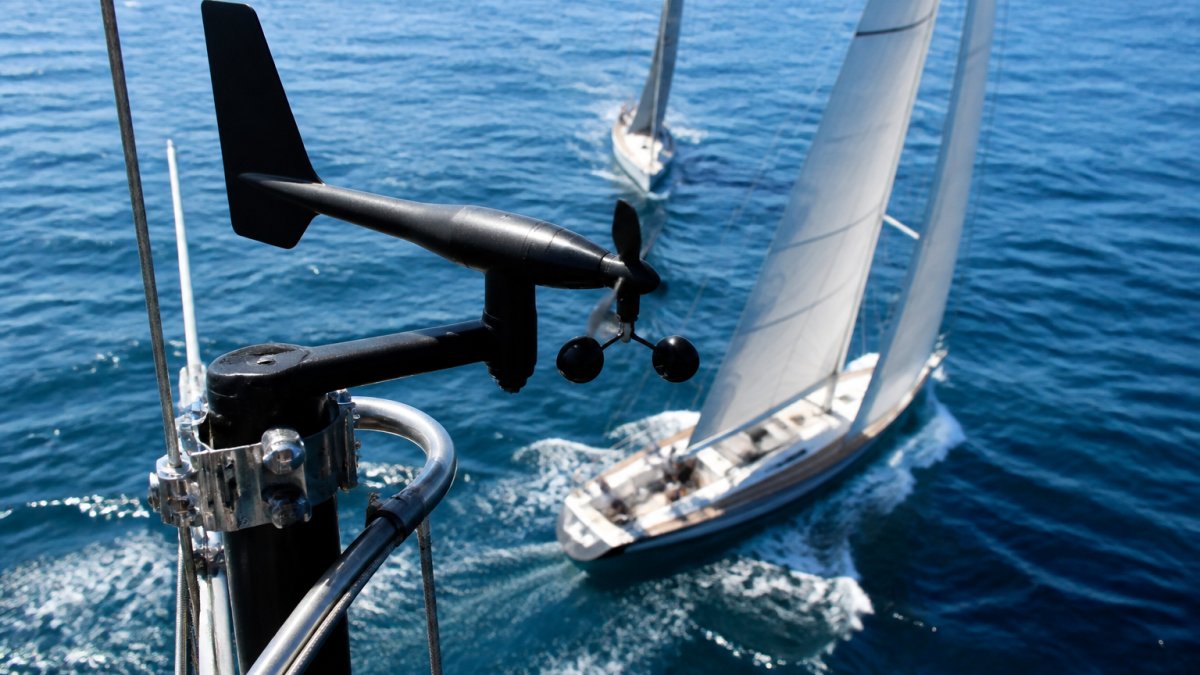
Most recreational sailors think their existing instruments are "good enough." They're not. A quality wind transducer eliminates guesswork from tactical decisions, telling you whether the wind shifted two degrees or ten, and whether a lull is coming or the breeze is building. That real-time data changes how you trim sails, when you tack, and which mark you can lay.
Charleston Yachting offers professional-grade wind sensors from brands like Raymarine and B&G.
Apparent Wind vs. True Wind Speed
Apparent wind is what you feel on deck, the combination of true wind and the wind created by your boat's motion. Your sails respond to apparent wind, but tactical decisions depend on understanding true wind, what's actually happening in the atmosphere.
Apparent wind angle changes with every course or speed change. A 10-knot true breeze feels like 15 knots close-hauled at 5 knots boat speed, but only 8 knots downwind. Without automatic true wind calculation, you're making tactical decisions on incomplete information.
A quality wind transducer samples wind data dozens of times per second and calculates true wind continuously, displaying both values so you always know what the atmosphere is actually doing.
Real-Time Data for Tactical Decisions
Tactical racing is about reacting to wind shifts before competitors do. A five-degree shift can mean the difference between laying the mark and needing an extra tack. Real-time wind data lets you respond instantly.
Modern wind transducers output data at high update rates, the B&G WS320 delivers wind calculations five times per second. Older mechanical sensors update once per second or less. At 8 knots boat speed, a one-second delay means you're 13 feet past the wind shift. Real-time data collapses that lag.
![BG WS320 Wireless Wind Sensor Pack with Wireless Interface Module [000-14383-001]](https://cdn.shopify.com/s/files/1/0842/4914/9751/files/72638XL.jpg?v=1775845080)
Ultrasonic vs. Mechanical Wind Sensors: Which Type Performs Better
The two dominant wind sensor technologies are mechanical vane sensors and ultrasonic sensors. Each has distinct advantages and trade-offs.
Mechanical Vane Sensors
Mechanical vane sensors use a physical propeller for wind speed and a vane for direction. They're proven, reliable, and well-understood by service technicians.
Mechanical sensors are simple and affordable. A vane responds directly to wind with no digital processing. Failures are usually visible: bent vane, stuck bearing, or corroded connector.
The weakness is environmental sensitivity. Salt spray corrodes bearings and deposits slow propeller rotation. Mechanical sensors require frequent calibration as bearing friction changes. In heavy air they overspin; in light air below 3 knots, propeller friction degrades accuracy.
Ultrasonic Sensors
Ultrasonic sensors measure wind by detecting sound speed between transducer elements, no moving parts, no propeller, no vane.
Without moving parts, nothing corrodes or wears out. Ultrasonic sensors maintain accuracy from near-zero to extreme wind, sample at 5-10 Hz or higher, and produce smooth output. The B&G WS320 wireless sensor delivers comparable accuracy to wired sensors while eliminating mast cables.
The trade-off is cost and troubleshooting complexity. Ultrasonic sensors are more expensive and require digital test equipment for diagnosis.
For racing, ultrasonic sensors are standard because the performance advantage in light air and extremes outweighs cost, which is why you need a wind transducer for racing if you're serious about competitive performance. The Raymarine RSW Wired Smart Performance Wind Transducer uses ultrasonic technology with wind tunnel-tested accuracy for sailing.
![Raymarine RSW Wired - Smart Performance Wind Transducer - Short Arm w/30M Cable [E70670]](https://cdn.shopify.com/s/files/1/0842/4914/9751/files/102244XL.jpg?v=1775848751)
Masthead Placement and Upwash Effects on Wind Data Accuracy
Where you mount your wind transducer matters as much as which sensor you choose. Masthead placement is standard, the sensor sits at the top of the mast, exposed to undisturbed wind. But "undisturbed" is relative.
Upwash is wind deflection around your mast and rigging. A masthead transducer measures upwashed wind, not true free-stream wind. The effect is small, typically 1-3 degrees of apparent wind angle error, but consistent and directional.
Professional racing teams measure upwash error during calibration and adjust instrument calibration to compensate. A transducer reading perfectly on a test rig can still introduce systematic error on your boat if upwash isn't accounted for.
Modern sensors like the Raymarine RSW are wind tunnel tested and factory-tuned to minimize upwash sensitivity, reducing the need for extensive on-boat calibration.
The practical takeaway: don't assume your wind data is automatically accurate. Account for upwash either through professional calibration or by understanding the systematic bias your rig introduces, then adjust your tactical decisions accordingly.
Raymarine RSW Wired - Smart Performance Wind Transducer - Short Arm w/30M Cable →
How to Interpret Apparent Wind Angle and Improve Performance
Apparent wind angle is the direction the wind appears to come from relative to your boat's heading. It's the angle your sails "see." Understanding how to read and use apparent wind angle is fundamental to faster sailing.
Racing instruments display apparent wind angle on a clear scale. Look for stability and symmetry: port and starboard tack angles should mirror each other. Consistent 2-degree differences signal calibration issues or rigging asymmetry.
In light air, small boat speed changes create noticeable apparent wind angle shifts. A 3-degree increase with stable true wind signals dropped boat speed, adjust trim or technique immediately.
Racing sailors use apparent wind angle trends to detect incoming pressure. Monitoring these shifts lets you position ahead of competitors.
Calibrating Marine Wind Instruments for Peak Accuracy
Wind transducers need calibration for accurate data. Factory calibration gets you close, but your specific boat, mast, and rigging require fine-tuning.
Calibration involves sailing a known course in light wind and comparing instrument readings against a reference standard. Many teams use a handheld anemometer, though some calibrate against known wind patterns or use a calibration service.
The key variables to calibrate are wind speed offset and wind angle offset. Wind speed offset accounts for the systematic bias your rig creates, typically a 1-5% overestimation or underestimation. Wind angle offset compensates for upwash and rigging asymmetry. Most modern instruments let you enter these offsets directly.
Calibration doesn't need to be perfect. A 2-3% wind speed error and 1-2 degree wind angle error are acceptable for club racing. The goal is consistency.
Integration with Your Existing Instruments and Autopilot
A new wind transducer only delivers value if it integrates with your existing instruments and autopilot. Incompatible equipment wastes money.
Most marine electronics use NMEA 2000 or NMEA 0183 for data communication. Before purchasing, verify your chartplotter, autopilot, and displays support the same standard. The Raymarine RSW Wired uses NMEA 2000 via SeaTalk NG; B&G sensors also use NMEA 2000.
Wireless sensors like the B&G WS320 add complexity with a wireless interface module. They're convenient, no mast cables, but introduce potential latency and require battery management.
For racing, latency matters. A 100-millisecond delay is acceptable; 500 milliseconds degrades tactical response. Wired sensors eliminate wireless latency.
The practical recommendation: if you're integrating a new wind transducer into an existing system, contact your electronics installer before purchasing. Compatibility issues are rare with modern equipment, but they're expensive to solve after you've already bought the sensor.
Cost-Benefit Analysis for Club-Level Racing
A professional-grade wind transducer costs between $850 and $950 for a complete system. That's a real investment for a club racer. The question is whether the performance gain justifies the cost.
For competitive club racers (top 20% finishers), the answer is yes. Better wind data translates to better tactical decisions and better finishes. A quality wind transducer is one of the highest-return upgrades available.
For casual club racers racing for fun, a wind transducer is a luxury, not a necessity.
Troubleshooting Common Wind Transducer Issues
Wind transducers fail occasionally. Most failures are preventable with basic maintenance and understanding.
| Wind Transducer Type | Technology | Best For | Key Advantage |
|---|---|---|---|
| Mechanical Vane | Propeller + vane | Budget-conscious sailors | Simple, proven, affordable |
| Ultrasonic | Sound-based measurement | Racing, light air, durability | No moving parts, high accuracy |
| Wireless Ultrasonic | Ultrasonic + wireless interface | Clean installations, small boats | No mast cable, same accuracy |
Frequently Asked Questions
What is the difference between a mechanical and ultrasonic wind transducer?
Mechanical wind sensors use a rotating vane and cup anemometer to measure wind speed and direction, while ultrasonic sensors emit sound waves to detect wind without moving parts. Ultrasonic sensors have faster update rates (typically 5-10 Hz) and no moving components to wear out, making them more reliable in harsh marine conditions. Mechanical sensors are simpler and often less expensive, but may experience drift and require more frequent calibration. For serious racing, ultrasonic sensors deliver superior real-time telemetry and consistency across all points of sail.
How accurate are modern marine anemometers for racing?
Modern wind transducers like the Raymarine RSW Wired and B&G WS320 deliver nautical precision through rigorous wind tunnel testing and digital signal processing. The B&G WS320 has been benchmarked against multiple sensors in over 500 wind tunnel tests and subjected to combined field tests exceeding 200,000 hours. Accuracy typically falls within 1-2 knots for wind speed and 2-3 degrees for wind angle when properly calibrated. This precision is critical for performance sailing, as even small errors in wind data can cost you tactical advantage during a race.
Why do racing sailors prefer vertical wind sensors over horizontal designs?
Vertical masthead units minimize aerodynamic interference and wind gradient effects that distort data. A horizontal sensor placement can create upwash around the mast and boom, causing apparent wind readings to skew higher than true wind speed. Vertical sensors mounted at the highest point of the mast experience cleaner, undisturbed airflow and deliver more accurate wind vector calculations. This positioning is especially important for tactical decision-making during close racing, where every knot and degree of wind angle directly influences your boat speed optimization and race strategy.
What are the signs that your wind transducer needs replacing?
Watch for sensor drift, where readings gradually become inconsistent with actual conditions. Mechanical sensors may show erratic jumps in wind speed or angle, while ultrasonic units might display freezing or delayed updates (high latency). Physical damage from UV exposure, corrosion, or impact will also degrade performance. If your wind data no longer matches conditions you feel on deck or conflicts with other instruments, it's time for replacement. Environmental conditions like salt spray and extreme temperature swings can accelerate degradation, making regular inspection essential for maintaining reliable real-time telemetry during racing.