

How Long Does a Marine GPS Unit Last

Table of Contents
- Average Lifespan of Marine GPS Units
- Hardware vs. Software Obsolescence in Marine Electronics
- Signs of Marine GPS Failure and When to Replace
- Environmental Factors Affecting Your GPS Longevity
- Marine GPS Firmware Updates and System Support
- Marine Electronics Replacement Cycle and Upgrade Planning
- Battery Health and Maintenance for Extended Performance
- Repair vs. Replace: A Cost-Benefit Analysis
- Frequently Asked Questions
Last Updated: September 30, 2026
Average Lifespan of Marine GPS Units
A marine GPS unit last typically lasts 5 to 10 years under normal conditions, though lifespan depends heavily on maintenance and environment.
Modern chartplotters resist saltwater exposure, but "still works" and "works reliably" differ. A 15-year-old GPS may power on with a dimmed display, lagging processor, and no software support.
The real question is whether your unit keeps pace with your needs. If approaching a decade and noticing slowdowns, replacement is worth considering.
Hardware vs. Software Obsolescence in Marine Electronics
Hardware failure and software obsolescence are separate problems. Physical components may outlast usefulness when software support ends.
Hardware obsolescence occurs when displays fade, buttons wear out, and circuitry degrades. Most marine GPS units last 10-15 years before hardware degradation becomes noticeable.
Software obsolescence is the bigger threat. Once firmware updates stop, your unit becomes vulnerable to compatibility issues. New transducers, autopilots, and sonar systems may not work because they use incompatible protocols.
A Garmin chartplotter from 2015 may display charts perfectly but cannot integrate new side imaging transducers or modern autopilots due to processing and software limitations.
Many boat owners upgrade not because their GPS failed, but because they cannot expand their marine system without replacing it.
Signs of Marine GPS Failure and When to Replace
Watch for these specific indicators that your marine GPS unit is nearing the end of its useful life:
- Display dimming or discoloration signals 1-3 years of remaining lifespan.
- Slow processing or freezing often precedes failure by 6-12 months.
- Loss of GPS signal or erratic positioning indicates receiver failure.
- Inability to accept firmware updates means no compatibility fixes or security patches.
- Physical water intrusion or corrosion requires urgent replacement.
- Incompatibility with new gear signals replacement is needed.
The decision to replace isn't about failure, it's whether the unit meets your needs. A GPS that can't integrate with new autopilots is effectively obsolete.
Environmental Factors Affecting Your GPS Longevity
Saltwater, UV radiation, temperature cycling, and humidity degrade marine GPS units. Understanding these mechanisms helps predict component failure.
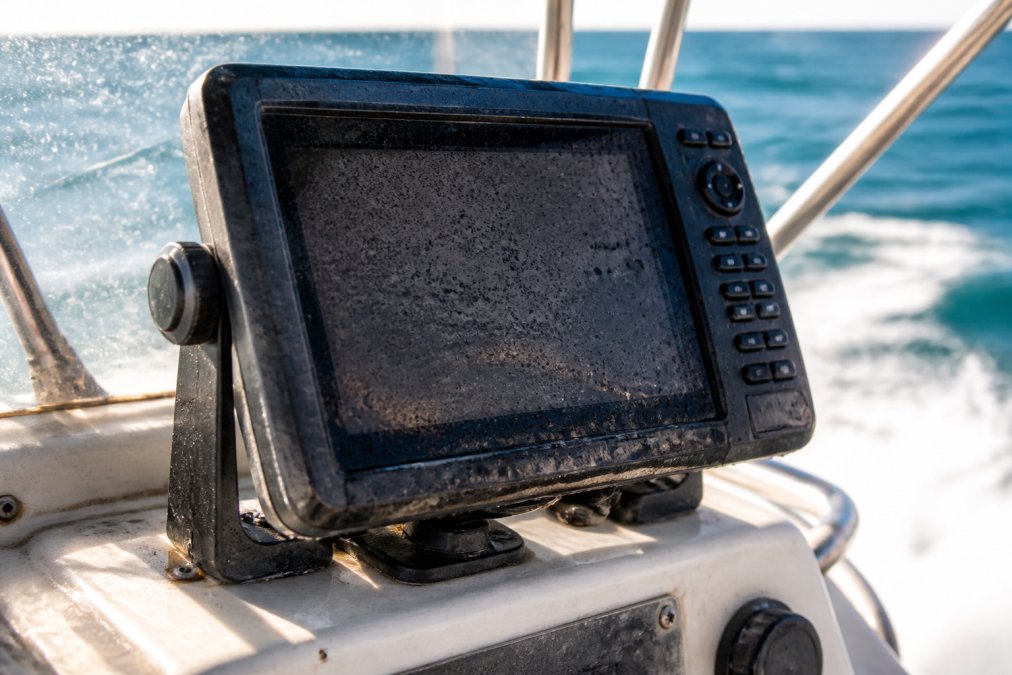
Saltwater corrosion: The primary threat
Salt spray penetrates seals and corrodes internal circuitry. Sodium chloride particles create micro-galvanic cells that accelerate corrosion of copper traces and solder joints.
Damage is progressive and invisible until severe. After one year, internal connectors show measurable corrosion. After five years, corroded connections may fail entirely.
A GPS on an open console in saltwater experiences 5-10 times more salt exposure than one in a cabin. Assume corrosion is occurring continuously in coastal waters.
Maintenance protocol for saltwater environments:
- Rinse the unit and hardware with fresh water after every saltwater outing.
- Inspect connector pins monthly for corrosion; clean and apply dielectric grease if needed.
- Check mounting hardware quarterly; replace corroded fasteners with marine-grade stainless steel.
- Apply protective coating every 6 months.
UV radiation and display degradation
Ultraviolet radiation damages LCD panels and degrades plastics. The display becomes dimmer and less responsive; plastics become brittle.
A GPS unit left uncovered in direct sunlight for five years shows noticeably reduced contrast. Prolonged UV exposure can cause display failure.
Units under a hardtop age significantly slower. Cabin or hardtop mounting extends display lifespan by 3-5 years.
Temperature cycling and mechanical stress
Daily temperature swings cause expansion and contraction of internal components at different rates, creating mechanical stress that cracks solder joints and causes intermittent failures.
Tropical boats experience more extreme temperature cycling. A Florida boat might see 40°F daily swings versus 20°F in the Pacific Northwest, doubling mechanical stress.
Temperature cycling accelerates battery degradation, reducing lifespan by 20-30% compared to stable storage.
Humidity, condensation, and internal moisture
Sealed units can develop internal condensation during temperature changes. Repeated cycles corrode internal components or cause display fogging.
Proper ventilation reduces condensation risk. Ensure air circulates around the unit. Running ventilation during storage prevents moisture buildup.
Condensation inside the display that won't clear indicates waterproofing failure. Replace or service immediately, as internal moisture accelerates corrosion.
Environmental impact on lifespan: Location matters
A cabin-mounted GPS in temperate climate lasts 12-15 years; the same unit on an open console in tropical saltwater shows wear after 5-7 years due to environmental stress.
Location is as important as maintenance for maximizing GPS lifespan. Install primary chartplotters inside cabins or under hardtops; reserve open-console mounting for backup units.
Maintenance checklist for environmental protection:
- Monthly: Rinse unit and connectors; inspect for corrosion or moisture.
- Quarterly: Check mounting hardware; apply protective coating if in saltwater.
- Annually: Clean display; verify no condensation; test functions after environmental stress.
- Every 2-3 years: Professional inspection if in harsh environment; replace corroded fasteners.
Marine GPS Firmware Updates and System Support
Firmware updates fix bugs, improve performance, and add device compatibility. Once updates stop, your unit enters decline.
Most manufacturers support a marine GPS unit last for 5-7 years after release. After support ends, your unit won't evolve with your marine system.
Check your manufacturer's website regularly for updates. Garmin and B&G release firmware quarterly. Skipping updates leaves your system vulnerable to compatibility issues and bugs.
New equipment may require firmware versions your older GPS no longer receives, forcing upgrades even if hardware is functional.
Software support matters more than hardware durability. Your GPS might last 12 years physically but become impractical after 7.
Marine Electronics Replacement Cycle and Upgrade Planning
Most recreational boaters replace their primary chartplotter every 7-10 years due to technology gaps, not failure.
Modern GPS units offer higher resolution displays, faster processing, touchscreen interfaces, smartphone integration, and advanced sonar imaging. Older units feel clunky by comparison.
Professional operators should upgrade every 5-7 years; casual weekend sailors can stretch to 10 years if the unit meets navigation needs.
Coordinate chartplotter replacement with autopilot, sonar, or radar upgrades to simplify installation and ensure compatibility.
Battery Health and Maintenance for Extended Performance
Battery degradation is predictable and manageable. Monitoring battery health can extend your unit's life by 2-3 years.
Handheld GPS battery degradation patterns
Lithium-ion batteries lose capacity predictably: 80-85% after two years, 60-70% after five years. This is gradual decline, not sudden failure.
Heat accelerates degradation 30-40% faster. Repeated full discharge cycles stress the battery more than regular top-offs.
Diagnostic steps for battery health
Most modern GPS units display battery percentage or condition in the settings menu. Check this regularly. If your unit shows 80% capacity after two years, that's normal.
Extending battery life through proper charging
When to replace the battery
Repair vs. Replace: A Cost-Benefit Analysis
When your marine GPS unit shows signs of age, the choice between repair and replacement isn't always obvious. The decision depends on the unit's age, the repair cost, and what you need it to do.
Repair makes sense when:
- The unit is less than 7 years old
- The repair cost is less than 30% of a replacement unit's price
- The repair addresses a single component (battery, display, connector) rather than the processor or motherboard
- You don't need new features or better integration with other systems
Replacement makes sense when:
- The unit is older than 8 years and multiple problems have appeared
- The repair cost exceeds 40% of a new unit's price
- You want to upgrade to a system with better display resolution or processing speed
- You need compatibility with new equipment you're adding to your boat
- The manufacturer has ended software support for your model
Frequently Asked Questions
How often should you replace marine electronics?
Most marine GPS units function reliably for 7-10 years with proper maintenance, though many remain operational beyond that. Replacement timing depends on firmware support availability, display technology degradation, and integration with newer NMEA 2000 or HTML 5.0 networked systems. When your chartplotter no longer receives software updates or cannot connect to modern accessories like wireless transducers or autopilots, that signals the start of your replacement cycle. Recreational boaters often upgrade sooner to access better chart resolution and processing speed, while commercial operators may extend lifespan through component replacement.
What are the signs of marine GPS failure?
Watch for intermittent GPS signal loss, delayed waypoint navigation, frozen or sluggish display response, battery that drains rapidly even when fully charged, and inability to acquire a fix in clear conditions. Physical damage, cracks in the display, water ingress around the bezel, or corrosion on connectors, indicates imminent failure. If your unit stops receiving firmware updates or the manufacturer discontinues technical support, you're entering end-of-life territory. Some older units may still power on but deliver inaccurate positioning or fail to integrate with modern transducers or sonar systems.
Does firmware support affect the lifespan of a marine GPS unit?
Yes. Firmware updates patch security vulnerabilities, improve GPS signal acquisition, and maintain compatibility with evolving chart standards and network protocols like NMEA 2000. When a manufacturer stops releasing updates, typically 10-15 years after launch, your unit becomes vulnerable to software bugs and cannot support new features or third-party device integration. A chartplotter with active firmware support can extend its practical lifespan significantly, while one abandoned by the manufacturer may become unreliable despite hardware that still powers on.
How does saltwater exposure impact marine GPS longevity?
Saltwater corrosion is the primary environmental threat to marine electronics. Salt spray attacks exposed connectors, circuit board traces, and component leads, causing intermittent failures and eventual component failure. Units rated as marine-grade with sealed connectors and conformal coating resist corrosion longer than consumer-grade devices. Battery degradation accelerates in humid, salty environments due to electrolyte breakdown. Regular freshwater rinsing of external surfaces and connectors, plus protective covers when not in use, can add years to your GPS lifespan by slowing the oxidation process that compromises signal reception and power delivery.