

What Is NMEA 2026 Networking? Standards Explained

Table of Contents
- NMEA 2026 Networking: The Event and the Protocol
- NMEA 2000 Network Basics: How the Backbone Works
- Why the 2026 Conference Matters for Industry Standards
- Registration Details and Deadlines for NMEA 2026
- NMEA Certification Requirements for Marine Technicians
- Marine Networking Troubleshooting: Fixing Common Faults
- Where the Conference and the Protocol Connect
- Frequently Asked Questions
Last Updated: September 10, 2026
NMEA 2026 Networking: The Event and the Protocol
The phrase "NMEA 2026 networking" pulls double duty, and that ambiguity trips up a lot of boat owners. It refers to two separate things: the NMEA 2026 conference, an annual gathering where the marine electronics industry sets standards and trains technicians, and the NMEA 2000 networking protocol itself, the data backbone that lets your chartplotter, autopilot, and engine gauges talk to each other. This guide from Charleston Yachting separates the two so you can stop guessing which one a search result means.
![Garmin NMEA 2000 Starter Kit [010-11442-00]](https://cdn.shopify.com/s/files/1/0842/4914/9751/files/37765XL.jpg?v=1775841974)
Here's the throughline that matters: the conference exists to keep the protocol usable, and the protocol only works if the hardware on your boat is installed correctly. Miss either half and you're troubleshooting a network that was never going to cooperate.
If you've ever stared at a dark multifunction display wondering why your depth sounder went silent, you already understand why this distinction matters. Below, we'll cover how the backbone works, what the 2026 conference changes for the industry, and the exact steps to diagnose a dead network.
NMEA 2000 Network Basics: How the Backbone Works
NMEA 2000 is a controller area network (CAN) standard that connects marine electronics over a single powered backbone, using standardized cables and connectors so devices from different manufacturers can share data. It's the marine equivalent of the CAN bus in your car, and it's what replaced the old point-to-point NMEA 0183 wiring that required a dedicated wire for every conversation (nmea.org).
![Garmin NMEA 2000 Backbone Cable (2M) [010-11076-00]](https://cdn.shopify.com/s/files/1/0842/4914/9751/files/31891XL.jpg?v=1775841772)
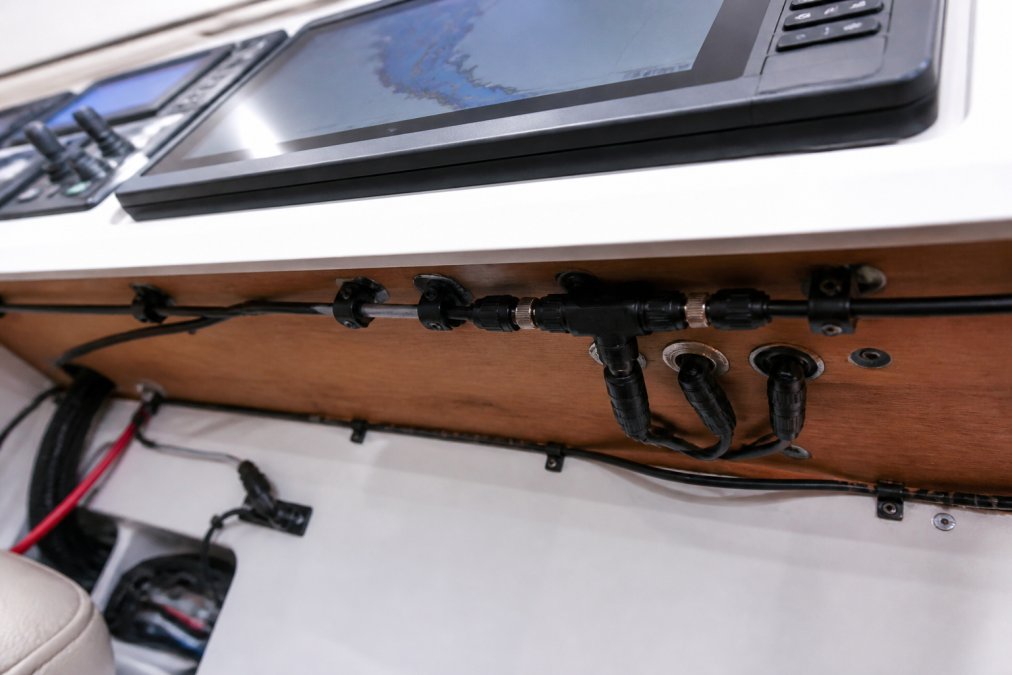
The architecture is simple once you see it. A single backbone cable runs the length of the boat. Every device taps into that backbone through a drop cable and a T-connector. Power feeds in at one point. Two terminators cap the ends.
That's it. No central hub, no switch, no configuration software. The network handles addressing automatically.
Cables, Connectors, and Terminators You Need
The parts list for a basic network is short, and getting it right the first time saves hours of fault-finding later. The Garmin NMEA 2000 Starter Kit bundles the essentials: a 2 m drop cable, a 6 m backbone cable, a 2 m power cable, two T-connectors, and both a male and female terminator.
For longer runs, the Garmin NMEA 2000 Backbone Cable extends the spine in 2 m segments. Where several devices cluster at one location, the Garmin NMEA 2000 Multi-Port T-Connector reduces the number of joints and the stress that long backbones put on them.
Terminators are the part everyone forgets. You need exactly two, one male and one female, and they must sit at the physical ends of the backbone. The male and female terminators each contain a 120-ohm resistor that absorbs signal reflections. Remove one and the network degrades or dies.
![Garmin NMEA 2000 Terminator, Male [010-11080-00]](https://cdn.shopify.com/s/files/1/0842/4914/9751/files/31895XL.jpg?v=1775841772)
Why the 2026 Conference Matters for Industry Standards
Here's the disambiguation most search results skip: the acronym in "NMEA 2026 networking" points to two unrelated things, and only one of them is an event.
- The organization. The National Marine Electronics Association (NMEA) is a trade body that publishes interface standards, runs a technician certification program, and holds an annual conference. When people say "NMEA 2026," they usually mean that conference.
- The standard. NMEA 2000 is a controller area network (CAN) protocol for marine electronics. NMEA 0183 is the older, slower serial protocol it largely replaced. Neither one is an event, and neither has a "2026 edition", the standards are revised on their own cycle, not annually.
So if you searched for "NMEA 2026 networking" and landed on a conference page when you wanted wiring help, you're in the right place now. The rest of this section covers the conference; the sections above and below cover the protocol.
What the Conference Actually Does
The conference is where the trade organization ratifies updates to its interface standards, and those updates reach your boat indirectly, as new firmware, new product certifications, and new compatibility claims on the box. The chain runs roughly like this:
- A manufacturer proposes a change or addition to a standard (a new sensor type, a new message format, a revised connector spec).
- A technical committee reviews it against existing devices and backward-compatibility requirements.
- The membership votes; the revision is published.
- Manufacturers build to the revised spec, submit products for certification, and ship them.
- You see the result as a device that drops onto your existing backbone without a proprietary adapter.
That last step is the one boat owners feel. When the industry agrees on how a new sensor reports data, you get interoperability. When it doesn't, you get a brand-locked accessory and a second network.
What the Conference Is Not
It is not a consumer boat show. It is not open to the public in the way a regional boat show is, and it is not where you go to buy a chartplotter. The exhibit hall is a trade floor, dealers, distributors, and technicians walking new hardware before it reaches retail shelves. If you're a boat owner, the practical value you extract from the conference is downstream: better-certified technicians, more interoperable gear, and standards that hold up when you mix brands on one backbone.
The Standards That Touch Your Boat
The standards work that matters most to a recreational vessel tends to cluster around a few areas: device interoperability on the NMEA 2000 backbone, AIS reporting and display requirements, electronic charting formats, and emergency signaling. Changes in any of those areas eventually show up as firmware updates, new certification requirements for the technicians you hire, or new equipment features. You don't need to track the committee work to benefit from it, but knowing it exists explains why a certified installer charges more than an uncertified one, and why a cheap unlisted connector can quietly break a network that was working fine last season.
Registration Details and Deadlines for NMEA 2026
Registration for the annual conference runs through the official NMEA registration portal, and deadlines are tiered: early registration closes well before the event, with late and on-site rates applying afterward. Because dates and fees change year to year, check the National Marine Electronics Association conference page for the current schedule rather than relying on last year's dates.
Who attends matters if you're deciding whether to send someone:
| Attendee Type | Typical Access | Best For |
|---|---|---|
| Marine technicians | Full sessions, certification exams | Earning or renewing credentials |
| Dealers and retailers | Exhibit hall, plenary sessions | Sourcing and industry trends |
| Manufacturers | All sessions, exhibit hall | Standards input and networking |
| Boat owners | Limited or none | Rarely open to the public |
The exhibit hall is where industry partners show new hardware, and it's the single best place to see how upcoming products handle system integration before they hit shelves.
NMEA Certification Requirements for Marine Technicians
Certification is the credential that separates a technician who can install a network from one who can diagnose why it failed. The program is administered by the trade organization and requires passing a written exam plus demonstrated field competence.
A common mistake is assuming certification is a one-time event (nmea.org). It isn't. Technicians renew on a cycle and must complete continuing education to stay current as protocol standards evolve. That's precisely why the annual conference doubles as a training event: many of the required professional development hours are earned in its concurrent workshops.
If you're hiring someone to work on your electronics, ask which certification level they hold and when they last renewed. The question filters out a surprising number of installers who learned NMEA 2000 informally and never tested their knowledge.
Marine Networking Troubleshooting: Fixing Common Faults
Most NMEA 2000 failures trace to a short list of causes: a missing or loose terminator, a bad drop cable, a power fault on the backbone, a device drawing too much current, or a backbone that exceeds the standard's length limit. Work through them in order and you'll find the problem faster than swapping parts at random.
A quick word on why the network is so unforgiving: NMEA 2000 is a differential bus. Two signal wires carry mirrored voltages, and the receiving device reads the difference between them. That design rejects electrical noise well, but it depends on the bus being terminated at both physical ends with 120-ohm resistors. Remove one terminator and signal energy reflects back down the backbone, corrupting messages. The network may not die outright, it may just drop a device intermittently, which is far harder to diagnose than a dead bus.
Step-by-Step Checks for a Silent Network
- Confirm both terminators are installed at the physical ends of the backbone and seated fully. Exactly two, one male and one female.
- Check backbone power. Measure voltage at a T-connector with the breaker on. The network needs a steady supply; a sagging reading points to a wiring or breaker problem, not a device problem.
- Inspect every T-connector for corrosion, bent pins, or a partially seated drop cable. A drop cable that looks connected but isn't fully seated is a common culprit.
- Disconnect devices one at a time. A single faulty node can drag the whole bus down. Isolating it is faster than testing every device.
- Verify total backbone length stays within the standard's limit. Long runs accumulate resistance and reflections; a multi-port T-connector reduces the number of joints and the stress on the spine.
- Look for a duplicate power feed. Two power injection points cause conflicts that mimic a dead network. There should be one.
Reading the Symptoms
The failure mode tells you where to look:
- Whole network dead. Suspect power first, then terminators. A dead bus is usually a power or termination problem, not a device problem.
- One device missing, everything else fine. Suspect that device's drop cable or the device itself. Swap the drop cable before condemning the device.
- Intermittent dropouts under load. Suspect termination, a marginal power feed, or a backbone that's too long. These are the hardest faults because they only appear when the boat is running.
- Garbled or duplicated data. Suspect a duplicate power feed or a device broadcasting a conflicting message.
What to Keep Onboard
A small diagnostic kit saves a season. Carry a spare male and female terminator, a spare drop cable, and a spare T-connector. The terminator is the single most useful spare because it's the cheapest part to fail and the fastest to swap. If you have a network that's been stable for years and suddenly isn't, the terminator is the first thing to test, not the last.
NMEA 0183 vs. NMEA 2000 in 2026
If your boat has older electronics, you may be running NMEA 0183 rather than NMEA 2000. The two are not interchangeable. NMEA 0183 is a point-to-point serial protocol, one talker, one or more listeners, a dedicated wire for each conversation. NMEA 2000 is a multi-talker bus where every device shares one backbone. A 2026 refit often means bridging the two: a chartplotter that speaks NMEA 2000 on the backbone and NMEA 0183 to an older autopilot or VHF. That bridge is a common failure point, because the two protocols have different electrical characteristics and different data rates. If you're mixing generations, document which device talks which protocol before you start pulling cable.
Where the Conference and the Protocol Connect
The two meanings of NMEA 2026 networking converge on one point: standards only help if the hardware on your boat follows them. The conference produces the specifications; the protocol carries them; your installation either honors the spec or it doesn't.
That's why buying certified components matters more than buying the cheapest connector on a marketplace listing. A backbone built from matched parts, correct terminators, and proper cable lengths behaves predictably for years. One assembled from mismatched pieces becomes a recurring headache.
Charleston Yachting stocks the Garmin NMEA 2000 line precisely because it's engineered as a system, not a pile of adapters. Same-day shipping means a failed terminator doesn't cost you a weekend on the water.
A silent network or a failed certification renewal can sideline your season, and both usually trace back to parts and knowledge you can secure in advance. Charleston Yachting carries the NMEA 2000 cables, terminators, and connectors that keep your backbone healthy, backed by same-day shipping and a curated inventory of marine electronics from Garmin and other industry-leading brands. Whether you're rewiring a helm or preparing a vessel for offshore work, get started with Charleston Yachting and equip your boat with components built to the standard.
Frequently Asked Questions
What is NMEA used for?
NMEA sets the data communication standards that let marine electronics from different brands share information on one network. On a boat, it carries GPS position, speed, depth, wind angle, and engine data between a chartplotter, autopilot, radar, and instruments. NMEA 2000 networking uses a single backbone cable with drop cables and terminators, so a Garmin display can read data from a B&G sensor without custom wiring. The standard also covers interface protocols for AIS and autopilots, which is why it underpins nearly every modern helm.
Is NMEA still used today?
Yes. NMEA 2000 remains the active standard for small and mid-size vessels, and manufacturers continue to release compatible products. The National Marine Electronics Association also runs an annual conference where industry partners discuss updates. NMEA 2026 networking, the event side of the term, gives technicians and builders a look at where the standard is heading. For boat owners, that means the backbone you install now will keep working with new displays and sensors for years, provided you follow the correct cabling and termination rules.
How to get NMEA certified?
Start with the NMEA 2000 Installer certification, which covers backbone layout, power injection, and troubleshooting. Training is available through the association's approved providers, and you typically need to pass a written exam. Many technicians then add the Marine Electronics Installer credential to handle radar and autopilot integration. Certification requirements include documented field experience for advanced levels. Check the association's registration portal for current course dates, fees, and renewal terms, since these change year to year.
What is the NMEA 2026 conference?
It is the annual meeting of the National Marine Electronics Association, where manufacturers, dealers, and technicians gather for plenary sessions, concurrent workshops, and an exhibit hall. The agenda usually covers interface standards, system integration, and professional development. Networking events and peer-to-peer collaboration are a major draw, since attendees compare installation practices and troubleshoot shared problems. Registration opens through the association's portal, and early deadlines often reduce the fee. It is the main venue for learning how NMEA 2026 networking standards are evolving.
How can I register for the NMEA 2026 event?
Registration runs through the association's official portal. You create an account, choose your attendee category, and select any pre-conference training or certification exams. Early registration usually closes a few weeks before the event, and on-site rates are higher. If you are sending a team, ask about group pricing. Keep your confirmation email, since it includes the schedule and any workshop selections. For updates on deadlines, watch the association's announcements rather than third-party event listings, which are often out of date.
Why is NMEA certification important for marine technicians?
Certification proves you can build and diagnose a network to the published standard, which reduces callbacks and protects the boat owner's investment. Insurers and boatyards increasingly ask for credentialed technicians on electronics work. The training also covers troubleshooting steps that save hours on the dock, such as checking termination resistance before replacing a display. For a business, certification requirements are a marketing asset: customers trust a technician who can show they meet the industry benchmark for NMEA 2000 network basics.