

Satellite Phone for Yachts: How It Works at Sea

Table of Contents
- How a Satellite Phone Works on a Yacht
- Satellite Phone Coverage at Sea
- Satellite Phone External Antenna for Boats
- Satellite Phone Plans and Airtime Costs
- Satellite Phone vs Marine VHF Radio
- Choosing the Right Satellite Phone for Your Yacht
- Conclusion
- Frequently Asked Questions
Last Updated: October 9, 2026
How a Satellite Phone Works on a Yacht
A satellite phone is not one device. It is a handset, a satellite network, and a service plan working together. Miss one and you have an expensive paperweight.
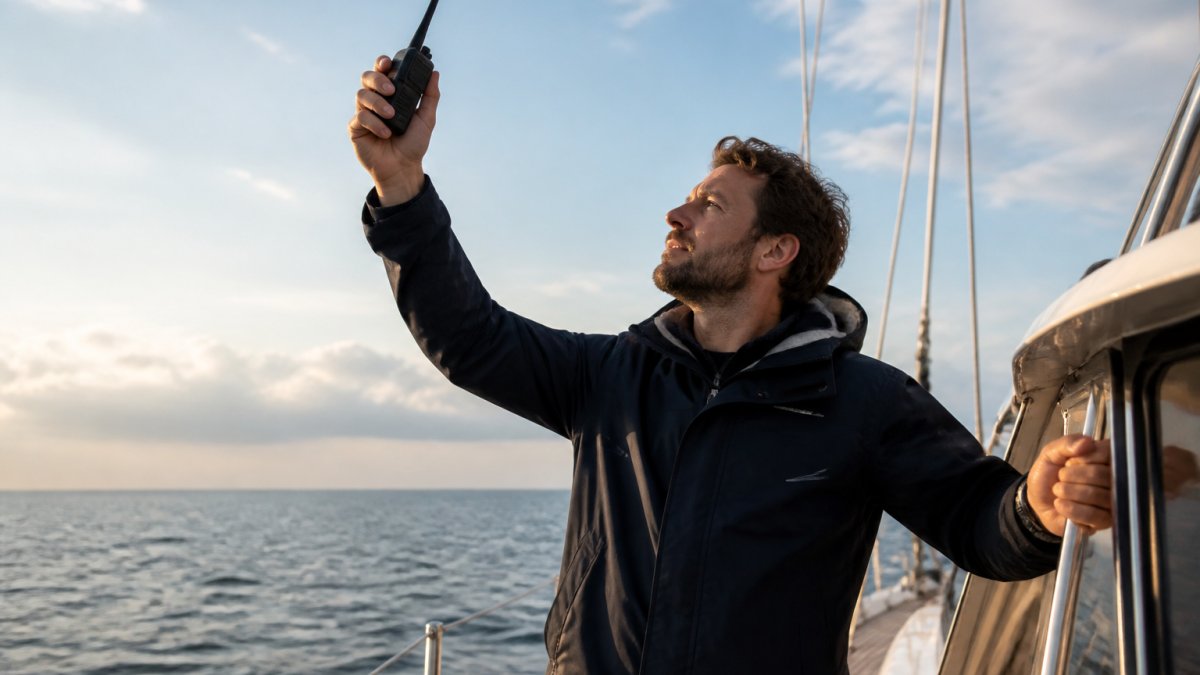
From Handset to Satellite to Shore
The handset is the radio, transmitting on satellite frequencies, typically in the L-band. Point it at open sky and it locks onto the nearest satellite in the constellation.
The signal then travels roughly 480 miles up to a low-earth-orbit satellite, which hands it to the next in line until it reaches a ground gateway.
Three things make this work at sea:
- Line of sight to the sky, with no metal rigging blocking the antenna
- An active subscription tied to a specific network
- Battery and power that survive a multi-day passage
The Iridium network, which powers the Garmin inReach line, uses a cross-linked constellation: the satellites talk to each other directly, so your call hops satellite to satellite without needing a ground station in range.
![Garmin inReach Mini 2 - Black [010-02602-01]](https://cdn.shopify.com/s/files/1/0842/4914/9751/files/93511XL.jpg?v=1775847516)
Satellite Phone Coverage at Sea
Coverage is global, but "global" comes with fine print. Satellite phone coverage at sea depends on your network, how far offshore you sail, and, critically, where you mount the antenna and how you read signal quality underway.
Iridium is the only network with true pole-to-pole coverage. Its satellites cross-link, so a vessel mid-ocean has a path to shore without waiting for a ground station in range, which is why most bluewater sailors and offshore racers carry Iridium gear.
How to Test Coverage Before You Leave the Dock
A marina test proves nothing: you are surrounded by boats, buildings, and often a cell signal that masks the satellite path. Test in open water instead:
- Power on in open sky with a clear horizon and no rigging directly overhead.
- Watch the signal bars for a full minute. Satellite acquisition is not instant, the handset has to find and lock a satellite, which can take 30 to 90 seconds on a cold start.
- Walk the deck and note where the signal drops. The mast, boom, and backstay cast a moving shadow as the boat heels, so the spot that works at the dock may fail at 20 degrees of heel.
- Log the best mounting location and route the antenna cable there, not to the most convenient spot.
What Actually Breaks Coverage at Sea
- Heavy cloud and rain, which weaken the signal but rarely kill it. Iridium's L-band penetrates weather better than higher-frequency services, but a serious squall line still adds fade.
- Rigging and sails blocking the antenna's view of the sky. Every piece of metal between the antenna and the satellite costs signal strength.
- Being below deck with no external antenna. The hull and cabin structure block satellite signals almost completely.
- A dead battery on a multi-day passage. A handset that dies at hour 30 of a 72-hour crossing is not a communication plan.
- Antenna cable loss. A long, thin coax run from the cabin to the masthead bleeds signal. Keep the run short and use the cable the manufacturer specifies.
Reading Apparent vs. Real Coverage
Signal bars on a satellite phone reflect the link to the satellite, not call quality once it reaches the ground gateway. A call can show full bars and still sound choppy if the gateway is congested or a handoff is mid-transfer. If a call drops, reposition the antenna rather than replace the phone.
For coastal cruising within a few dozen miles of shore, coverage is rarely a problem. For a transatlantic crossing, network choice decides everything, and antenna placement decides whether it pays off.
Satellite Phone External Antenna for Boats
A satellite phone external antenna for boats is the single upgrade that changes offshore performance.
The antenna does one job: give the radio a clear path to the sky.
What to look for in a marine antenna:
- Marine-grade materials, typically stainless steel mounts and UV-stable plastics
- A mount that survives salt spray and constant vibration
- Cable routing that keeps the run short and away from other electronics
- A connector that matches your handset or docking station
The mistake we see most often: mounting the antenna low on the pushpit because it is convenient. It works in the marina, then the boat heels offshore and the mast shadow cuts the signal.
Satellite Phone Plans and Airtime Costs
Satellite phone plans and airtime costs vary more than the hardware, and the pricing structure is where most buyers get surprised. You can pay month to month or commit annually for a lower rate; the right choice depends on how often you leave cell range and which network your device uses.
How Plans Are Actually Structured
Most providers build plans around three components:
- A monthly access fee, charged whether you use the device or not.
- A bucket of minutes or messages, voice minutes, text messages, or a mix, depending on the device.
- Overage charges, per-minute or per-message rates that apply once you exceed the bucket. These are where costs escalate fast.
For the Garmin inReach devices we carry, an active satellite subscription is required to access the Iridium network, either month-to-month or annual. That flexibility matters if your sailing is seasonal: a cruiser who sails May through October and hauls out for winter should not pay for twelve months of access.
Garmin inReach Messenger Plus SOS Satellite Communicator w/Photo Voice →
![Garmin inReach Mini 3 [010-03387-00]](https://cdn.shopify.com/s/files/1/0842/4914/9751/files/111753XL.jpg?v=1775850048)
A Decision Framework for Choosing a Plan
Rather than guessing, work through these criteria in order:
- Usage pattern. Track real usage for one season before committing. Most sailors overestimate voice minutes and underestimate messaging.
- Worst-case scenario. Match the plan to your worst case, not your average trip. A three-day coastal hop needs less than a two-week offshore passage with daily check-ins.
- Suspension policy. Check whether the provider lets you suspend service during haul-out or off-season. Some do, some charge a reduced access fee, and some require you to keep paying.
- SOS inclusion. Confirm that emergency SOS is included in the plan, not billed as a premium add-on. On Iridium-based devices like the inReach line, SOS to a 24/7 coordination center is a core feature, but the plan terms still matter.
- Upgrade path. You can usually move to a larger bucket mid-cycle, but the change requires a connection to the provider's system, exactly what you lack offshore.
Common Cost Traps
- Buying the cheapest plan and assuming you can upgrade mid-passage. Changing plans usually requires a connection to the provider's system. Set the plan up before you leave the dock.
- Ignoring overage rates. A plan with a low monthly fee and high overage can cost more than a higher-tier plan if you use the device regularly.
- Forgetting the annual commitment. Annual plans lower the monthly rate but lock you in. If your sailing plans change, you may be paying for months you do not use.
- Assuming all networks price the same. Iridium's cross-linked constellation and pole-to-pole coverage come at a different cost structure than geostationary networks. Match the network to your cruising grounds first, then compare plans within that network.
Connecting Plans to Onboard Systems
On many yachts, the satellite device pairs with a phone app for messaging, tracking, and SOS, and sometimes feeds location data to a chartplotter. That affects plan choice: continuous tracking consumes more data than occasional check-ins, so size the plan for that data flow, not just voice calls. Reliable connectivity ensures that your vessel remains visible to rescue coordination centers through GPS emergency tracking, which functions as a critical safety layer when you venture beyond the reach of cellular networks.
Satellite Phone vs Marine VHF Radio
A satellite phone and a marine VHF radio are not competitors. They do different jobs, and a well-equipped vessel carries both.
Marine VHF radio is a short-range line-of-sight tool reaching other vessels, bridges, and shore stations within roughly 20 miles.
A satellite phone reaches anyone, anywhere, for a fee.
| Feature | Satellite Phone | Marine VHF Radio |
|---|---|---|
| Range | Global | About 20 miles |
| Cost | Subscription required | Free to use |
| Best for | Offshore, remote anchorages | Coastal traffic and hailing |
| Emergency use | SOS to a coordination center | Hailing nearby vessels |
| Power draw | Low, battery dependent | Wired to vessel power |
The practical rule: VHF handles everything within sight of land. The satellite phone covers everything beyond it. If you cross an ocean, you need both.
Choosing the Right Satellite Phone for Your Yacht
The right device depends on how far you go and whether you need voice or just messaging. Most coastal and near-offshore sailors are covered by a compact satellite communicator; bluewater passages call for a full handset with an external antenna.
Charleston Yachting stocks the Garmin inReach line because it runs on the Iridium network and pairs with a phone app for messaging, tracking, and SOS. Three options cover most sailors:
![Garmin inReach Messenger Plus SOS Satellite Communicator w/Photo Voice Messaging [010-02887-00]](https://cdn.shopify.com/s/files/1/0842/4914/9751/files/105880XL.jpg?v=1775849293)
- Garmin inReach Mini 2 at $349.99. Compact, 3.5 oz, IPX7 water-rated, up to 14 days of battery in 10-minute tracking mode. Best for weekend and coastal sailors who want messaging and SOS without bulk.
- Garmin inReach Mini 3 at $449.99. Adds a color touchscreen and up to 350 hours of battery with 10-minute tracking. Best for sailors who want to type messages on the device itself.
- Garmin inReach Messenger Plus at $399.99. Sends text, photo, and voice messages over Iridium, with a battery that lasts for weeks. Best for crews who want richer updates from offshore.
Every one of these sends an interactive SOS to Garmin Response, a 24/7-staffed coordination center. That is the feature that matters most when something goes wrong far from help.
Conclusion
Choosing the right communication gear is the difference between a confident passage and a nervous one.
Charleston Yachting carries the Garmin inReach line for exactly that reason. You get Iridium global coverage, interactive SOS to a 24/7 response center, and same-day shipping so your gear arrives before your next window.
Get started with Charleston Yachting and sail beyond cell range with the right satellite communicator onboard.
Frequently Asked Questions
How does a satellite phone work on a yacht?
A satellite phone connects directly to a satellite network instead of cell towers. When you place a call or send a message, the handset transmits to an orbiting satellite, which relays the signal to a ground station and then to the regular phone network. On a yacht, this means you stay reachable well beyond coastal cell coverage, provided you have an active subscription and a reasonably clear view of the sky.
Do satellite phones work anywhere at sea?
Coverage depends on the network. Systems running on the Iridium network, such as the Garmin inReach line, provide global pole-to-pole coverage, so they work across open ocean. Geostationary networks cover most populated latitudes but thin out near the poles. Check the coverage map for your planned cruising grounds before you rely on any device as your only offshore communication.
Can you use a satellite phone inside a yacht?
Sometimes, but performance drops below deck. Fiberglass and wood allow some signal through, but a cabin roof, metal fittings, and rigging can block it. For reliable calls, step into the cockpit or on deck with a clear view of the sky. If you need to stay below, a satellite phone external antenna for boats mounted high on the mast or pushpit solves the problem by keeping the antenna in open sky.
Is a satellite phone more reliable than a marine VHF radio offshore?
They serve different jobs. Marine VHF radio is the standard for short-range communication, ship-to-ship traffic, and distress calls to the Coast Guard within roughly 20 nautical miles, and it is free to use. A satellite phone reaches far beyond VHF range for voice calls, texts, and SOS alerts, but it requires a paid airtime plan. Most offshore sailors carry both.