

MFD vs Dedicated Sailing Instruments: What to Choose

Table of Contents
- MFD vs Dedicated Sailing Instruments: A Quick Comparison
- What Is a Multifunction Display (MFD)?
- The Case for Dedicated Sailing Instruments
- NMEA 2000 Network Architecture: The Backbone of Your System
- Redundancy in Marine Navigation Systems: Why It Matters
- Power Consumption and Failure Modes
- Best Marine Electronics for Sailboats: Product Examples
- Frequently Asked Questions
Last Updated: September 20, 2026
MFD vs Dedicated Sailing Instruments: A Quick Comparison
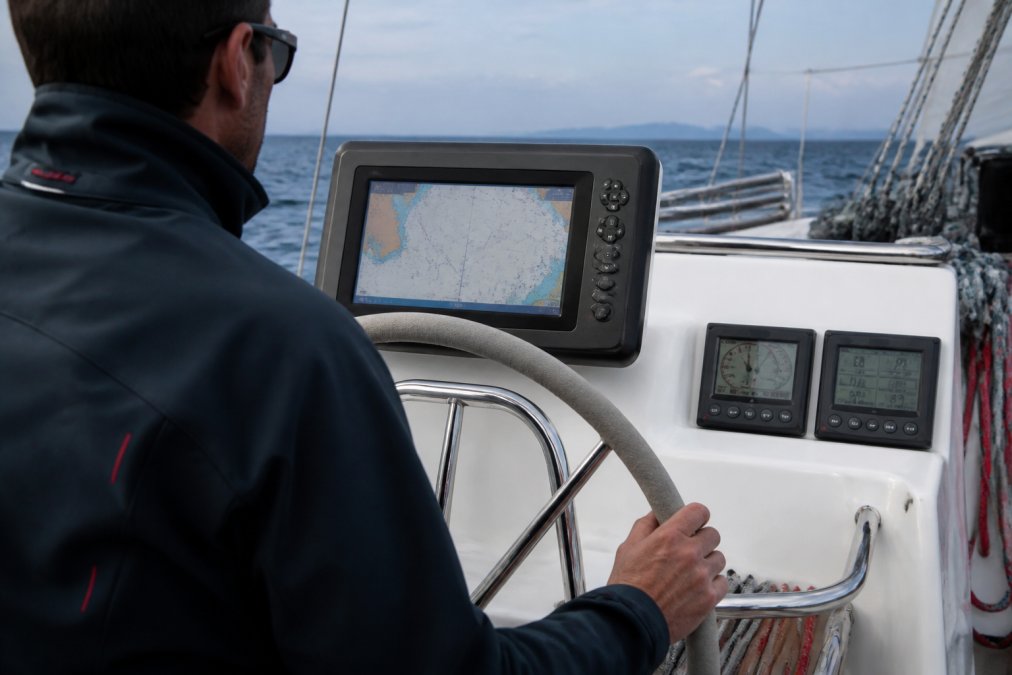
The choice between a multi-function display vs dedicated sailing instruments comes down to one question: do you want one powerful screen that does everything, or several simple screens that each do one thing perfectly? At Charleston Yachting, we see both setups every week, and neither is universally right. A large MFD gives you charts, radar, sonar, and data in one place.
| Factor | MFD | Dedicated Instruments |
|---|---|---|
| Data shown | Charts, radar, sonar, AIS, engine | Speed, depth, wind, heading |
| Failure impact | Single point of failure | Isolated, one gauge lost |
| Power draw | Higher, backlight-heavy | Lower, transflective LCD |
| Glanceability | Requires navigation | Instant read at a glance |
| Best for | Route planning, radar, sonar | Racing, cockpit, backup |
What Is a Multifunction Display (MFD)?
A multifunction display is a single networked screen that combines chartplotting, radar, sonar, AIS targets, and instrument data into one interface. The B&G Zeus 3S 9 is a good example: a 9-inch touchscreen with a rotary dial and keypad, built-in Wi-Fi, and sailing features like SailSteer and Laylines. It runs on NMEA 2000 and 0183, so it can pull data from transducers, radar, and autopilot.
![BG Zeus 3S 9 - 9" Multi-Function Sailing Display [000-15408-001]](https://cdn.shopify.com/s/files/1/0842/4914/9751/files/81399XL.jpg?v=1775846073)
The Case for Dedicated Sailing Instruments
Dedicated sailing instruments win on one thing above all: glanceability. A B&G Triton2 Digital Display shows speed, depth, wind, and heading on a 4.1-inch optically bonded screen that never fogs. You read it in half a second without touching a menu. For racing crews and shorthanded sailors, that speed matters. Dedicated displays also fail in isolation. If one gauge dies, the rest keep working.
![BG Triton2 Digital Display [000-13294-001]](https://cdn.shopify.com/s/files/1/0842/4914/9751/files/62238XL.jpg?v=1775843986)
NMEA 2000 Network Architecture: The Backbone of Your System
NMEA 2000 is the data bus that lets your electronics talk to each other, and it is the single most important decision in a hybrid MFD-plus-dedicated-instrument setup. It is a single backbone cable with drop cables to each device, carrying both power and data on the same four wires. Every certified device, a wind sensor, an AIS receiver, a Triton2 display, a Zeus 3S MFD, plugs into that same backbone through a T-connector.
How the backbone is actually built
A working NMEA 2000 network has four physical parts:
- The backbone, a single run of cable, ideally down the centerline of the boat, with a maximum length of about 328 feet (100 meters) for a standard network.
- Drop cables, short spurs from the backbone to each device. Each drop should be no more than about 20 feet (6 meters), and the total of all drops should stay under roughly 256 feet (78 meters).
- T-connectors, one per device, so the backbone never breaks. Devices do not daisy-chain; they hang off the backbone in parallel.
- Terminators, a 120-ohm resistor at each end of the backbone. Two terminators, no more, no fewer.
Power is injected into the backbone through a power tee, usually near the middle of the run, and the network carries 12 V DC to every device on it.
LEN budgeting: the number most buyers ignore
Every NMEA 2000 device has a Load Equivalency Number (LEN). One LEN equals 50 milliamps of current draw on the network. A small display might be 2 LEN; a radar or autopilot computer can be 8 LEN or more. A standard NMEA 2000 backbone is rated for a total of 64 LEN. Add up the LEN of every device on the network before you buy, and if you exceed the budget, you need a second power injection point or a heavier backbone, not just another T-connector.
Bridging legacy NMEA 0183 gear
Most boats built before the mid-2000s have NMEA 0183 instruments, a slower, single-talker, single-listener serial standard that does not share a bus. You can still mix 0183 and 2000 gear, but you need a protocol converter (sometimes called a multiplexer or bridge) that translates 0183 sentences into NMEA 2000 PGNs and back. Common examples include the Actisense NGW-1 and the Digital Yacht iKonvert.
Redundancy in Marine Navigation Systems: Why It Matters
Redundancy in marine navigation systems means no single failure takes down your ability to navigate. An MFD is a single point of failure: if that screen dies, you lose charts, radar, and data at once. Dedicated instruments spread the risk. A hybrid setup gives you both: the MFD for planning and radar, dedicated displays for the numbers you need to keep sailing.
Power Consumption and Failure Modes
Most comparison articles stop at "MFDs draw more power." That is true, but it is not useful until you put numbers on it and separate the two failure modes that actually end passages: a dead screen and a dead network.
BG Zeus 3S 9 - 9" Multi-Function →
Power draw: the numbers that matter on passage
Dedicated sailing instruments use transflective LCD technology. Instead of fighting ambient light with a backlight, a transflective screen reflects sunlight back through the display, so it gets more readable in bright conditions while drawing very little current. A B&G Triton2 Digital Display is rated at about 1.8 W maximum, roughly 0.15 A at 12 V. A Raymarine i70s sits in the same range.
![BG Triton2 Speed/Depth/Wind System Pack - Wired Wind Pack [000-14955-002]](https://cdn.shopify.com/s/files/1/0842/4914/9751/files/88518XL.jpg?v=1775846993)
Failure modes: what actually breaks, and how
The two systems fail in fundamentally different ways, and that difference is the strongest argument for a hybrid cockpit.
MFD failure modes:
- Screen or backlight failure, the most common hard failure. A cracked panel, a failed backlight inverter, or water ingress at the card door takes the whole display down.
- Software and firmware faults, freezes, boot loops, and failed updates. These are recoverable with a reboot or a card swap, but not always at sea.
- Single point of failure, because charts, radar, sonar, AIS, and instrument data all render on one screen, losing that screen loses all of them at once. The network may still be alive; you just cannot see it.
Dedicated instrument failure modes:
- Transducer failure, a fouled or failed paddlewheel, depth transducer, or wind vane. The display is fine; the data is wrong or missing.
- Cable and connector corrosion, the most common real-world failure. Drop cables, T-connectors, and masthead connections corrode and cause intermittent dropouts long before anything dies outright.
- Isolated display loss, if one Triton2 dies, the others keep working. You lose one number, not the whole picture.
Designing for failure
The practical takeaway is not "pick one." It is to make sure no single failure removes your ability to navigate. A hybrid setup does that: the MFD handles planning and radar, dedicated displays keep speed, depth, wind, and heading visible if the MFD goes dark, and a handheld GPS plus paper charts cover the case where the whole network goes down.
Best Marine Electronics for Sailboats: Product Examples
The best marine electronics for sailboats balance a central MFD with dedicated displays. Charleston Yachting stocks the full range, with same-day shipping on most orders. Here are the options we recommend most:
- B&G Zeus 3S 9 ($2,599.00): The central MFD. 9-inch SolarMAX HD IPS screen, SailSteer, Laylines, RacePanel, built-in Wi-Fi.
- B&G Nemesis 9 ($2,099.00): A customizable 9-inch sailing display for mast or cockpit, with drag-and-drop dashboards and point-of-sail context modes.
- B&G Triton2 Digital Display ($629.00): The dedicated workhorse. 4.1-inch transflective screen, 1.8W max draw, IPX7 waterproof.
- B&G Triton2 Speed/Depth/Wind System Pack ($1,679.00): Everything in one box: display, thru-hull transducer, wind sensor, and NMEA 2000 backbone starter kit.
- Raymarine i70s ($654.99): A 4.1-inch multifunction instrument with SeaTalkng and NMEA 2000 connectivity, plus AIS repeater mode.
Frequently Asked Questions
Can an MFD completely replace dedicated wind and depth displays?
An MFD can display wind and depth data, but many sailors keep dedicated instruments as a backup. If the MFD fails, you lose all data on that screen. Dedicated displays like the B&G Triton2 provide a separate, always-on view of critical information. For offshore passages, having both systems on an NMEA 2000 network gives you redundancy without duplicating every sensor.
What is the benefit of a hybrid marine electronics system?
A hybrid system combines a large MFD for navigation and route planning with dedicated instruments for constant wind, speed, and depth readouts. This setup lets you use the MFD's chartplotter and sonar features while keeping essential sailing data visible at all times. It also reduces the risk of a single point of failure, since the dedicated displays operate independently of the MFD.
How does screen redundancy affect safety during offshore passages?
Screen redundancy means having more than one way to view critical data. If your MFD fails, a dedicated instrument like the B&G Triton2 Digital Display can still show speed, depth, and wind. This is especially important offshore where repairs are impossible. A second chartplotter or a tablet connected via Wi-Fi can also serve as a backup, but dedicated instruments are the most reliable because they draw less power and have fewer components.
Are dedicated instruments easier to read in direct sunlight?
Many dedicated sailing instruments use transflective LCD technology, which reflects ambient light to improve visibility. The B&G Triton2 and Raymarine i70s both feature optically bonded displays that reduce glare and condensation. MFDs have improved with bright IPS screens, but dedicated instruments often consume less power while remaining readable in direct sun, making them a strong choice for cockpit displays.
What is the role of NMEA 2000 in connecting MFDs and instruments?
NMEA 2000 is a standardized network that lets marine electronics share data over a single backbone cable. It carries power and data to devices like MFDs, wind sensors, depth sounders, and autopilots. This simplifies installation and allows you to mix brands if they are NMEA 2000 certified. For example, the B&G Triton2 display can be integrated into a wider navigation system using NMEA 2000, and the Raymarine i70s supports NMEA 2000 connectivity for engine, environment, and navigation data.