

Essential Marine Electronics for Saltwater Fishing

Table of Contents
- 1. The Best Fish Finder for Saltwater Fishing: Sonar That Reads Deep Water
- 7. Installation, Compatibility, and Protecting Marine Electronics From Saltwater
- Conclusion: Building a Saltwater Electronics Setup That Lasts
- Frequently Asked Questions
Last Updated: October 15, 2026
1. The Best Fish Finder for Saltwater Fishing: Sonar That Reads Deep Water
The best fish finder for saltwater fishing is a marine electronics combo unit that pairs CHIRP traditional sonar with scanning sonar and preloaded coastal charts, because offshore structure and suspended fish demand both depth penetration and target separation.
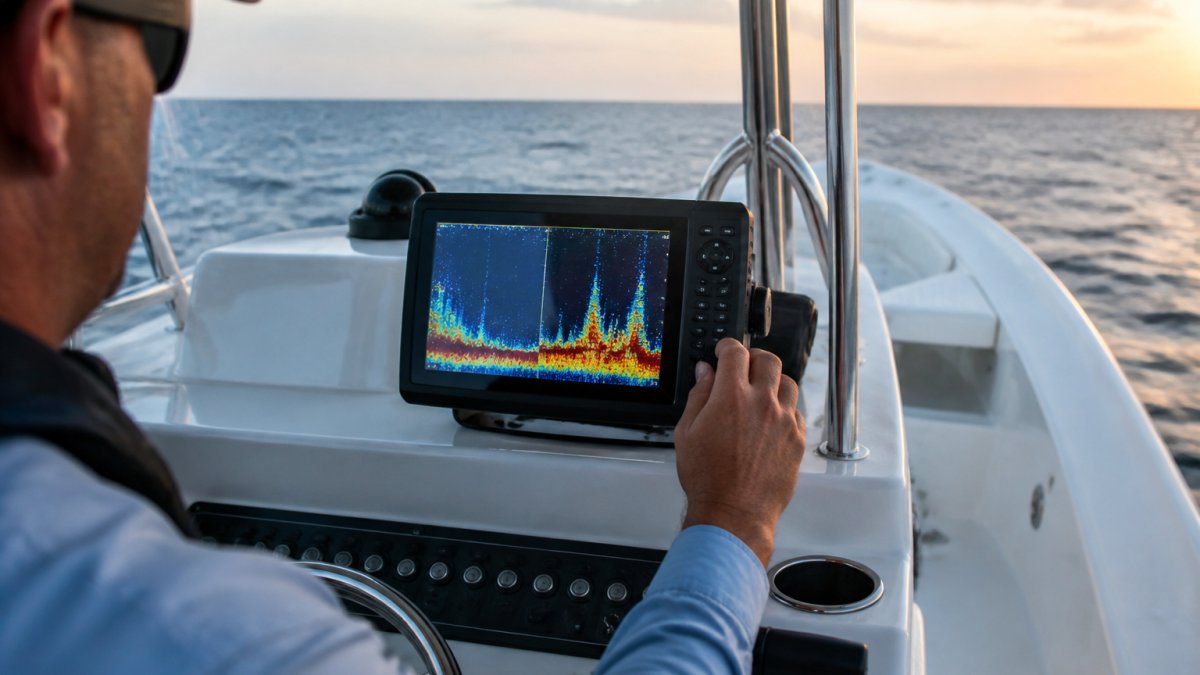
A fish finder is a sonar unit that sends electrical pulses through a transducer, converts the returning echoes into a display, and shows fish location, water depth, and bottom structure in real time.
Both units below include transducers, so you can fish the day they arrive.
Garmin ECHOMAP UHD2 74CV: A 7-Inch Combo With Coastal Charts
The ECHOMAP UHD2 74CV is the value pick: a bright 7-inch keyed display, Garmin CHIRP traditional and ClearVü scanning sonar, and preloaded BlueChart g3 coastal charts with Navionics data.
What most buyers miss is the Wi-Fi networking. Pair two compatible ECHOMAP UHD2 units and sonar, waypoints, and routes sync wirelessly between them.
Handheld VHF with its own battery, charged before every trip- Handheld GPS or a phone with offline charts loaded
- Registered MMSI number, posted where any crew member can read it
- Spare fuses, a multimeter, and labeled spare connectors
- A second GPS source feeding your fixed VHF
- Printed float plan left with someone ashore
The IC-M94D covers the first two items in one unit. Its AIS receiver also lets you see approaching traffic if your fixed radio goes down.
![Icom IC-M94D VHF Marine Radio w/AIS DSC [M94D 21 USA]](https://cdn.shopify.com/s/files/1/0842/4914/9751/files/94177XL.jpg?v=1775847625)
7. Installation, Compatibility, and Protecting Marine Electronics From Saltwater
Saltwater destroys electronics through corrosion, and no warranty covers neglect. The three failure points we see most are unprotected connections, unsealed mounting holes, and dissimilar metals touching.
Protect your investment with these habits:
- Coat every connector with dielectric grease before mating it
- Seal mounting holes with marine sealant, not silicone caulk
- Use tinned copper wire only; bare copper wicks salt and corrodes from inside
- Rinse displays and housings with fresh water after every trip, never a pressure washer
- Check NMEA 2000 backbone terminators once a season
Compatibility is the other half of the job. NMEA 2000 is the modern standard and lets a Garmin display, a Lowrance antenna, and an Icom radio share one network. NMEA 0183 still appears on instruments like the SST-110, so confirm your display has an 0183 port before you buy.
Garmin ECHOMAP UHD2 74CV Chartplotter/Fishfinder Combo w/US Coastal Maps →
Conclusion: Building a Saltwater Electronics Setup That Lasts
The hard part isn't choosing individual units. It's building a system where a chartplotter, a transducer, and a radio all speak the same language, hold up to salt, and still work when one piece fails.
Charleston Yachting stocks the full chain, from Garmin and Simrad combos to Airmar transducers and Icom radios, with same-day shipping on the parts you need before the next weather window. Our catalog is curated for offshore work.
Shop All and get your boat wired for the season.
Frequently Asked Questions
What electronics do you need for saltwater fishing?
A practical starting setup includes a fish finder or combo unit for sonar, a GPS chartplotter for navigation and waypoints, a VHF radio for communication and distress calls, and a transducer matched to your hull and fishing depth. Add a sea temperature gauge if you chase offshore temp breaks, and a handheld VHF as backup. If you fish far offshore, redundancy matters: a second GPS source and a ditch bag with a portable radio keep you covered if the main system fails.
Does Garmin LiveScope work in saltwater?
Forward-facing sonar like Garmin LiveScope is designed for freshwater and saltwater use, but performance depends on conditions. In saltwater, wave action, boat movement, and depth can affect image clarity. It works best in calmer inshore and nearshore situations where you can hold position over structure. For deeper offshore fishing, traditional CHIRP sonar and side-scan remain more reliable for marking fish and bottom detail.
What is the difference between a chartplotter and a fish finder?
A chartplotter shows your position on a map with waypoints, routes, and depth contours. A fish finder uses sonar to show what is below the boat, including fish, structure, and bottom composition. Many modern units combine both functions. For example, the Garmin ECHOMAP UHD2 74CV includes CHIRP traditional and ClearVü sonar alongside preloaded coastal charts, so you get navigation and fish finding in one display.
How do you protect marine electronics from saltwater?
Rinse exposed connectors and transducer cables with fresh water after every trip, and apply dielectric grease to connections before reassembly. Mount displays where spray is least likely to pool, and use waterproof connector covers on unused ports. Bronze thru-hull housings like the Airmar B175HW resist corrosion better than untreated metals, but they still need periodic inspection. Keep a dry bag or ditch bag for handheld radios, and check NMEA 2000 backbone terminations each season for corrosion.
Which marine radio is best for offshore fishing?
For a fixed-mount setup, a Class D DSC VHF with NMEA 2000 connectivity is the standard. The Icom IC-M510 EVO offers 25W transmit power and NMEA 2000 integration with your multifunction display. For redundancy, carry a handheld like the Icom IC-M94D, which includes AIS, DSC, and a Float'n Flash feature. Offshore anglers should have both: the fixed unit for range and the handheld for emergencies if you abandon the helm.