

5 Best Marine Wind Transducers for Cruising in 2026

Table of Contents
- Quick Comparison: 5 Best Marine Wind Transducers for Cruising
- Ultrasonic vs Mechanical Wind Sensor: Which Technology Suits Your Boat?
- 1. Raymarine RSW Wired Smart Performance Wind Transducer
- 2. Garmin gWind Transducer with GND 10 Black Box Bridge
- 3. B&G WS320 Wireless Wind Sensor Pack
- 4. B&G WS310 Wired Wind Sensor
- 5. Garmin GMI 40 Wireless Wind Pack with gWind Wireless 2
- Marine Wind Instrument Calibration: Getting Accurate True Wind Data
- Sailboat Wind Sensor Maintenance Tips for Long-Term Reliability
- Frequently Asked Questions
Last Updated: September 16, 2026
Quick Comparison: 5 Best Marine Wind Transducers for Cruising
Choosing the right marine wind transducers for cruising comes down to one question: do you want a wired sensor that never needs charging, or a wireless unit that saves you from running cable through the mast? For most cruising sailors, the answer depends less on budget and more on how your boat is already wired. This guide from Charleston Yachting breaks down five transducers we stock and support, with the trade-offs that actually matter at the masthead.
A marine wind transducer is the masthead sensor that measures wind speed and wind direction, then converts those readings into electronic data your instruments display as apparent wind and true wind. The sensor itself is only half the system. The other half is how that data reaches your instrument display, whether over NMEA 2000, NMEA 0183, or a proprietary network.
Here is the short version before we get into the details.
| Model | Price | Wired/Wireless | Network | Best For |
|---|---|---|---|---|
| Raymarine RSW Wired | $934.99 | Wired | SeaTalk NG / NMEA 2000 | Accuracy without calibration fuss |
| Garmin gWind + GND 10 | $629.99 | Wired | NMEA 2000 + Nexus | Mixed-brand refits |
| B&G WS320 | $839.00 | Wireless | NMEA 2000 | No cable through the mast |
| B&G WS310 | $577.00 | Wired | NMEA 0183 / NMEA 2000 | Budget wired reliability |
| Garmin GMI 40 Wind Pack | $1,099.99 | Wireless | NMEA 2000 / BlueNet | Touchscreen display included |
Below, we cover each unit in detail, then walk through calibration and the maintenance habits that keep a masthead sensor reading true for years.
![Raymarine RSW Wired - Smart Performance Wind Transducer - Short Arm w/30M Cable [E70670]](https://cdn.shopify.com/s/files/1/0842/4914/9751/files/102244XL.jpg?v=1775848751)
Ultrasonic vs Mechanical Wind Sensor: Which Technology Suits Your Boat?
Mechanical wind sensors use moving parts: a three-bladed propeller or cups for wind speed, and a wind vane for wind angle. Ultrasonic sensors have no moving parts at all, measuring wind by timing sound pulses across a fixed array. For cruising, mechanical sensors remain the practical default because they are serviceable, widely supported, and cost less to replace.
The trade-off is straightforward. Mechanical units wear at the bearings and can be fouled by insects, salt, or bird activity. Ultrasonic units avoid that wear but cost more and, in the past, drew more power. Modern solid-state designs have closed much of that gap.
For a cruising boat that spends long stretches at anchor, a mechanical anemometer with a good maintenance routine usually wins on value. Racers chasing tactical sailing data in light air may prefer the faster response of a solid-state sensor.
If you are unsure which direction to go, the five units below span both approaches and every major network.
1. Raymarine RSW Wired Smart Performance Wind Transducer
The RSW Wired is the pick for sailors who want expert-level accuracy without a calibration project. Raymarine designed it so the sensor arrives calibrated, and the included wired gateway handles the conversion to SeaTalk NG without a separate processor.
That "install and go" claim is the real differentiator here. Most wind systems require you to correct for masthead offset, alignment, and speed error after installation. The RSW Wired ships with a 30-meter mast cable and a wired gateway, so the masthead unit and the below-deck conversion box are both in the box.
Power draw is negligible at under 100 mW, and the unit carries an IPx6/IPx7 waterproof rating at the masthead. It is rated for wind up to 115 mph, which matters if you cruise in squall-prone waters.
The honest limitation: if your boat runs a non-Raymarine network, the SeaTalk NG gateway adds a conversion step. This unit is at its best inside a Raymarine instrument system.
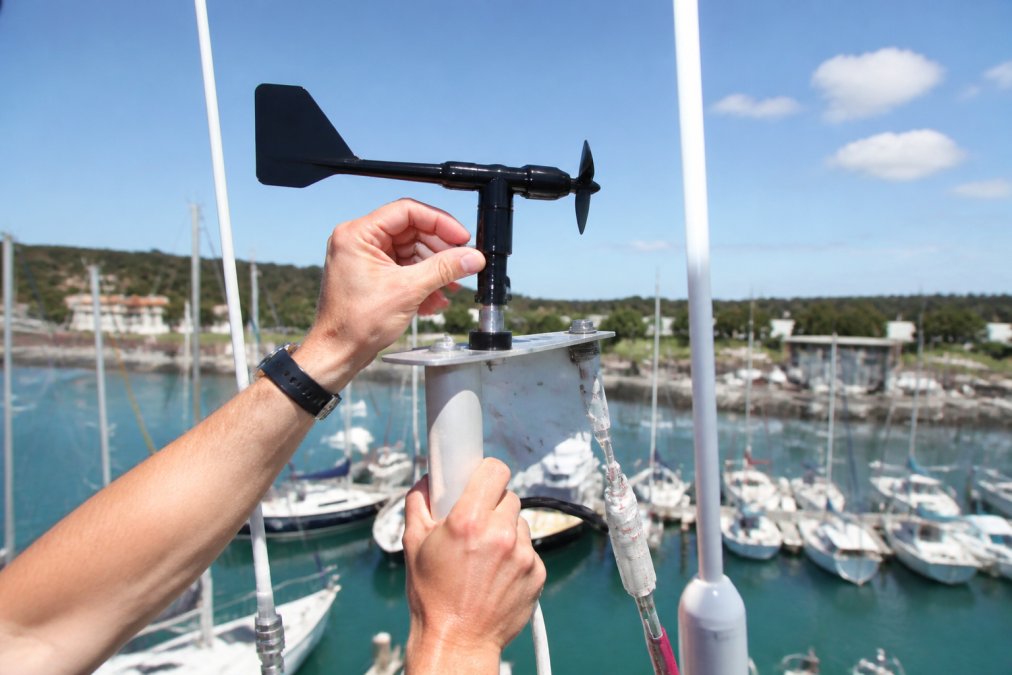
2. Garmin gWind Transducer with GND 10 Black Box Bridge
Garmin's gWind solves a problem most guides skip: what happens when your boat has an older Nexus network and a newer Garmin chartplotter. The included GND 10 black box bridges Nexus equipment and NMEA 2000, so both sides can share data.
![Garmin gWind Transducer w/GND 10 Black Box Bridge [010-01227-00]](https://cdn.shopify.com/s/files/1/0842/4914/9751/files/51102XL.jpg?v=1775842741)
The sensor itself uses twin-fin technology with a three-bladed propeller. Unlike a cups design, the propeller stays efficient across a wider range of wind angles, and Garmin pairs it with optic reading for better accuracy in light air. Twin-fin geometry also produces a more stable true wind angle reading, which is what you actually steer by.
Raymarine RSW Wired - Smart Performance →
Installation is genuinely plug-and-play between Nexus, Garmin chartplotters, NMEA 2000, and USB. The 25-meter mast cable and mounting hardware are included.
Where it falls short: the GND 10 is doing real work here, and if you already run a clean NMEA 2000 backbone with no Nexus gear, you are paying for a bridge you will not use. Buy the transducer-only version instead.
3. B&G WS320 Wireless Wind Sensor Pack
The WS320 is the answer for anyone who does not want to pull cable through a mast. It transmits wind data wirelessly to an interface module, and B&G states the wireless version matches the wired version's accuracy on both wind angle and wind speed.
B&G benchmarked the WS320 against multiple sensors across more than 500 individual wind tunnel tests, and the sensor has been through combined field testing exceeding 200,000 hours.
4. B&G WS310 Wired Wind Sensor
If you want B&G accuracy at the lowest price in this group, the WS310 is the straightforward choice. It is a wired sensor built for cruising and club racing, with the same emphasis on data accuracy and aerodynamics as the WS320 but without the wireless hardware.
5. Garmin GMI 40 Wireless Wind Pack with gWind Wireless 2
This pack bundles a wind sensor with a display, which changes the math. The GMI 40 is a 4.3-inch touchscreen instrument that shows wind, speed, depth, heading, engine, and fuel data from compatible devices, and it connects wirelessly to the gWind Wireless 2 transducer.
![BG WS320 Wireless Wind Sensor Pack with Wireless Interface Module [000-14383-001]](https://cdn.shopify.com/s/files/1/0842/4914/9751/files/72638XL.jpg?v=1775845080)
Marine Wind Instrument Calibration: Getting Accurate True Wind Data
Calibration is where most wind systems quietly go wrong. A masthead sensor measures apparent wind at the top of a mast that is also moving, heeling, and bending. True wind requires the system to correct for boat speed, heading, and masthead offset, and every one of those corrections has to be set correctly.
Sailboat Wind Sensor Maintenance Tips for Long-Term Reliability
Masthead sensors fail for boring reasons: spider webs, salt crust, insect nests, and worn bearings. A seasonal cleaning routine prevents most of it.
Before each season, inspect the following:
- Propeller or cups: spin them by hand. They should rotate freely with no grinding or wobble. Stiff rotation means bearing wear.
- Wind vane: check that it swings freely and returns to center. A vane that sticks will give you a frozen wind angle.
- Cable and connector: look for chafe where the cable exits the mast and corrosion at the connector pins.
- Mounting bracket: confirm fasteners are tight. Vibration loosens hardware over a season.
- Wireless battery: on a wireless unit, check charge state and replace the battery on schedule rather than waiting for failure.
Frequently Asked Questions
What is the difference between a mechanical and ultrasonic wind transducer?
Mechanical wind transducers use moving parts like cups or a propeller to measure wind speed and a vane for direction. Ultrasonic sensors have no moving parts and calculate wind speed and direction by measuring how sound travels between transducers. Mechanical units are generally less expensive and easier to service, while ultrasonic models offer higher precision and no wear from spinning components. For most cruising sailors, mechanical transducers like the Garmin gWind or B&G WS310 provide reliable data at a lower cost.
Do I need to calibrate my wind transducer after installation?
Yes. Even factory-calibrated units benefit from on-water calibration to correct for masthead alignment and hull-specific wind flow. Marine wind instrument calibration involves setting the calibration offset so the transducer reads straight ahead when the boat is motoring into the wind, then fine-tuning true wind angle and speed. Raymarine Smart Wind technology reduces the setup burden, but a basic calibration pass still improves accuracy for tactical sailing and autopilot performance.
Are wireless wind transducers reliable for offshore cruising?
Wireless models like the B&G WS320 and Garmin gWind Wireless 2 have logged hundreds of thousands of combined field-testing hours and deliver the same accuracy as wired versions. The main trade-off is battery management: solar-charged batteries need periodic replacement. For offshore passage-making, many sailors still prefer wired transducers because there is no signal dropout risk and no battery to service at the masthead. Both approaches work, but wired remains the conservative choice for long-distance cruising.
What are the most common causes of wind transducer failure?
The most frequent failures are bearing wear from spinning cups or propellers, UV degradation of plastic housings, water intrusion through cracked seals, and cable chafe where the mast cable passes through the deck. Regular sailboat wind sensor maintenance, including rinsing with fresh water, inspecting the mounting bracket, and checking cable glands, extends service life significantly. Transducers mounted at the masthead face the harshest conditions on the boat, so annual inspection before the season is worth the climb.
How do I choose the right wind transducer for my sailboat?
Start with your existing electronics network. If you run NMEA 2000, the Raymarine RSW Wired, Garmin gWind with GND 10, and B&G WS310 integrate directly. For older NMEA 0183 systems, the B&G WS310 supports MWV sentences at 10Hz, and the Garmin GND 10 bridge converts Nexus data to NMEA 2000. Consider mast height for cable length, whether you want wired reliability or wireless convenience, and your budget. Prices range from $499.99 for a transducer-only replacement to $1,099.99 for a full display-and-sensor pack.