

Are Marine VHF Radio Features Worth the Upgrade?

Last Updated: October 24, 2026
Quick Summary
For coastal cruising, prioritize a fixed-mount marine vhf radio with DSC and built-in GPS, then add a handheld as backup. Antenna height and a clean feedline decide your real range far more than wattage, so install the antenna as high as practical. Expect to spend $269.99 to $1,299.99 depending on whether you need AIS transmit.
- Fixed-mount radios transmit up to 25 watts, while handhelds typically run 5 to 6 watts.
- DSC sends your vessel identity and GPS position in one press on Channel 70.
- Range in nautical miles runs roughly 1.2 times the square root of antenna height in feet.
- Most radios lock the MMSI after first entry, so enter it once, carefully.
- The Standard Horizon GX1410GB is the lowest entry point at $269.99 with built-in GPS.
Table of Contents
- Fixed-Mount vs. Handheld: Which Marine VHF Radio Fits Coastal Cruising?
- Marine VHF Radio with DSC and GPS: The Safety Core
- Handheld VHF Radio for Boating: Backup Role and Limits
- Marine VHF Radio Range: Antenna Height, Power, and Real-World Reach
- Feature Comparison: Five Coastal-Cruising Radios Side by Side
- DSC Setup and MMSI Registration Checklist
- Choosing Your Coastal Cruising Radio at Charleston Yachting
- Frequently Asked Questions
Fixed-Mount vs. Handheld: Which Marine VHF Radio Fits Coastal Cruising?
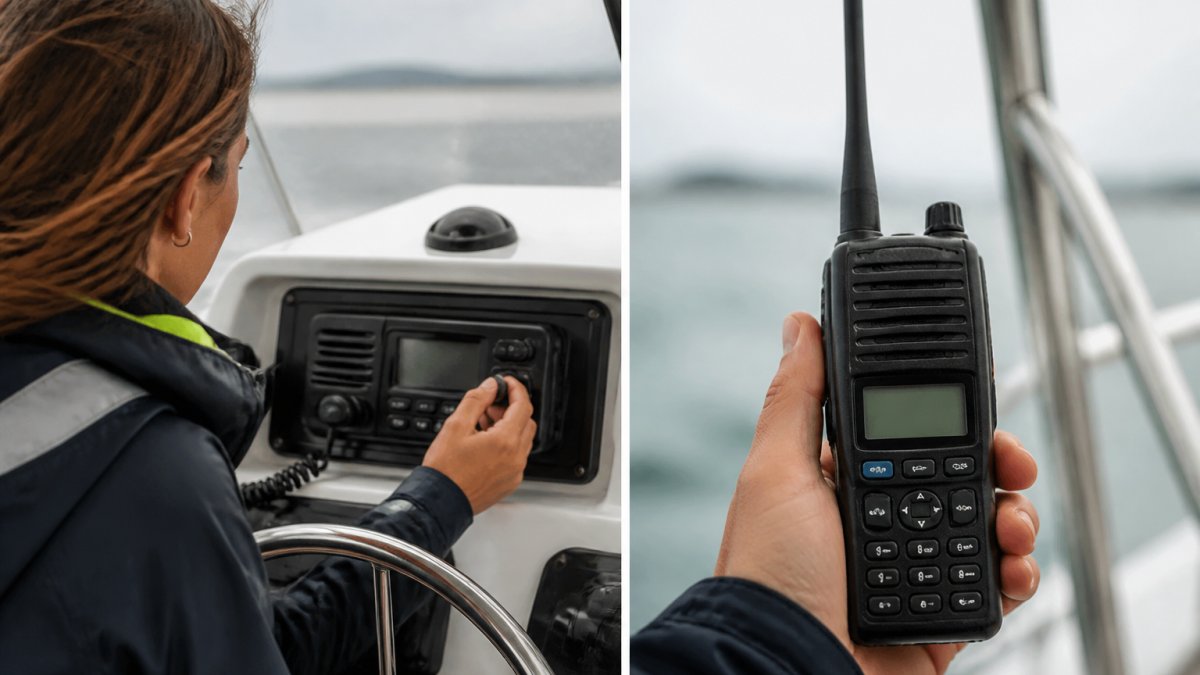
Most coastal cruisers should buy a fixed-mount marine VHF radio first and treat a handheld as backup. Fixed-mount units transmit at up to 25 watts, while handhelds top out far lower. That power gap decides who hears you when the weather turns.
At Charleston Yachting, we see this question settle most upgrade decisions. Here is the short version:
- Fixed-mount: 25 watts, antenna mounted high, wired to boat power, DSC built in. This is your primary safety radio.
- Handheld: portable, battery-dependent, lower output. It belongs in a ditch bag or a pocket, not as the only radio aboard.
The Federal Communications Commission requires boaters to keep a watch on Channel 9 or Channel 16 whenever the radio is powered on, per the USCG Navigation Center radio guidance. A radio you can hear from the helm matters more than a radio you can carry.
Marine VHF Radio with DSC and GPS: The Safety Core
A marine VHF radio with DSC and GPS is the single most important safety feature you can add. Digital Selective Calling sends a structured distress alert carrying your vessel identity and position, rather than relying on a voice mayday someone has to hear and copy correctly.
That distinction is everything. A DSC distress call transmits vessel identification, latitude and longitude, and time in one press. The BoatUS Foundation communications study guide identifies Channel 16 as the distress channel and Channel 13 as the bridge-to-bridge channel for commercial shipping.
Digital Selective Calling (DSC) is a digital alerting system that sends automated distress and individual calls over Channel 70, including your MMSI and GPS position. It works even when no one is listening to voice traffic.
Built-in GPS matters because DSC is useless without a position feed. The Standard Horizon GX1410GB carries an internal 66-channel WAAS GPS receiver, so DSC works without wiring the radio to a separate plotter.
Handheld VHF Radio for Boating: Backup Role and Limits
A handheld VHF radio for boating is a backup, not a substitute. It gets you communication when the main electrical system fails, when you are in the dinghy, or when you go overboard. It does not replace 25 watts and a masthead antenna.
Battery life runs roughly 7 to 16 hours depending on the model, according to Boat & Sail Magazine battery benchmarks. Charge it before every trip and carry a spare if the day runs long.
Modern handhelds have closed much of the feature gap. The Icom IC-M94D includes an AIS receiver and DSC in a floating, IPX7-rated body, with 6 watts of transmit power and roughly 10 hours of operating time on its 2400 mAh battery. That is a genuinely capable backup. It is still a backup.
Marine VHF Radio Range: Antenna Height, Power, and Real-World Reach
Marine VHF radio range is governed by antenna height more than by wattage. VHF signals travel essentially line of sight, so the height of your antenna above the water, not the number on the power setting, sets the outer limit of who can hear you.
The practical mechanism is the radio horizon. Because VHF propagation is line of sight, the distance to the horizon grows with the square root of antenna height. A masthead antenna on a sailboat might sit 50 to 60 feet above the water; a rail-mounted antenna on a powerboat might sit 10 to 15 feet up.
Power still matters, but at the margins. The Federal Communications Commission caps marine VHF at 25 watts for fixed-mount radios; handhelds typically run 5 to 6 watts. Higher power helps punch through clutter and reach a station that is already near the edge of line of sight, but it cannot bend a signal around the curve of the earth.
Installation decides whether you get the range the antenna height promises. Keep the coax as short as practical and use low-loss cable; every extra foot of thin coax and every poorly soldered connector bleeds signal before it reaches the antenna.
Receiver sensitivity, measured in microvolts, decides whether you hear weak signals from distant shore stations. Transmit power decides whether they hear you. Both matter, and neither fixes a bad antenna.
Feature Comparison: Five Coastal-Cruising Radios Side by Side
Here is how the five radios we stock compare for coastal work. Prices are our current listings.
| Radio | Type | Price | AIS | GPS | Best For |
|---|---|---|---|---|---|
| Simrad RS40-B | Fixed | $1,299.99 | Class B transmit | Built-in | Busy coastal traffic |
| B&G V60-B | Fixed | $1,299.99 | Class B transmit | Built-in | Sailors on a B&G network |
| Garmin VHF 215 | Fixed | $549.99 | No | Built-in | Garmin chartplotter owners |
| Standard Horizon GX1410GB | Fixed | $269.99 | No | Built-in | Budget-first installs |
| Icom IC-M94D | Handheld | $399.95 | Receive only | Built-in | Backup and dinghy use |
Simrad RS40-B. The strongest all-round pick for coastal cruising. Class B AIS transmits your position so other AIS-equipped vessels see you, not just the other way around.
B&G V60-B. Nearly identical capability to the Simrad, with the same Class B AIS transceiver and the same $1,299.99 price. The differentiator is the Man Overboard function and Track Buddy, which polls the position of up to five vessels.
Garmin VHF 215. The value pick for anyone running Garmin displays. Class D DSC, 25 watts, built-in GPS, and all U.S., Canadian and international marine channels plus 10 NOAA weather channels. Plug-and-play over NMEA 2000 to compatible chartplotters.
Simrad RS40-B VHF Radio w/Class B AIS Transceiver Internal GPS [000-14473-001] →
Standard Horizon GX1410GB. The lowest entry point at $269.99, and it still delivers Class D DSC, a built-in 66-channel GPS, and an IPX8 submersible rating. Watch out: no AIS, no NMEA 2000, and no remote mic capability.
Icom IC-M94D. The best handheld here for coastal work. 6 watts, AIS receive, DSC, floating construction, and 1500 mW of audio output for noisy cockpits. It receives AIS but does not transmit, so it will not make you visible to others.
Best for: coastal cruisers who want to be seen by commercial traffic. Skip if: your budget is under $600 and AIS is not a priority.
DSC Setup and MMSI Registration Checklist
DSC only works if you register it and wire it correctly. An unregistered radio cannot transmit a valid distress alert, and the Coast Guard cannot identify you from a blank or mistyped identity.
Get an MMSI before you power the radio on. The Maritime Mobile Service Identity is a nine-digit number that identifies your vessel in DSC traffic.
Enter the MMSI exactly once, carefully. Most fixed-mount and handheld radios lock the MMSI after the first entry. A typo can mean a factory reset, a service return, or a radio that is permanently misidentified.
Connect and verify the GPS position feed. DSC distress alerts carry your latitude and longitude, but only if the radio has a live position source.
Program the directory with local shore stations. Enter the MMSI or group identities of the Coast Guard station, local marinas, and any buddy boats you cruise with.
Test with a DSC test call, never on Channel 16. DSC test calls go out on Channel 70 and are addressed to a specific station; they confirm the link without cluttering the distress channel.
Rehearse the distress button procedure. Know which button or cover protects the distress key, how long to hold it, and how to cancel an accidental alert. The time to learn this is at the dock, not in a squall.
Record the MMSI and share it with your crew. Keep the number in the boat's log, in your phone, and with anyone who might use the radio.
A correctly registered MMSI, a live GPS feed, and a rehearsed distress procedure are what turn DSC from a feature on a spec sheet into a working safety system. Skip any one of them and the radio may still transmit, but it may not transmit what rescuers need.
Choosing Your Coastal Cruising Radio at Charleston Yachting
The right marine VHF radio for coastal cruising comes down to three questions: do you need AIS transmit, what network is your helm already on, and what is your budget. Answer those and the choice narrows quickly.
We carry all five radios above, along with the antennas and connectors that make them perform. Same-day shipping means the install does not wait on a warehouse. Browse our marine electronics selection.
Frequently Asked Questions
What features should I look for in a marine VHF radio for coastal cruising?
Prioritize Class D DSC, built-in GPS, and 25-watt transmit power for fixed-mount units. DSC lets you send a distress call with your position at the push of a button, and built-in GPS means the radio has coordinates even if your chartplotter fails. Add AIS if you sail crowded harbors or in fog, and check for NMEA 2000 so the radio talks to your existing electronics. NOAA weather channels with alert are standard on most current models.
How far does a marine VHF radio reach?
Marine VHF radio range is mostly line of sight, so antenna height matters more than wattage. A fixed-mount radio at 25 watts with an antenna mounted 3 meters above the water can typically reach shore stations and other vessels 15 to 25 miles away. A handheld at 5 to 6 watts with its antenna near deck level usually manages 3 to 8 miles. Raising the antenna is the single biggest range improvement you can make.
Is a fixed-mount or handheld VHF radio better for coastal cruising?
A fixed-mount radio is the primary choice for coastal cruising because it delivers 25 watts of transmit power, supports DSC with your MMSI programmed, and connects to a masthead antenna for real range. A handheld VHF radio for boating is a backup, not a replacement: it runs 5 to 6 watts, has 7 to 16 hours of battery life, and works if the main electrical system fails or you end up in the water. Carry both.
Does a marine VHF radio need built-in GPS?
Built-in GPS is worth having because DSC distress calls transmit your latitude and longitude automatically. Without a position source, a DSC alert still fires but rescue coordination has to work harder to find you. Models like the Standard Horizon GX1410GB and Garmin VHF 215 include internal GPS, so DSC works out of the box with no extra wiring to a chartplotter. If your radio lacks GPS, connect it to a compatible GPS source via NMEA.
Are AIS features useful on a coastal VHF radio?
AIS is useful in traffic and reduced visibility. A receiver shows nearby AIS-equipped vessels on the radio screen or a compatible chartplotter, and a transceiver also broadcasts your position so others see you. The Simrad RS40-B and B&G V60-B include Class B AIS transceivers, which help in crowded harbors and shipping lanes. If you mostly daysail in open water with light traffic, DSC and GPS cover the core safety need.
The gap between a $270 radio and a $1,300 radio is not audio quality. It is whether other vessels can see you on AIS. Charleston Yachting stocks both ends of that range, with same-day shipping and premium hardware from Garmin, B&G, and Simrad. Get started with Charleston Yachting and get the right radio installed before your next coastal run.
