

Best Marine Electronics for Small Fishing Boats

Table of Contents
- Best Marine Electronics for Small Fishing Boats: Quick Comparison
- Best Fish Finder for Small Boats
- Small Boat GPS Chartplotter Options
- Marine VHF Radio for Small Boats
- Building a Complete Boat Electronics Setup for Fishing
- Sonar Technology and Transducer Selection
- Matching Electronics to Your Boat Type and Fishing Style
- Total Cost of Ownership and Budget Tiers
- Frequently Asked Questions
Last Updated: October 19, 2026
Best Marine Electronics for Small Fishing Boats: Quick Comparison
Choosing the right marine electronics for a small fishing boat means matching your boat's size, fishing style, and budget to gear that works for your setup. Many anglers overspend on features they'll never use, while others settle for displays too small to read in bright sunlight.
The difference between a $450 combo and an $1,800 system isn't just screen size, it's sonar technology, networking, and integration.
This guide covers the best marine electronics for small fishing boats across categories, from standalone fish finders for kayaks to chartplotter combos, with recommendations for different boat types and fishing scenarios.
Quick Picks:
- Best Overall Combo: Garmin ECHOMAP UHD2 74CV, 7-inch display, dual sonar, preloaded coastal maps, $699.99
- Best Budget Option: Garmin ECHOMAP UHD2 53CV, 5-inch display, same sonar technology, $449.99
- Best Standalone Fish Finder: Lowrance Eagle 4x, compact 4-inch portrait display, perfect for kayaks and tight spaces, $123.00
- Best Premium Combo: Simrad GO9 XSE, 9-inch touchscreen, advanced CHIRP sonar, radar-ready, $829.99
- Best VHF Radio: Icom IC-M430, compact fixed-mount, built-in GPS, color display, $599.95
| Equipment Type | Best Pick | Price | Best For |
|---|---|---|---|
| Fish Finder Combo | Garmin ECHOMAP UHD2 74CV | $699.99 | Coastal and inland fishing |
| Budget Combo | Garmin ECHOMAP UHD2 53CV | $449.99 | Small boats, limited helm space |
| Standalone Fish Finder | Lowrance Eagle 4x | $123.00 | Kayaks, canoes, minimal installation |
| Premium Combo | Simrad GO9 XSE | $829.99 | Advanced sonar, touchscreen navigation |
| VHF Radio | Icom IC-M430 | $599.95 | Safety and communication |
Best Fish Finder for Small Boats
A fish finder cuts the guesswork out of finding structure, depth changes, and fish. On small boats with limited helm space, you need a sunlight-readable display that's simple to install.

The Garmin ECHOMAP UHD2 74CV delivers dual sonar in a 7-inch package that fits most small boat dashboards: traditional CHIRP plus ClearVü scanning sonar, which shows a picture-like view of the bottom.
If you're tight on budget or helm space, the Garmin ECHOMAP UHD2 53CV delivers the same sonar technology in a 5-inch display at $449.99. The smaller screen is readable, though you'll scroll more.

Standalone Options vs. Combo Units
The choice depends on whether you need GPS navigation. Standalone fish finders like the Lowrance Eagle 4x ($123.00) are purpose-built for fishfinding. Its 4-inch portrait display works brilliantly on kayaks and canoes where mounting space is measured in inches. The Bullet Transducer provides wide-angle coverage, double most standalone units, and autotuning sonar gets you started without fiddling with frequency settings.
Combo units bundle fishfinding and GPS chartplotting into one display: navigation, waypoint marking, route planning, and sonar on the same screen. For boats that venture beyond sight of familiar landmarks, a combo is essential. For ponds or staying within a few miles of home, a standalone saves money and installation complexity.
Small Boat GPS Chartplotter Options
A chartplotter gives you GPS positioning, electronic charts, and waypoint marking, critical for returning to productive fishing spots.
The Garmin GPSMAP 743xsv ($1,299.99) is a 7-inch touchscreen that fits standard helm openings on most small boats.
For a larger display, the Garmin GPSMAP 943xsv ($1,809.98) adds a 9-inch IPS display with better viewing angles and includes the GT23-TM transducer.
The Simrad GO9 XSE ($829.99) offers a 9-inch touchscreen at a lower price point. It comes with a 9-pin High-Speed Skimmer Transducer and C-MAP Discover charts.

The Raymarine Axiom+ 7 RV ($1,399.99) prioritizes speed and responsiveness.
Screen Size and Display Readability
The ideal screen size depends on viewing distance and helm layout, not absolute measurements. A 5-inch display mounted 24 inches from your eyes is more readable than a 7-inch unit mounted 48 inches away.
Brightness is non-negotiable. Sunlight reflecting off water washes out dim screens. The Raymarine Axiom+ series hits 1,800 nits, noticeably brighter in harsh conditions (Axiom+ High-Performance Chartplotter Displays). If you fish at midday, brightness matters more than touchscreen convenience.
Resolution affects how much information fits on screen. A 7-inch display at 800 x 480 shows less detail per pixel than a 9-inch display at the same resolution.
Marine VHF Radio for Small Boats
A VHF radio is your safety net on the water, connecting you to the Coast Guard, other vessels, and marinas.
The Raymarine Ray53 ($494.99) is built for small boats: a full-function VHF with Class D Digital Selective Calling (DSC), so the Coast Guard can locate you if you send a distress call.
The Icom IC-M430 ($599.95) adds a color TFT LCD display with three viewing modes, Light, Dark, and Night, the first color display in its class.
Both units support NMEA 2000 networking for integration with modern chartplotters. The Icom's color display offers enhanced readability in varying light.
Building a Complete Boat Electronics Setup for Fishing
Most anglers buy electronics one component at a time: a fish finder, then a GPS, then maybe a radio. The right approach is to plan your complete system upfront, considering power draw, installation constraints, and how devices will communicate.
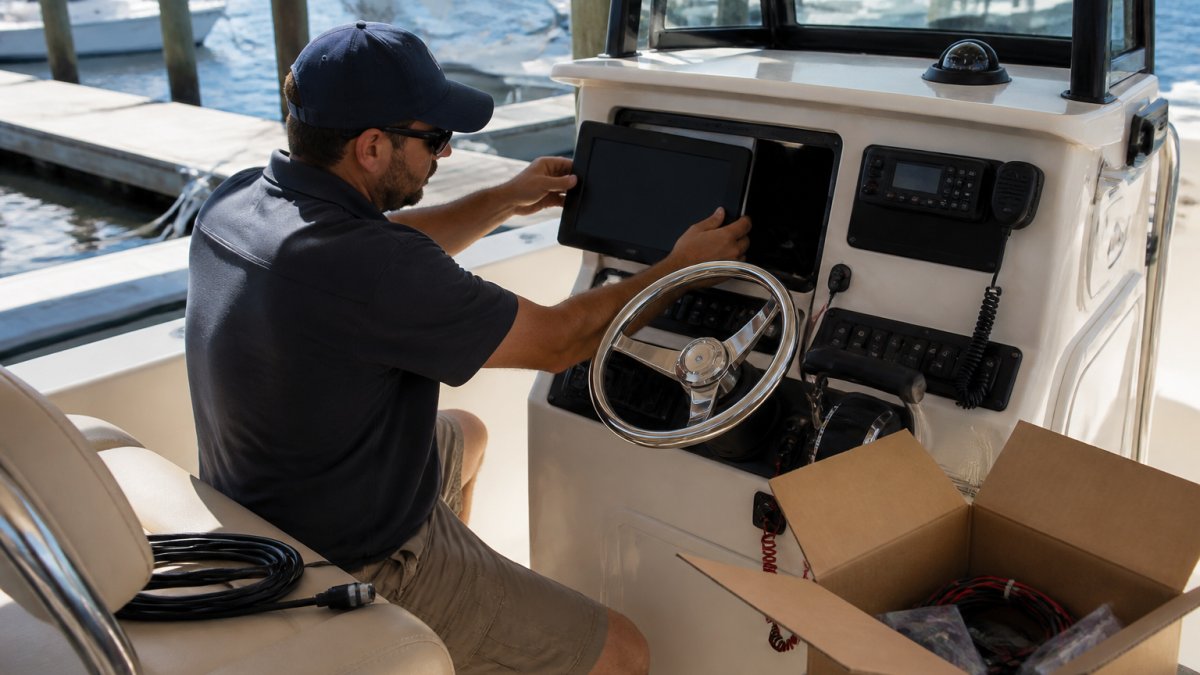
A typical small boat setup includes a chartplotter/fish finder combo, a VHF radio, and a transducer, handling navigation, fish finding, and emergency communication. If you add radar or autopilot later, all devices should share data via NMEA 2000 networking.
Power Draw and Battery Sizing
A fish finder and chartplotter combo draws 1-2 amps normally. Add a VHF radio (1-7 amps depending on transmit mode), and total demand climbs to 8-10 amps continuously. Running electronics for 6 hours without engine charging requires a dedicated battery with 60-80 amp-hours of capacity.
Small boats often rely on a single battery for engine starting and electronics. That works if you run the engine frequently, but fails on calm days anchored and fishing.
Calculate your actual runtime. A 50 amp-hour battery powering 8 amps provides roughly 6 hours before dropping to 50% charge. In practice, that's 4-5 hours of fishing before you need to run the engine to recharge.
Installation and Mounting Constraints
Transducer mounting is the most common installation bottleneck on small boats. The transducer must sit on the hull below the waterline, either transom-mounted or through-hull.
Garmin ECHOMAP UHD2 74CV Chartplotter/Fishfinder Combo w/US Coastal Maps →
Through-hull installation requires drilling and permanently sealing a hole in the hull. It's more involved but solves interference issues.
Display mounting depends on helm layout. Center consoles have a flat surface for flush mounting; open boats with integrated consoles may need tilt or gimbal mounts.
Power and data cables run from the display to the transducer and battery. Plan routing before installation, avoiding sharp edges, hot engine compartments, and moving parts like steering cables.
Networking and System Integration
Modern marine electronics communicate via NMEA 2000, a standardized network that lets your chartplotter share data with your VHF radio, autopilot, and engine gauges.
NMEA 2000 requires a backbone cable running through the boat and T-connectors where devices attach. It's more complex than standalone electronics: a networked system allows each device to access critical data from multiple sources.
Older electronics use NMEA 0183, a simpler standard for basic data like position and depth. If you're mixing old and new equipment, verify compatibility before purchase. All the units in this guide support NMEA 2000, so you can network them together.
Sonar Technology and Transducer Selection
Sonar is how your fish finder sees underwater. Understanding the basics helps you choose the right transducer and interpret what's on screen.
Traditional CHIRP sonar transmits across a range of frequencies, producing clear target separation and definition. It's the reliable workhorse for most fishing scenarios.
ClearVü scanning sonar produces a picture-like view of the bottom, showing structure, vegetation, and fish in remarkable detail.
The Garmin GT54UHD-TM ($499.99) is an all-in-one transducer delivering ClearVü at 800 kHz, SideVü at 455/1200 kHz, and high-wide CHIRP sonar.
Transducer frequency affects range and detail. Higher frequencies (600-1200 kHz) provide detail but limited range; lower frequencies (50-200 kHz) reach deeper but show less detail.
Matching Electronics to Your Boat Type and Fishing Style
The best marine electronics for small fishing boats depend on your boat and how you fish.
Kayak and Canoe Fishing: Use the Lowrance Eagle 4x ($123.00), the only standalone fish finder designed for portable boats.
Center Console Boats (20-25 feet): Step up to the Garmin ECHOMAP UHD2 74CV ($699.99) paired with the Icom IC-M430 VHF radio ($599.95).
Dedicated Fishing Boats or Larger Vessels: Invest in the Simrad GO9 XSE ($829.99) or Raymarine Axiom+ 7 RV ($1,399.99). Both offer advanced sonar imaging, faster processing, and superior displays.
Freshwater vs. Saltwater: Freshwater fishing benefits from traditional CHIRP sonar and LakeVü maps (included with Garmin ECHOMAP units).
Total Cost of Ownership and Budget Tiers
The upfront price of marine electronics is only part of the cost. Consider installation labor, transducers, cables, and future upgrades.
Budget Tier ($500-$800): Start with the Garmin ECHOMAP UHD2 53CV ($449.99) and a basic VHF radio, covering fish finding and emergency communication. Installation is straightforward if you're comfortable with basic wiring.
Don't assume higher price guarantees better results. A $450 ECHOMAP unit with proper transducer placement can perform effectively.
Consider resale value. If you upgrade in 3-5 years, a popular unit may retain a portion of its purchase price.
Choosing the right marine electronics for small fishing boats comes down to matching your boat's size, your fishing style, and your budget to equipment that actually solves your problems. Our same-day shipping means you can order today and install this weekend. Shop All marine electronics and find the right setup for your boat.
Frequently Asked Questions
What marine electronics do you really need on a small fishing boat?
At minimum, a fish finder with sonar and a GPS receiver. A combined GPS chartplotter and fish finder handles both navigation and fish detection in one unit, saving space and power. Add a VHF radio for safety and communication. For serious fishing, add a dedicated high-resolution sonar transducer. Start with a combo unit like the Garmin ECHOMAP UHD2 53CV ($449.99) and upgrade components as your fishing needs grow.
How much should you spend on a small boat electronics setup for fishing?
Budget $450-$600 for a basic combo unit with decent sonar and GPS. Mid-range systems run $800-$1,400, adding larger screens, better sonar clarity, and networking. Premium setups exceed $1,800 with advanced imaging and full system integration. The Lowrance Eagle 4x ($123) works for kayaks and ultra-compact boats. Most recreational anglers find value in the $500-$900 range where you get reliable CHIRP sonar, good chart coverage, and room to expand.
Can a fish finder and GPS chartplotter be combined in one unit?
Yes. Multifunction displays combine GPS navigation, charting, and sonar in a single screen. All major combo units in Charleston Yachting's catalog integrate both functions. The advantage is space savings, shared power supply, and unified control. Drawbacks: if one system fails, you lose both functions; screen real estate is shared between navigation and sonar views. For small boats with limited helm space, a combo unit is usually the best choice.
What screen size works best for a small boat fish finder?
5-7 inches is ideal for small boats. A 5-inch display (like the Garmin ECHOMAP UHD2 53CV) fits tight helm layouts and kayaks. 7 inches (Garmin ECHOMAP UHD2 74CV, $699.99) offers better readability without overwhelming the dash. 9 inches (Simrad GO9 XSE, $829.99) requires more space but delivers superior visibility in bright sunlight. Choose based on available helm space and whether you prioritize navigation detail or sonar clarity. Ensure the display has high brightness (1,200+ nits) for daytime viewing.
How do you power marine electronics on a small fishing boat?
Most marine electronics run on 12V or 24V DC from your boat's battery. A single fish finder and chartplotter typically draw 1-3 amps at full brightness. Add a VHF radio (2-5 amps transmit) and you need a dedicated battery or substantial cranking battery. For a full setup, use a deep-cycle battery separate from the engine start battery. Calculate total draw: Garmin ECHOMAP draws ~1 amp, Raymarine Ray53 VHF draws ~2 amps in standby. Upgrade to a 100Ah deep-cycle battery if running multiple units for extended periods.