

Best Marine Chartplotter for Saltwater Fishing: A Buyer's Guide

Last Updated: October 31, 2026
Quick Summary
The best marine chartplotter for saltwater fishing is a combo unit that pairs sealed, corrosion-resistant construction and a bright sunlight-readable screen with sonar tuned for depth. For offshore work, the 12-inch Garmin ECHOMAP Ultra 2 126sv at $3,299.99 is our first pick, while the 9-inch ECHOMAP UHD2 94sv at $1,399.99 suits inshore and nearshore boats.
- Saltwater-ready units need IPX7 waterproofing, nano-coated glass, and high nit ratings for sun glare.
- A chartplotter handles navigation and a fish finder handles sonar, so most anglers buy a combo.
- The 7-inch ECHOMAP UHD2 74sv with a GT54 transducer costs $1,099.99.
- The Raymarine Axiom+ 12 RV has an IPS display rated up to 1,800 nits and costs $2,599.99.
- Match the transducer to your deepest regular fishing depth before sizing the screen.
Table of Contents
- What Separates a Saltwater Chartplotter From a Freshwater Unit
- Chartplotter vs Fish Finder: What You Actually Need Aboard
- Top Saltwater Fish Finder GPS Combo Picks
- Choosing a Chartplotter for Inshore Fishing
- Choosing a Chartplotter for Offshore Fishing
- Charts, Transducers, and the Total Cost of Ownership
- Outfitting Your Boat With the Right Saltwater Electronics
- Frequently Asked Questions
What Separates a Saltwater Chartplotter From a Freshwater Unit
If you fish saltwater fishing grounds, the electronics have to survive salt water.
Salt spray is relentless. It creeps into connectors, etches exposed metal, and fogs a screen that isn't sealed to a proper rating. Look for glass that resists water and oil so your touch controls keep working with wet hands.
Brightness matters just as much. On an open boat with no shade, a dim screen is useless by mid-morning.
Durability, Display Brightness, and Corrosion Resistance
Three specs decide whether a unit holds up season after season:
- Waterproofing: IPX7 sealing keeps spray and rain out of the housing.
- Screen treatment: Nano-coated, impact-resistant glass sheds water and smudges.
- Display brightness: Higher nit ratings stay readable in direct sun.
A freshwater unit often checks only the first box. Saltwater punishes shortcuts.
Chartplotter vs Fish Finder: What You Actually Need Aboard
A chartplotter is a GPS display that shows your position on a navigation chart and stores waypoints, routes, and tracks. A fish finder is a sonar unit that reads depth and marks fish and bottom structure below the boat.
Here is the practical split:
| Feature | Chartplotter | Fish Finder | Combo Unit |
|---|---|---|---|
| Primary job | Navigation and position | Depth and fish targets | Both in one screen |
| Key sensor | Multi-band GPS | Transducer | GPS plus transducer |
| Best for | Running to and from the grounds | Finding structure | Most saltwater boats |
| Typical setup | Display plus charts | Display plus transducer | Display, transducer, charts |
A combo saves dash space and wiring. The trade-off is that you pay for both capabilities in one box, so match the screen size and sonar to how you actually fish.
Top Saltwater Fish Finder GPS Combo Picks
Every pick below is a combo, so you get navigation and sonar in one unit. We stock each of these because they cover the real spread of saltwater budgets and boat sizes, from a 7-inch starter screen to a 12-inch offshore command center.
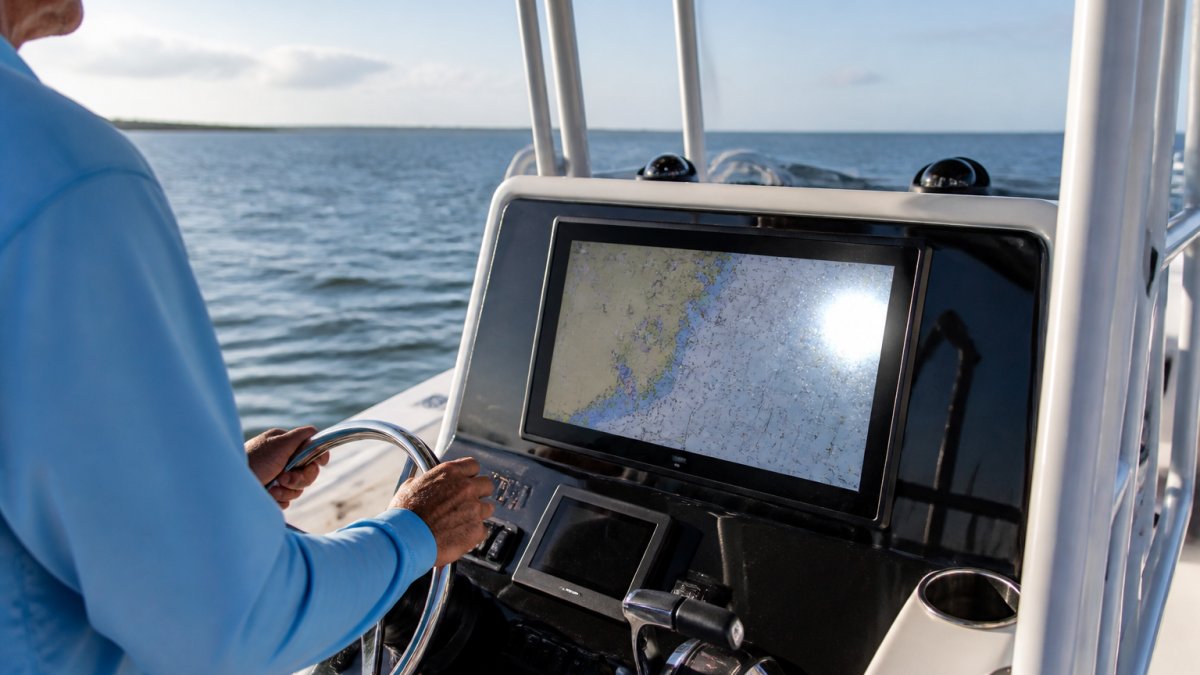
Garmin ECHOMAP Ultra 2 126sv: The Large-Screen Offshore Pick
The 126sv is the unit we point serious offshore anglers toward first. Its 12-inch sunlight-readable touchscreen is big enough to split into chart and sonar views without squinting, and the bundled GT56UHD-TM transducer adds CHIRP traditional sonar plus Ultra High-Definition ClearVü and SideVü scanning. It runs $3,299.99. See the full 126sv bundle and specs.

Best for: Offshore boats with dash space and a serious electronics budget. Skip if: You run a small skiff and can't justify the size or price.
Garmin ECHOMAP UHD2 94sv and 74sv: The Mid-Range Workhorses
The 94sv hits the sweet spot for most coastal anglers. At $1,399.99, it is the value pick for inshore and nearshore work. Check the 94sv combo package.

Step down to the 74sv and you get the same sonar trio and coastal maps on a 7-inch screen with a GT54 transducer, for $1,099.99. Compare the 74sv price and bundle.

Best for: Inshore and nearshore boats that want full sonar without the flagship price. Skip if: You need a 12-inch split screen offshore.
Raymarine Axiom+ 12 RV and Simrad NSX 3007: The Alternative Platforms
If you prefer a different operating system, the Axiom+ 12 RV brings a quad-core processor, a bright IPS display rated up to 1,800 nits, and HydroTough nano-coated glass that repels water and oil. It runs $2,599.99. View the Axiom+ 12 RV listing.
The Simrad NSX 3007 is the compact alternative. C-MAP DISCOVER X charts and fast Autorouting round it out at $1,324.99. See the NSX 3007 bundle details.
Best for: Anglers already invested in Raymarine or Simrad networks. Skip if: You want the simplest possible out-of-box experience.
Choosing a Chartplotter for Inshore Fishing
Inshore work rewards a compact, fast-refreshing screen more than raw depth capability. Back-bay and inlet fishing means tight quarters, shallow water, and constant repositioning, so a 7- or 9-inch unit with quick chart redraw and clear side imaging earns its space. The 74sv and NSX 3007 both fit that brief well. But inshore is not one fishery. A back-bay skiff, an inlet boat, and a nearshore center console have different chart, sonar, and mounting needs.
Chart Coverage for Back Bays and Inlets
Inshore chart coverage is where cheap units fail. Back-bay anglers need detailed charts of creeks, flats, and channels, not just offshore contours. Confirm the chart bundle includes the coastal and back-bay detail for your region, and check update costs after the first year. Built-in Garmin Navionics+ includes a one-year update subscription; premium upgrades like Navionics Vision+ cost extra. A unit with the wrong chart region is a navigation liability, not a bargain.
Garmin ECHOMAP Ultra 2 126sv w/GT56UHD-TM Transducer - Garmin Navionics+ →
Shallow-Water Sonar Trade-Offs
Inshore sonar is a different job from offshore. You are reading structure, bait, and bottom in the top 100 feet, not holding bottom in 1,000. Side and down scanning shine here: they show docks, channel edges, and bait schools that a traditional beam misses. High-frequency CHIRP gives sharper detail and better fish separation in shallow water. A bundled transducer covers most inshore anglers; deep-drop fishing is the exception, not the rule.
Decision Guidance by Boat and Fishing Style
Match the unit to your boat and your water, not to the spec sheet. A practical decision matrix:
| Boat and style | Screen size | Sonar priority | Chart priority |
|---|---|---|---|
| Back-bay skiff | 7-inch | Side and down scanning | Back-bay and creek detail |
| Inlet and nearshore | 9-inch | CHIRP plus side scanning | Coastal and inlet detail |
| Offshore center console | 12-inch | High-power low-frequency bottom holding | Offshore ledges and banks |
A 7-inch combo suits a bay boat; a 12-inch unit suits a center console running offshore. Watch out: buying a screen too large for a small console leaves no room for a compass or gauge and blocks your sightline through the windshield. If you are weighing an upgrade against a working older unit, the deciding factor is usually sonar and chart currency, not screen size.
Best for: Inshore and nearshore boats that want full sonar without the flagship price. Skip if: You need a 12-inch split screen offshore.
Choosing a Chartplotter for Offshore Fishing
Offshore fishing flips the priorities. You need a display you can read from the helm at speed, sonar that holds bottom in deep water, and networking for radar and autopilot. A 12-inch screen like the 126sv or the Axiom+ 12 RV lets you run chart, sonar, and radar side by side. But screen size is the easy part. The harder decisions are transducer selection, chart coverage, and how the unit handles salt spray and glare when you are 30 miles out.
Transducer and Sonar Selection for Saltwater Depths
Depth capability comes down to the transducer, not the display. A common pattern offshore is to pair a high-power transducer with a lower-frequency beam for deep bottom holding, and a higher-frequency beam for detail in the top 300 feet. Here is how the trade-offs break down:
- Low frequency (around 50 kHz): Holds bottom in deep water, often 1,000 feet or more with a high-power transducer. Wider beam marks more water but shows less detail.
- Medium frequency (around 80-130 kHz): A compromise for mid-depth bottom fishing and structure.
- High frequency (around 200 kHz and CHIRP ranges): Sharper detail and better fish separation in the top 300 feet, but loses bottom in deep water.
For offshore bottom fishing, a 1 kW transducer is the common step up from a bundled unit. For deep-drop fishing, a higher-power unit rated for the depths you fish matters more than the display. A common mistake is buying the biggest screen and skimping on the transducer. Sonar quality follows the transducer, not the display.
Chart Coverage and Chart Costs Offshore
Offshore chart coverage is not uniform. Coastal charts cover the shoreline and nearshore, while offshore charts cover the canyons, banks, and ledges. Built-in Garmin Navionics+ includes a one-year update subscription; premium upgrades like Navionics Vision+ cost extra. Before you buy, confirm the chart bundle covers the inlets, ledges, and offshore grounds you actually fish.
Saltwater Durability and Glare Offshore
Offshore is where salt spray, glare, and vibration punish shortcuts. Look for IPX7 waterproofing, nano-coated glass that sheds water and oil, and a display bright enough to read in open glare. The Axiom+ 12 RV has HydroTough nano-coated glass and displays rated up to 1,800 nits; the 126sv has a sunlight-readable touchscreen. Higher nit ratings stay readable in direct sun, and sealed connectors resist corrosion.
Networking and Radar Integration
Offshore boats grow. Confirm NMEA 2000 compatibility before you add autopilot, heading sensor, or radar, and check that the unit supports the radar and autopilot you plan to run. The 126sv supports NMEA 2000 networking for autopilots and heading sensors; the Axiom+ 12 RV networks over Raynet Ethernet and NMEA 2000. Buy the network backbone you will need in two years, not just the one you need today.
Best for: Offshore boats with dash space and a serious electronics budget. Skip if: You run a small skiff and can't justify the size or price.
Charts, Transducers, and the Total Cost of Ownership
The sticker price is not the whole cost. Budget for three things beyond the box:
- Chart subscriptions: Built-in Garmin Navionics+ includes a one-year update subscription; premium upgrades like Navionics Vision+ cost extra.
- Transducer upgrades: A bundled transducer covers most anglers, but deep-drop fishing may call for a higher-power unit.
- Networking and installation: NMEA 2000 cabling, mounting, and labor add to the total.
A common mistake is buying the biggest screen and skimping on the transducer. Sonar quality follows the transducer, not the display.
Outfitting Your Boat With the Right Saltwater Electronics
Match the unit to your boat and your water, not to the spec sheet.
If you are weighing an upgrade against a working older unit, the deciding factor is usually sonar and chart currency, not screen size.
Charleston Yachting stocks these combos with same-day shipping and premium marine electronics from Garmin, Simrad, and Raymarine, so you can get the right unit on the water fast.
Frequently Asked Questions
What features should I look for in a saltwater chartplotter?
Prioritize a sunlight-readable display, an IPX7 waterproof rating, and a transducer that handles the depths you fish. Multi-band GPS improves position accuracy near inlets and structure. If you run offshore, NMEA 2000 compatibility lets you add radar, autopilot, and engine data later. Built-in Garmin Navionics+ or C-MAP charts with a one-year update subscription save you from buying a chart card on day one.
Do I need a separate fish finder with a saltwater fish finder GPS combo?
Usually not. A combo unit bundles chartplotting and sonar in one display, which is why most saltwater anglers run a single combo at the helm. The Garmin ECHOMAP UHD2 94sv, for example, includes traditional CHIRP, ClearVü, and SideVü sonar plus a GT56UHD-TM transducer in the box. A separate fish finder only makes sense if you want a dedicated bow unit or a second station, and even then wireless networking lets compatible units share sonar, waypoints, and routes.
Can a marine chartplotter work without an internet connection?
Yes. Chartplotters store preloaded charts on internal memory and microSD cards, and GPS positioning comes from satellites, not cellular service. The Garmin ECHOMAP Ultra 2 126sv ships with built-in Garmin Navionics+ mapping.
How much should I spend on a marine chartplotter for saltwater fishing?
The Garmin ECHOMAP UHD2 74sv runs $1,099.99, the UHD2 94sv is $1,399.99, the Simrad NSX 3007 is $1,324.99, the Raymarine Axiom+ 12 RV is $2,599.99, and the ECHOMAP Ultra 2 126sv is $3,299.99. Budget separately for premium chart upgrades and any additional transducers.
The hardest part of outfitting a saltwater boat is matching screen size, sonar, and charts to how you actually fish. Charleston Yachting carries the full spread of saltwater combos, from the 7-inch 74sv to the 12-inch 126sv, backed by same-day shipping and expert-curated marine electronics. Get started with Charleston Yachting and put the right chartplotter on your dash this season.
