

Sailboat Autopilot: How to Pick the Right System

Last Updated: November 2, 2026
Quick Summary
To select the best sailboat autopilot, match the drive unit to your steering type first, then size it to your loaded displacement rather than boat length. Confirm network compatibility, plan the power budget, and compare installed cost before choosing a brand.
- Tiller, wheel and below-deck drives cover nearly every sailboat, so identify your steering type before comparing brands.
- Size the drive by loaded displacement, adding crew, water, fuel and gear to the documented figure.
- A 200 Ah lead-acid bank gives about 100 Ah of usable energy, so budget for the choppy-condition duty cycle.
- Walk the decision path in order: steering type, loaded displacement, intended sailing, then budget.
- Wire the pilot on its own circuit with a dedicated breaker sized to the drive's peak current.
Table of Contents
- Start With Your Steering Type, Not the Brand
- Sailboat Autopilot Sizing: Match Drive Capacity to Displacement
- Sailboat Autopilot Wheel Steering: What Fits and What to Check
- Below-Deck Sailboat Autopilot Systems: Linear and Hydraulic Drives
- Core Computer, Sensors and Chartplotter Integration
- Power Budget and Electrical System Requirements
- The Best Autopilot for Sailboat Owners: Matching System to Use Case
- Installation, Commissioning and Your Fallback Plan
- Frequently Asked Questions
Start With Your Steering Type, Not the Brand
The fastest way to narrow the field is to ignore brand names for a minute and look at what your boat already has. Learning how to select the best autopilot system for your sailboat starts with one question: how does the helm actually move the rudder? Every sailboat autopilot is built around a drive unit, and that drive unit has to physically connect to your existing steering system. Get that match wrong and no amount of brand prestige will save the installation.
Charleston Yachting stocks autopilot systems from Raymarine, Simrad and B&G. Start by identifying what kind of steering your boat carries.
Tiller, Wheel and Below-Deck: The Three Drive Families
Three drive families cover nearly every sailboat on the water:
- Tiller drive mounts directly to the tiller and pushes it side to side. Simple, removable, and ideal for smaller boats.
- Wheel drive clamps a drive ring onto the wheel and turns it with a belt or ring gear. No holes below deck.
- Below-deck drive hides a linear or hydraulic ram connected to the rudder quadrant, out of sight and out of weather.
A tiller-steered boat up to 13,200 lbs suits the Raymarine EV-100 Tiller Evolution Autopilot, a complete autopilot-in-a-box that includes the drive, sensor core and control head.

Sailboat Autopilot Sizing: Match Drive Capacity to Displacement
Sailboat autopilot sizing is a displacement question, not a length question. Manufacturers rate drives by the weight they can steer, and that rating is the hard ceiling you cannot cross. A long, light-displacement boat may need a smaller drive than a shorter, heavy-displacement cruiser.
Check the loaded displacement figure on your documentation, then add crew, water, fuel and gear. That total, not the brochure number, is what the drive must handle in a following sea.
Sailboat Autopilot Wheel Steering: What Fits and What to Check
Sailboat autopilot wheel steering is the most popular setup on cruising boats because it installs without cutting into the steering system. A wheel drive clamps to the wheel itself, so the rudder, quadrant and cables stay untouched.
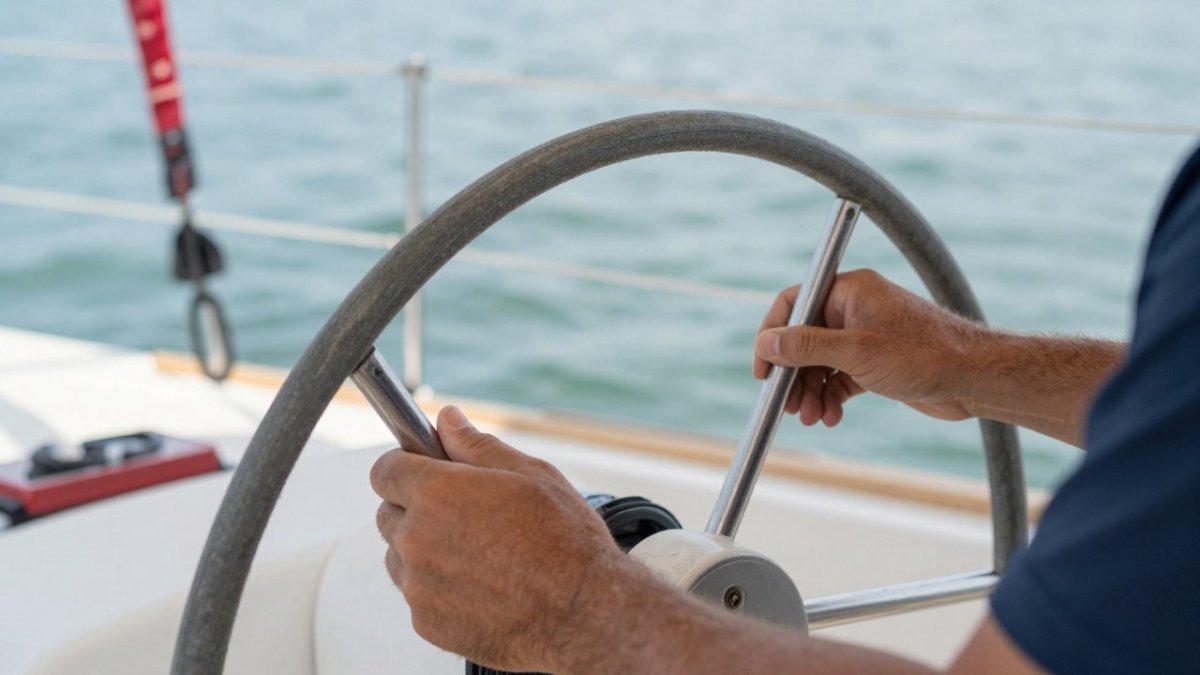
Check the wheel fit and clearance around the helm before ordering. The Raymarine EV-100 Wheel Evolution Autopilot fits most types of sailboat wheels and is for boats up to 16,500 lbs, with simple, robust clutch engagement.

Best for: coastal cruisers and weekend sailors who want a clean install. Skip if: your boat is over the displacement rating or has an unusual wheel design.
Below-Deck Sailboat Autopilot Systems: Linear and Hydraulic Drives
A below-deck sailboat autopilot is the right answer once the boat gets heavy or the sailing gets serious. These systems mount a ram below deck, connected to the rudder quadrant or tiller arm, and they steer with far more authority than a wheel ring.
The split is mechanical versus hydraulic. Mechanical steering uses cables and a quadrant, so a linear drive pushes a tiller arm directly. Hydraulic steering uses a pump or solenoid valve to move fluid. Match the drive type to the steering type, always.
The Raymarine EV-200 Sail Linear Drive Evolution Autopilot includes a Type 1 linear drive. The EV-400 Sail Evolution Autopilot requires a Type 2 or Type 3 drive unit.

Core Computer, Sensors and Chartplotter Integration
Every autopilot system has the same four parts, whatever the brand: a core computer, a control head, a heading sensor and a drive unit. The core computer runs the steering algorithms. The heading sensor, usually a solid-state compass, tells it where the boat points. The control head is what you press.
Integration is where buyers get burned. Many current systems communicate over NMEA 2000 or a manufacturer network such as SeaTalkng. Before you buy, confirm your plotter and instruments speak the same network.
Power Budget and Electrical System Requirements
Autopilot power consumption is modest but constant, and it matters most on long passages under sail. A wheel or tiller drive draws power every time it corrects course, and in choppy conditions that is often. Below-deck linear drives draw more current but correct less frequently. The practical question is not the nameplate draw but the duty cycle: how many minutes per hour the drive actually runs in the conditions you sail.
Build the budget in three steps.
- Estimate average draw, not peak draw. A tiller or wheel drive typically averages a few amps over an hour in moderate conditions, with short peaks when the clutch engages and the motor runs. A below-deck linear drive averages higher current but runs in shorter bursts. Use the manufacturer's published average current figure where available, and treat peak current as a wiring and breaker question rather than a battery question.
- Multiply by duty cycle for the passage. In flat water and steady wind, a pilot may correct only a handful of times per hour. In a quartering sea or light, shifty air, it may run most of the hour. A common pattern is to budget for the choppy-condition duty cycle, not the calm one, because that is when you cannot hand-steer comfortably.
- Compare the 24-hour total against usable battery capacity. Usable capacity is not the label on the battery. A lead-acid bank should not be drawn below roughly half its rated capacity without shortening life, so a 200 Ah lead-acid bank gives about 100 Ah of usable energy. Lithium iron phosphate banks can be drawn much deeper, often to 80 percent or more, which changes the math significantly.
Worked example: suppose the pilot averages 3 A in choppy conditions and runs 50 percent of the time over a 24-hour passage. That is 3 A × 12 hours = 36 Ah. Add instruments, plotter, lights, and refrigeration, and the total may land near 100-150 Ah for the day. A 200 Ah lead-acid bank with 100 Ah usable is then marginal; a 200 Ah lithium bank is comfortable.
Raymarine EV-100 Tiller Evolution Autopilot [T70153] →
Charging sources decide whether the budget closes. Engine alternators, solar, wind, and hydrogenerators each have realistic output windows. Solar output falls in cloud and at night; wind and hydro depend on boat speed and sea state.
Most systems run on 12V DC, and many accept 24V. Wire the pilot on its own circuit with a dedicated breaker sized to the drive's peak current, and keep cable runs short to limit voltage drop. A pilot that browns out during a correction is a pilot that will disengage at the worst moment.
Watch out: sizing the battery bank to the calm-water duty cycle is the most common power mistake; the pilot will be fine on a flat day and drain the bank on the first rough overnight passage.
The Best Autopilot for Sailboat Owners: Matching System to Use Case
The best autopilot for sailboat owners is the one sized to the boat and matched to the steering, not the one with the longest feature list. Instead of starting from a brand, walk a short decision path: steering type first, then loaded displacement, then intended sailing, then budget.
Step 1, Steering type. Tiller, wheel, or below-deck. This alone decides which drive families are even possible.
Step 2, Loaded displacement. Take the documented displacement, then add crew, water, fuel, and gear. That total is the number the drive must steer in a following sea. Stay at or below the drive's rated displacement; do not buy a drive rated just under your loaded weight.
Step 3, Intended sailing. Coastal daysailing and weekend cruising tolerate a simpler pilot with a wheel or tiller drive. Offshore and long-distance passage-making push toward below-deck linear or hydraulic drives with more authority, better sensors, and integration with wind data.
Step 4, Budget, including total cost of ownership. Purchase price is only part of the number. Installation, wiring, a dedicated breaker, sensors, drive components, and likely maintenance all add to the total. A below-deck install on a boat without existing access may require yard labor that rivals the hardware cost.
Here is how the path sorts common boats:
| Boat and use case | Steering | Recommended system | Price |
|---|---|---|---|
| Tiller boat up to 13,200 lbs | Tiller | Raymarine EV-100 Tiller | $2,199.99 |
| Wheel-steered cruiser up to 16,500 lbs | Wheel | Raymarine EV-100 Wheel | $2,199.99 |
| Mechanically steered boat up to 22,000 lbs | Linear | Raymarine EV-200 Linear Drive | $4,199.99 |
| Larger vessel needing Type 2/3 drive | Below-deck | Raymarine EV-400 Sail | $2,799.99 |
| Smaller boat, hydraulic or mechanical | Below-deck | Simrad NAC-2 Core Pack | $1,789.99 |
| Boat 33 ft or greater, high-current drive | Below-deck | Simrad NAC-3 Core Pack | $2,599.99 |
| Performance sailing and racing | Below-deck | B&G H5000 Pilot Computer | $2,649.99 |
The B&G H5000 Pilot Computer features dedicated steering modes and sailing algorithms, including Gust Response, Recovery and High Wind Response.
A boat-specific decision tree beats a feature checklist because it forces the compatibility question first. If two systems both fit your steering and displacement, then compare sensors, network integration, and control ergonomics for your crew.
Installation, Commissioning and Your Fallback Plan
Installation is where a good system becomes a great one. Plan for these steps:
- Confirm drive fit and clearance before drilling anything.
- Run cabling on its own circuit with a dedicated breaker.
- Mount the heading sensor away from magnetic interference and heavy current-carrying cables.
- Commission and calibrate per the manual, then sea-trial in calm water first.
- Test the clutch or bypass so you can return to manual steering instantly.
Failure planning matters as much as installation. Every pilot needs a fast way back to manual steering, and every crew member should know where the clutch is. Carry a backup tiller or emergency tiller, and never rely on the pilot alone near a lee shore.
Frequently Asked Questions
What are the three types of autopilot for a sailboat?
Sailboat autopilot systems fall into three drive families: tiller drives that push the tiller, wheel drives that turn the wheel through a belt or ring, and below-deck drives that connect directly to the rudder stock. Tiller and wheel units are simpler to install and cost less. Below-deck linear and hydraulic drives handle heavier displacement and give faster steering response, but they require access to the steering quadrant and more installation work.
How do I size a sailboat autopilot for my boat?
Sailboat autopilot sizing starts with loaded displacement, not length. Manufacturers publish a maximum displacement rating for each drive: the Raymarine EV-100 Tiller covers tiller-steered boats up to 13,200 lbs (6,000 kg), the EV-100 Wheel covers boats up to 16,500 lbs (7,500 kg), and the Type 1 Linear Drive in the EV-200 package is rated for mechanically steered vessels up to 22,000 lbs (10,000 kg). Size to your boat loaded for a cruise, then confirm the drive suits your steering system.
Can a sailboat autopilot connect to my chartplotter?
Yes, if both units share a network. Raymarine Evolution systems use SeaTalkng, which also connects to NMEA 2000, and the Simrad NAC-2 and NAC-3 core packs ship with an NMEA 2000 starter kit. Check that your existing plotter supports the same network before buying.
Is an autopilot worth it on a sailboat?
For short-handed or solo sailing, an autopilot changes what a crew can safely do. It holds a course while you trim sails, reef, cook or rest, and it steers to wind angle on long beats. The trade-off is cost and power draw: complete systems run from about $1,790 to $4,200 depending on drive type, . Plan battery capacity around the pilot before you commit.
Choosing an autopilot comes down to steering type, displacement and honest power math, and getting the components to talk to each other. Charleston Yachting carries the Raymarine, Simrad and B&G systems covered here, with same-day shipping and premium rigging and hardware to complete the install. Get started with Charleston Yachting and spec a pilot that matches your boat, not the brochure.
