

Comparing Marine Transducer Types for Better Fishfinding

Table of Contents
- Transducer Types at a Glance: A Comparison Table
- How Transducers Work with Fish Finders and Sounders
- Through-Hull vs Transom-Mount Transducer: Which Mounting Wins
- Fishfinder Transducer Frequency: High vs Low and CHIRP
- Transducer Installation and Placement That Protects Performance
- Choosing a Saltwater Fishfinder Transducer for Your Hull
- Matching a Transducer to a Fish Finder or Multifunction Display
- Decision Matrix: Boat Type, Hull Material, and Fishing Conditions
- Frequently Asked Questions
Last Updated: October 21, 2026
Transducer Types at a Glance: A Comparison Table
Picking the right marine transducer comes down to one question: where can you mount it, and what do you need it to see? At Charleston Yachting, we field this constantly.
Here is the fast comparison before we dig into the details.
| Type | Hull Requirement | Best For | Trade-off |
|---|---|---|---|
| Transom-mount | Any planing hull | Trailered boats, shallow water | Can lose signal at speed or in aerated water |
| Through-hull | Solid fiberglass, metal, wood | Offshore, deep water, clean readings at speed | Requires a hole in the hull |
| In-hull | Solid fiberglass only | No hull penetration, protected unit | Reduced sensitivity, no temperature reading |
| Live/forward-facing | Trolling motor or pole mount | Real-time fish and lure tracking | Highest cost, shorter range |
The rest of this guide explains why each row behaves the way it does, and where most buyers get it wrong.
How Transducers Work with Fish Finders and Sounders
A transducer converts electrical energy into sound and back again, making it the single component that decides what your fish finder can display.
The transducer, not the screen, sets the ceiling on clarity and target separation. A premium display fed by a cheap, poorly placed transducer still shows mush; match the two and even a mid-range sounder performs well.
Three variables drive the result:
- Frequency controls the trade-off between depth penetration and detail.
- Beam width sets how much water you cover under the boat.
- Mounting location determines whether you get a clean signal at all.
Get those three right and the sonar beam does the rest.
Through-Hull vs Transom-Mount Transducer: Which Mounting Wins
Through-hull wins for offshore and deep-water fishing; transom-mount wins for trailered boats and shallow-water work. The long answer depends on your hull and how you use the boat.
Transom-mount units bolt to the stern, cost the least to install, and adjust easily. The catch: prop wash and hull turbulence create aerated water that scatters the signal, so readings drop out at speed. Airmar's TM165HW, a 600 W transom-mount CHIRP unit, has a wide beam that covers more water under boats up to 25 feet.

Through-hull units sit flush in the hull bottom, in clean water ahead of the prop. They hold bottom tracking at speed and survive trailer abuse. The price is a hole in your hull and a professional install.
In-Hull and Through-Hull Transducers
In-hull transducers glue inside the hull and shoot through solid fiberglass, so there is no penetration and nothing to damage. The trade-off: signal weakens through the hull, and you lose water-temperature readings.
Through-hull housings come in plastic, bronze, and stainless steel. Match the housing to your hull material. Navico's xSonic SS175M, for example, is a stainless steel tilted through-hull CHIRP unit rated for steel or aluminum hulls up to 36 feet, with a 20-degree tilted element that compensates for deadrise so the beam fires straight down.
Fishfinder Transducer Frequency: High vs Low and CHIRP
Low frequency penetrates deep water; high frequency delivers sharper detail in shallow water. The reason behind it, and the way CHIRP changes the math, determines whether you see a single bait ball or a smeared blob at 300 feet.
Why frequency controls depth and detail
Sound loses energy as it travels through water, and higher frequencies lose it faster. A 200 kHz pulse gives a tight beam and fine target separation but fades in deep water; a 50 kHz pulse carries farther but produces a wider beam and coarser returns.
Traditional fixed-frequency units fire a single tone at 50 kHz or 200 kHz. Deep-water energy requires a long pulse, but a long pulse blurs close targets because one fish's return overlaps the next, the core trade-off every fixed-frequency unit lives with.
What CHIRP actually changes
CHIRP (Compressed High-Intensity Radiated Pulse) sweeps across a band of frequencies in a single transmission, say 40-60 kHz low or 130-210 kHz high. The sounder pattern-matches the return against the known sweep, compressing the pulse in processing. The result: the deep-water energy of a long pulse with the target separation of a short one, which is how CHIRP separates fish a fixed-frequency unit merges into one mark.
Frequency bands in practice
- Low frequency (roughly 40-60 kHz): maximum depth penetration and the widest coverage per pulse. Best for offshore bottom fishing, wreck hunting, and deep ledges. Detail is coarser, and a wide beam can miss fish tight to structure.
- Medium CHIRP (roughly 85-135 kHz): the all-around band. Deeper sounding than high frequency with better resolution than low, which is why it is the workhorse choice for offshore and coastal anglers who need both range and readable returns.
- High frequency (roughly 150-250 kHz): best bottom detail and fish target separation in shallow water. Ideal for inshore structure, brush piles, and spotting individual fish in the top 100 feet. Fades quickly in deep water.
Matching frequency to your fishing
Any single-frequency or narrow-band unit forces a choice between depth and detail. Dual-channel and wide-band CHIRP units run a low and a high channel at once, worth the cost for anglers who fish deep and shallow in the same trip. If you fish one depth zone, a single well-chosen band beats a cheap dual-band unit that does neither well.
Transducer Installation and Placement That Protects Performance
Placement decides performance more than any spec sheet: a good transducer in turbulence reads worse than a budget unit in clean water. Get the location right first, then worry about the model, this is the part most selection guides skip.
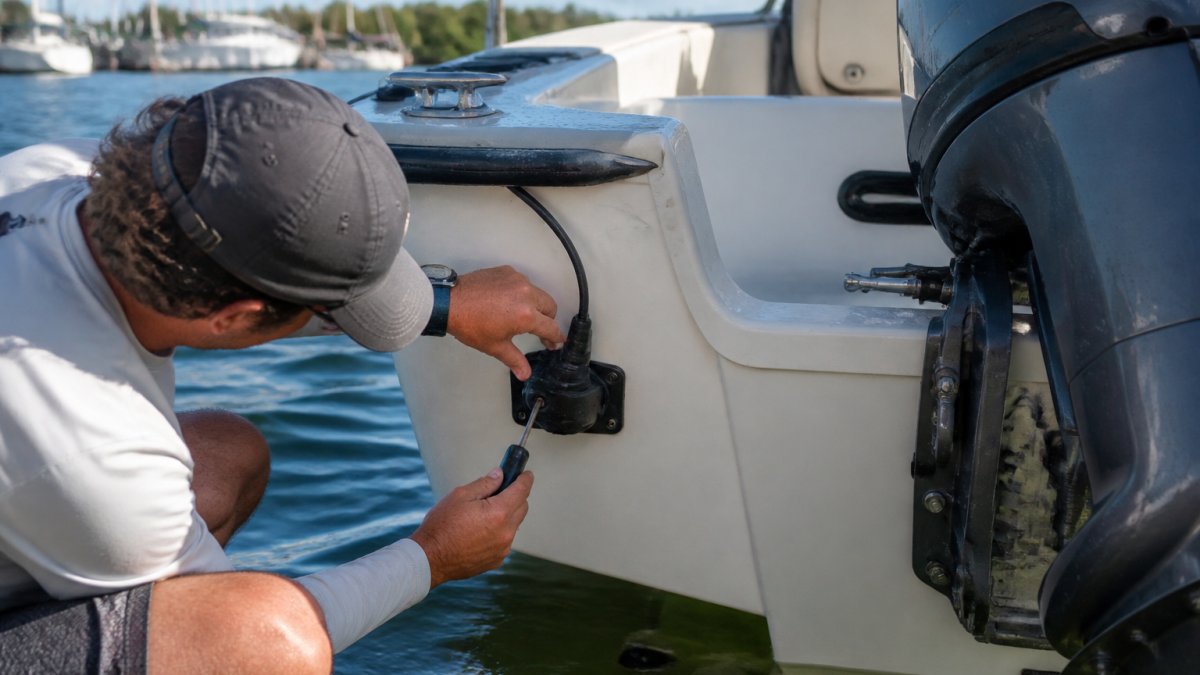
Placement rules by mount type
Transom-mount: Set the unit so its face sits in smooth water with the trailing edge slightly below the hull bottom, clear of strakes, rivets, and the prop.
Through-hull: Position ahead of the propeller and intake strainers, in clean water on the hull bottom.
Garmin LiveScope 2 HD Transducer - LVS42HD [010-03899-00] →
In-hull: Mount only on solid, uncored fiberglass, in a bubble-free bed of epoxy. Air voids and cored hull sections scatter the signal and produce weak or missing returns.
Diagnosing poor readings
Most bad sonar readings trace to one of four causes:
- Aerated water at speed. If the bottom drops out above a certain speed, the face sits in prop wash or hull turbulence. Move it or adjust the trailing edge angle, a transom unit that reads at idle but blanks at 20 mph is almost always in aerated water.
- Wrong angle. If the bottom reads as a slanted line or the depth is consistently off, the beam is firing at an angle. A tilted-element through-hull or a shimmed transom bracket corrects it.
- Air voids in an in-hull install. If the unit works at low speed but fades at speed, or reads shallower than actual depth, the epoxy bed likely has bubbles. Re-bed it.
- Electrical interference. Vertical noise lines or a fuzzy bottom point to a bad ground, a trolling motor on the same circuit, or a transducer cable routed alongside power wiring. Separating the cable from power runs often clears it.
tip Test your mounting location before you drill. Tape the transducer to a pole and hold it at your intended spot at cruising speed. If the reading breaks up, move it. Ten minutes with a pole saves a mis-drilled hole.
Maintenance and long-term reliability
Transom-mount units collect marine growth that degrades the signal; a light coat of transducer-approved antifouling paint helps, but never paint over the face itself. Check through-hull housings for corrosion and bedding integrity at each haul-out, and re-bed in-hull epoxy that cracks and admits air. Connector pins are a common saltwater failure point, use dielectric grease and a drip loop.
Choosing a Saltwater Fishfinder Transducer for Your Hull
Saltwater punishes hardware, so housing material and connector quality matter as much as frequency. Stainless steel and bronze resist corrosion; plastic is fine for trailered boats.
For offshore work, a through-hull medium CHIRP unit is the workhorse choice: it sounds deeper than high frequency and holds bottom at speed. If you fish structure and want to watch fish react to a lure, live sonar changes the game entirely, which brings us to matching.

Matching a Transducer to a Fish Finder or Multifunction Display
Compatibility is where most upgrades stall, and it comes down to three things: connector pins, CHIRP support, and transducer ID. A 9-pin transducer will not plug into an 8-pin display port without an adapter, and a display without CHIRP support cannot use a CHIRP transducer's full bandwidth.
Check these before you buy:
- Confirm the connector pin count and type match your display
- Verify your sounder supports the transducer's frequency band
- Check whether the unit needs a Mix and Match adapter cable
Airmar's TM165HW, for instance, is a Mix and Match transducer requiring a brand-specific adapter cable. Skipping that check is how buyers end up with a unit that fits but will not talk to the display.
Connector pins, CHIRP support, and transducer ID decide compatibility. Confirm all three against your display's manual before ordering, not after.
Decision Matrix: Boat Type, Hull Material, and Fishing Conditions
Use this matrix to narrow the field fast, then confirm specs against your display.
| Boat & Use | Hull Material | Recommended Type | Why |
|---|---|---|---|
| Trailered center console, inshore | Fiberglass | Transom-mount high-wide CHIRP | Easy install, wide shallow coverage |
| Offshore sportfisher, deep water | Fiberglass or wood | Through-hull medium CHIRP | Clean readings at speed, deeper sounding |
| Aluminum or steel hull | Metal | Stainless tilted through-hull | Corrosion-resistant, deadrise-corrected |
| No-drill preference | Solid fiberglass | In-hull | No penetration, protected unit |
| Structure and live tracking | Any | Live forward-facing | Real-time fish and lure response |
Live sonar sits in its own category. Garmin's LiveScope 2 HD connects directly to a compatible chartplotter with no black box, and its forward, down, and perspective modes show fish and lures in real time, the tool for watching reaction, not deep-water bottom tracking.

The honest limitation: live sonar costs the most and reaches a shorter range than a good through-hull CHIRP unit. Buy it for structure fishing, not as a replacement for your primary sounder.
Frequently Asked Questions
What are the main types of marine transducers?
The main types are transom-mount, through-hull, and in-hull. Transom-mount units bolt to the stern and suit planing hulls up to about 25 feet. Through-hull units cut through the hull for clean readings at speed and work on steel, aluminum, fiberglass, or wood. In-hull units glue inside a fiberglass hull and shoot through the solid laminate, so no hole is drilled. Airmar's TM165HW and B75, plus Navico's SS175M, cover these categories.
What is the difference between a through-hull and a transom-mount transducer?
A through-hull transducer mounts through the hull, giving clean readings at speed and no risk of damage from trailers or debris. A transom-mount transducer bolts to the stern, is easier to install and replace, and costs less, but it can lose signal in aerated water or at high speed. The through-hull vs transom-mount transducer choice comes down to hull material, boat size, and how often you run fast in rough water.
Which transducer is best for saltwater fishing?
A saltwater fishfinder transducer needs a stainless steel or bronze housing to resist corrosion, plus enough power and a frequency range that holds bottom in deep water. The Navico xSonic SS175M uses a stainless steel thru-hull housing and medium CHIRP from 85 to 135 kHz, which suits steel or aluminum hulls up to 36 feet. For smaller planing hulls, the Airmar TM165HW's 600 W and 150 to 250 kHz range deliver strong shallow-water detail.
Is a higher-frequency transducer better for finding fish?
Not always. Higher frequencies such as 200 kHz and the 850 to 1600 kHz range of the Garmin LiveScope 2 HD produce sharper detail and better target separation in shallow water, but they lose depth quickly. Lower and medium frequencies, like the 85 to 135 kHz band of the SS175M, push deeper and hold bottom at speed. The right fishfinder transducer frequency depends on whether you fish shallow structure or deep ledges.
How do I choose the right transducer for my boat?
Start with hull material and size, then match the mounting style. Fiberglass planing hulls up to 25 feet pair well with a transom-mount unit such as the Airmar TM165HW at $464.00. Steel or aluminum hulls up to 36 feet suit the Navico SS175M at $1,499.99. If you want live forward-facing sonar, the Garmin LiveScope 2 LVS42HD at $2,199.99 tracks bottom to 125 feet with no black box.
The hardest part of a transducer upgrade is not choosing a type. It is confirming that the unit, the cable, and the display all agree before you drill or glue anything. Charleston Yachting stocks transducers from Garmin, Navico, and Airmar, ships same-day, and carries the adapter cables and mounting hardware that make a clean install possible. Shop All and match your sounder to the right marine transducer the first time.